

Is inventory a current asset?

The quick answer is yes, because it comprises products or goods, which you anticipate selling within a year or two, and generate business revenue.

Product inventory is a crucial aspect of many businesses, especially restaurants and retail stores. Without proper oversight of materials, small components, ingredients, and finished goods, your business’s sales may plunge very quickly.

Therefore, learning whether the inventory actually sits as a current asset or liability is important for store owners in order to plan their business finances confidently.

Now, before you ask what type of asset is inventory, let us get straight to what is inventory and whether it is really a current asset or what?

💡Inventory Insights

Businesses worldwide lose nearly US$ 1.1 trillion each year, citing poor inventory management as a major cause

What Is Inventory?

Inventory is stuff that retailers keep inside the warehouse to sell or manufacture goods. Either inventory can be readymade items available to sell to customers or used to make new products. Either way, inventory is instrumental because it’s tied to your sales process, which is obviously significant to run your preliminary operations.

Whenever you sell an inventory, you earn revenue for your company and record the same in the income statement. Simultaneously, you have to update the inventory count in order to make sure you have adequate items on the shelves that fulfill guests’ demands.

Is Inventory a Current Asset?

Inventory is a current asset held by retail businesses, with the sole intention of selling to customers and earning money. Since the inventory helps retailers earn money in a very short time (i.e., one year or less), they are usually deemed as a current asset on the company’s balance sheet.

When the retailers sell inventory, they produce business revenue, which is listed in their income statement as cost of goods sold (COGS). That said, inventory is classified as a current asset in terms of business accounting.

However, it remains an asset if and only if it is anticipated to be sold sooner or later. Otherwise, damaged or outdated items lose their true value and ultimately are written off as an expense. Hence, inventory neither becomes a liability nor holds the same asset value once it becomes outdated.

Make Business Reports Without Manual Efforts

Maintain accurate records of assets, liability and expenses in a single platform and generate comprehensive reports instantly.

Try Now for Free

Why Is Inventory a Current Asset?

Inventory is considered a current asset simply because a retail store owner expects to sell and make money within a defined period. They are basically the company’s liquid assets poised to generate revenue in the near future. Therefore, no surprise that it appears in the current asset column on the balance sheet.

Another thing is that they are tied to your daily operations rather than just piling up stocks on the shelves. Inventory continuously aids in generating business funds and, therefore, accounting standards label it as a current asset.

Not only excess inventory, but anything from which a business can reasonably make cash is classified as a current asset. This will also include money owed by customers (accounts receivable), office supplies, and investments.

Where Do Current Assets Appear on the Balance Sheet?

In the balance sheet, current assets are clearly at the top of the asset section. The section that outlines all resources anticipated to be sold or somehow turned into cash in the near future. Accounts receivable, inventory, and other short-term assets occupy this section as they are linked with your core operations.

Different Types of Inventory

1. Raw Materials

They are the first type of inventory, as raw materials indicate the starting point of the production process. Basic materials like an electric motor, chips, or whatever is required to begin the production work are considered raw materials.

2. Supplies (Indirect Materials)

Supplies, or better known as indirect materials, are also a part of your inventory. Packaging aids, lubricants, or extra supplies required in regular operations occupy some space in your warehouse, even if they don’t add much value to the manufactured goods.

3. Work in Progress (WIP)

Any ongoing work in the manufacturing process that has not been fully completed is also a type of inventory. They take an active part in the process, and which is why they are often described as a distinct inventory type.

4. Ready-for-sale Goods

Recently manufactured goods, like packaged food items, are also called inventory. These inventory items have surpassed the production process and are simply waiting to move off the shelves. Such inventory directly converts into cash the moment someone purchases it.

Best Practices to Organize Your Product Inventory

Dealing with constant inventory challenges? Here are expert-recommended standard practices to ace inventory management.

  • Follow FIFO: Use the FIFO (First-In, First-Out) approach and sell the oldest inventory to buyers first. By doing so, you have no items sitting idly on the shelves, reducing the risk of expiration or potential damage that could quickly write off the expenses.
  • Conduct Stock Audits: Instruct your warehouse team to conduct thorough inventory checks periodically instead of relying on spreadsheet data. This practice aids retailers in capturing mismatches or costly errors.
  • Forecast Demands: Keep evaluating current market trends and customer behavior to forecast what’s in demand. Accordingly, manufacture goods or purchase items that fulfill your sales requirements.
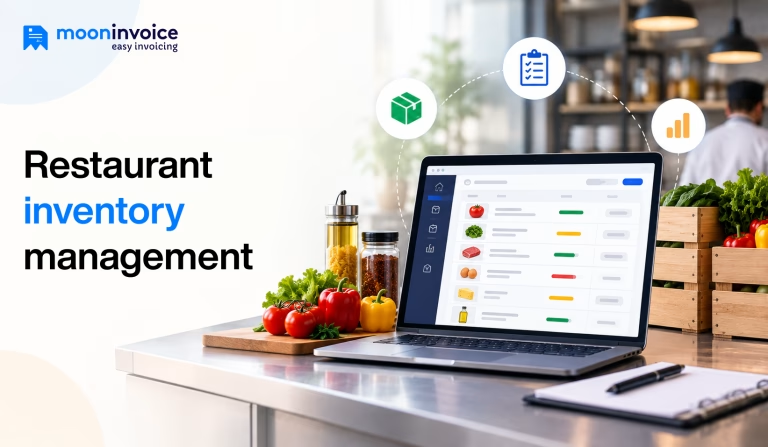
  • Invest in Automation Tools: Crunching numbers on your own works well only if you have a low volume of inventory. If not, embrace automation software that aids you in properly tracking inventory (or SKUs) and notifies you when inventory levels are low.

Control Inventory, Without Any Chaos

Start Managing Inventory Tirelessly with Moon Invoice

CTA icon
POS billing
CTA icon
Stock alerts
CTA icon
P&L reports
CTA Banner

Final Thoughts

To sum it all up, inventory is an asset, and learning its role in business accounting further helps in keeping finances reliable and decision-ready. Inventory represents real value and appears on the balance sheet as a current asset, meaning it supports compliance and better planning. That said, now you know how crucial it is to manage inventory.

If you are still managing inventory manually or using calculators, then it’s time to ditch the outdated methods and adopt an automated process. After all, customer satisfaction is one thing, and generating revenue for your business is completely another. Inventory, if managed properly using modern tools, can skyrocket your sales and reap many business benefits.

People Also Ask

We at Moon Invoice, are the best minds behind smarter invoicing and seamless business growth. We love to solve financial problems and keep providing effective tips through our blogs, newsletters, and social media channels. As a team, we continue exchanging ideas about growing financial challenges and smart use of automation tools.