

At a Glance
Construction job costing is a method for tracking all expenditures in a construction project. It helps in understanding the true cost of a job while tracking the correct expenses, such as labor, materials, and overhead. Real-time tracking, accurate code coding, and the incorporation of automation concepts are among the best practices to follow.
A deep understanding of construction job costing is essential for professional contractors. It is a detailed pricing method that helps you understand how project expenses are calculated. So you have clarity on which major expenses your project incurs and how they are allocated across project phases. Moreover, it helps analyse the project’s profitability.
But how to price a job in construction, and what best practices can you follow? This blog will unwrap everything to upgrade your knowledge. Let’s begin!
📌 Key Takeaways
- Job costing in construction covers all direct & indirect costs associated with the project.
- Real-time monitoring is essential to get an accurate picture of the project cost.
- Analysing costs helps prevent budget overruns.
- Cost insights are helpful in making the right decision over finances and operations.
- Understanding construction job-costing methods helps with better financial management.
- Maintaining a clear cost breakdown is important, as it helps improve relationships with clients & stakeholders.
- Using construction accounting software, construction companies can simplify their overall costing.
What Is Job Costing in Construction?
Construction job costing is a method for tracking all direct and indirect costs associated with a specific construction project. In other words, the cost structure reflects the project’s true cost. The key cost components include direct labor, material, overhead, and equipment. A contractor or related professional can use it to evaluate a project’s performance and profitability while tracking all related expenditures.
Why Job Costing Matters in Construction Projects?
Job costing is very helpful for tracking all expenses associated with the construction project. It enables contractors to know whether the project is cost-effective or exceeding its budget.
You can use construction job-costing methods to make informed decisions about expense allocation and financing, supported by accurate data. With better cost control, they can identify and fix issues early, before they ruin the project’s finances.
A clear costing report also helps improve pricing strategies and justify accurate estimates for future bidding. So you can maintain a healthy, satisfactory cash flow throughout the project lifecycle.
Job Costing vs Process Costing
Job costing and process costing are two important and commonly used accounting methods. However, in the particular construction industry, job costing is mostly useful. Why? The reason is below:
Job costing is the process of assigning costs to each job, including detailed expense breakdowns. That means it is work-based costing, in which costs are allocated according to the work performed. On the other hand, process costing is based on the processes involved in the industry. It is commonly useful in manufacturing units.
| Job costing | Processing costing |
|---|---|
| Cost is determined for each work/project. | Cost is determined for each process/ production phase. |
| Cost tracking is based on the job. | Cost tracking is based on the stage of operation. |
| It has a high flexibility in nature. | It is quite low in flexibility. |
| Costs are assigned to the specific job. | Costs are assigned to the specific process. |
| Useful in industries like construction, interior design, or any other involving different work phases. | Useful in industries such as food and chemical manufacturing. |
| The cost tracking level is detailed. | The cost tracking level is generalized. |
| The profit measurement is per job. | The profit measurement is per batch or per unit. |
Ease Your Estimation With Moon Invoice
Use our customized estimate templates and create an estimate in 60 seconds.
Key Components of Job Costing in Construction
These are the following components on which accurate cost tracking and construction job costing rely:
Labor Cost
Labor costs are among the highest in construction projects and often vary by location. It includes labor wages, often paid by the day or by the hour. The other benefits, such as labor compensation, overtime pay, and other related expenses, are also considered. Indirect labor costs, such as the wages of project managers, accountants, and other in-house staff, are also included. These are in-house staff who support the project indirectly.
Material Cost
Material cost can be direct or indirect. Direct material cost covers the cost of materials used in construction. Wood, cement, bricks, sheets, etc., come in this category. The indirect cost materials include glue, cleaning supplies, and safety gear. It is a good practice to record material costs as they are supplied.
Equipment Cost
A construction job requires equipment and tools. You can either purchase equipment or rent it. However, in both cases, proper cost consideration and allocation to the job are necessary.
In some cases, construction companies have their own machines and equipment, i.e., pre-owned. But calculating the cost of such owned equipment is quite difficult, as it doesn’t involve direct costs.
The best solution is to charge the standard rate and regularly track the equipment’s value in such a case. You need to consider revenue-related factors, operating costs (maintenance and repair), and cost to own (insurance, interest, and depreciation).
Subcontractor Cost
Many projects rely on the subcontractor’s cost. Tracking the subcontractor expenses covers material cost, labor, and change orders.
Overhead Allocation
Overhead costs are indirect costs, such as office rent, insurance, and administrative costs. Often, these are ignored, but the proper allocation of these costs is necessary for accurate profitability.
How to Calculate Construction Job Costing?
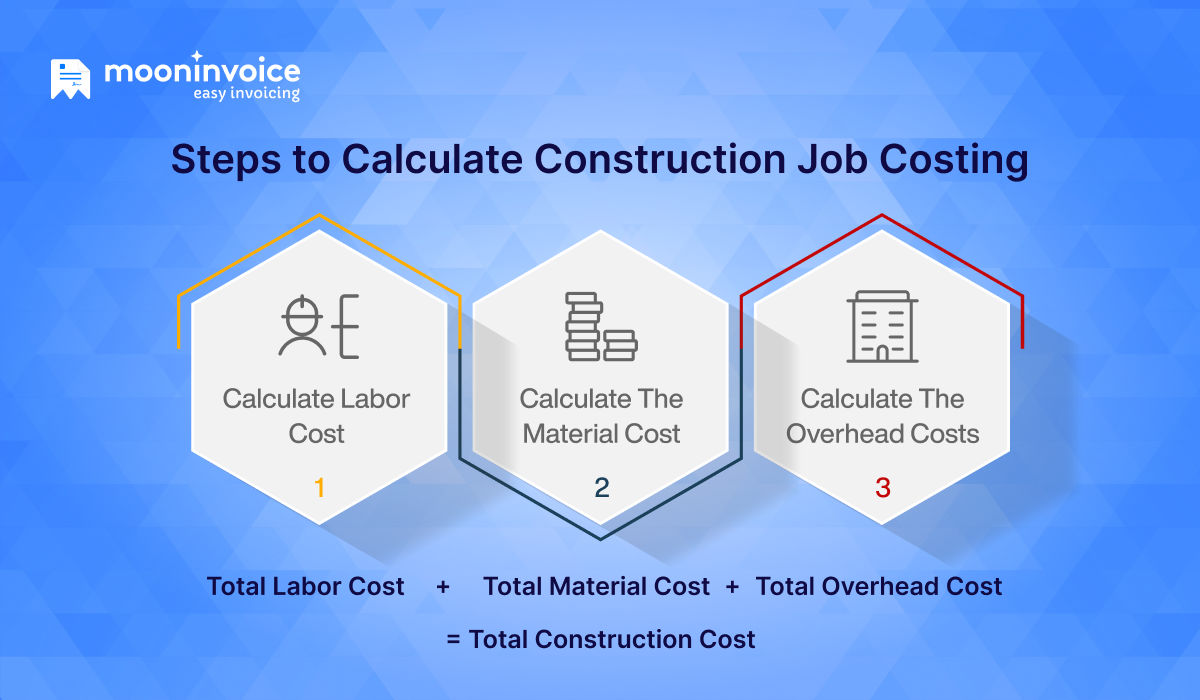
Calculating job costs requires accurate & systematic data collection, followed by summing all costs associated with the project. Follow the steps below to compute the construction job cost:
1. Calculating Labor Cost
Labor costs refer to payments made to employees, third parties, and subcontractors. To calculate the total cost, multiply the hourly rate by the number of working hours. Let’s understand it through the example:
Suppose a production worker charges $6 per hour, and a quality analyst charges $10 per hour. The total number of working hours for the production workers is 4 hours, and for the quality analyst is 2 hours. So, calculating the total direct labor cost:
Total direct labor cost = $6x 4 hours + $10 x 2 hours
24+20 = $64
We are assuming the bonus and benefits as $50 and $20
Total Labor Costs = $64 + $50 + $20 = $134
2. Calculating the Material Cost
Material costs include direct & indirect costs in the construction project. Direct costs include all the raw materials used in construction. Indirect costs, on the other hand, include all the tools & equipments useful in construction. Sum up all the direct and indirect expenditures to calculate the total material expenditures.
Suppose the following materials are being used in the project:
| Material | Quantity | Rate |
|---|---|---|
| Bricks | 10 | $2 per unit |
| Steel pipe | 3 | $5 per unit |
| Timber packets | 2 | $6 per unit |
Total direct material cost = $2 x 10 + $5 x 3 + $6 x 2
= $20 + $15 + $12
= $47
Considering the cost of tools = $100 (indirect cost)
= $47+ $100 = $147
3. Calculating the Overhead Costs
Overhead costs are indirect expenses necessary to run the business. It covers all the office expenses, insurance, and any software, such as accounting or project management tools, used during the project. You must calculate the total overhead costs by summing all the expenses.
- Office expense = $1,000
- Insurance = $400
- Equipment = $500
Total overhead cost = $1000 + $400 + $500 = $1,900
Now, calculating the total construction cost as per the formula:
$134 + $147 + $1,900 = $2,181
So, the total construction job cost is $2,181.
What Are the Advantages of Construction Job Costing?
Construction job cost tracking is valuable for all types of construction projects. Here are the key advantages of it:
Helps in Profit Analysis
Construction job costing helps to determine the profitability. Construction professionals can compare the estimated price to the actual cost. It becomes easier for them to track profit margins when costing reports are clear.
Track Every Expense
A construction job cost accounting makes it simple to track & monitor every expenditure. The key benefit is that it directly influences decision-making. It means you can easily make the right decisions on controlling spending.
Better Resource Allocation
Construction job costing helps identify how your team is using resources. Costing shows the labor cost per hour and which materials and equipment are used during construction. You have a clear view of which resources are underused and which are overused. Also, it is quite easy to address it early if there is any cost overrun.
Cash Flow Tracking
A costing report in the construction industry helps identify the flow of payments. Especially when it comes to managing advance payment, which is very common in such an industry.
What Are the Common Challenges in Job Costing?
These are the job costing challenges that you can face as a construction professional:
No Real-time Data Entry
Accurate financial insights come when field workers enter data in real time. Unfortunately, field workers in the construction industry often fail to do so. As a result, the financial report contains incorrect information, showing the project cost as either low or high.
Poor Communication
This is another challenge when departments are misaligned, and information is not shared among them. Information on labor, materials, and other project-related matters can be misunderstood or shared too late. As a result, it affects the overall project lifecycle.
Improper Cost Coding
Problems also arise when expenses are assigned to the incorrect job. There could also be an inconsistency in the code use. It means there is no true profitability analysis that impacts the overall project’s costing.
Overlooking the Indirect Expense
Indirect expenditures are often neglected during the construction costing process. The result is an incorrect cost report, which affects the overall construction job cost.
Stick to Manual Work
Keep utilizing the spreadsheets and other manual concepts, or outdated concepts, as they are highly prone to errors. The best practice is to use accounting software that reduces the technology gap and achieves high accuracy.
What Are the Best Practices to Improve Construction Job Costing?
Dealing with job costing is quite challenging. However, using the following best practices, one can efficiently manage it:
Real-time Cost Tracking
It is crucial to track and record labor, material, and other costs in real time as they are updated. This maintains accurate job costing and helps detect issues early, enabling corrective actions. Any delay in cost recording can lead to errors and undermine overall costing.
Maintains Strong Communication
Communication is crucial in construction. The site team, project managers, and accountants should be on the same page and collaborate effectively to ensure that no information is missed or miscommunicated. This ultimately affects the overall construction job costing.
Give Training to Your Team
The other best practice is to provide the team with training to handle project costing efficiently. The likelihood of errors decreases when the team is highly knowledgeable and well-trained in cost management. Guide them to the best solution for accurately calculating the cost while clarifying their basic concepts.
Implement Robust Cost Code System
In general, cost codes are numeric or alphanumeric labels and can vary by construction company. Cost coding is the assignment of a specific code to each task. This strategy helps simplify pricing and expense tracking systematically. You can easily compare estimated vs. actual costs and gain full insights into performance.
Utilizing the Software
Utilizing AI-powered invoicing software like Moon Invoice not only speeds up the process but also minimizes errors. The platform provides a readymade construction estimate template that helps to create a professional estimate in less time. Hence, it saves time and also speeds up the process. Contractors can easily convert estimates into invoices.
Similar to an estimate, Moon Invoice offers ready-to-use invoice templates, making invoicing simple. You can generate an impressive, professional construction invoice in a short time. Also, the software provides 20+ payment integrations, allowing fast payment acceptance.
There is no chance of errors, thanks to the template’s auto-calculation feature, which automatically computes tax, discount, and total amount. Its quick scan feature lets the contractor easily create the receipt by scanning the physical document.
You can easily manage expenses digitally and categorize them into labor, material, and other costs for more accurate budgeting. Users can easily compare estimated and actual costs.
Real-time financial reporting helps you gain an accurate overview of your finances and make informed budgeting decisions. Also, they can adjust the pricing strategy to improve the business’s profitability.
Additionally, the software helps manage construction projects. You can easily track & manage your project hours and effortlessly convert them into billable hours.
Overall, the software not only helps contractors gain full control over project finances through advanced features and concepts, but also provides a comprehensive project management solution.
Looking for Effortless Expense Management?
Choose Moon Invoice to track and manage your construction project expenditure like a pro.
Closing Words
Considering and calculating construction job costing is very important for a construction project. Additionally, you must know how to price a job in construction correctly. You can maintain a healthy cash flow by effectively managing job costing and the overall project budget. They can make smarter decisions and also ensure projects are completed on schedule, thereby ensuring long-term business success.
Though the approach is somewhat complex, using a reputable tool like Moon Invoice can simplify things through automation. Try it today!
Frequently Asked Questions
What are the main types of costs in construction?
Do general contractors make 10% or 30% of jobs?
What is the formula for job costing in construction?
How to estimate a construction job?
What is the 10 10 rule in construction?



Jayanti Katariya is the founder & CEO of Moon Invoice, with over a decade of experience in developing SaaS products and the fintech industry. He holds a degree in engineering. Since 2011, Jayanti's expertise has helped thousands of businesses, from small startups to large enterprises, streamline invoicing, estimation, and accounting operations. His vision is to deliver top-tier financial solutions globally, ensuring efficient financial management for all business owners.