

Catering services are a promising business as the demand for lavish food items, haute cuisine, and fine dining is increasing day-by-day. A catering business is especially a great addition to your business if you run a restaurant, own a hotel, or work for an event-planning organization.
Catering services add a massive boost to your total income and help you expand your business. So, now the question is, do you know how to calculate catering costs?
Sometimes, even when you deliver great catering services, profit margins still shrink. That’s because of the poor pricing of the catering menu. In this blog, we will explore how to charge for catering, the types of pricing for caterers, essential tips for optimizing catering food costs, and more.
Let’s jump straight into the topic…
📌 Key Takeaways
- Accurately calculating catering costs helps achieve higher profit margins in your catering business.
- Key initial steps include counting guests, assessing menu complexity, and calculating food cost per person.
- Additional costs like supplies, beverages, liquor, and service charges should be included in the total pricing.
- Gross profit margin, cost-plus pricing, and market-based pricing are the main strategies used by caterers.
7-Step Process on How to Price Catering Services
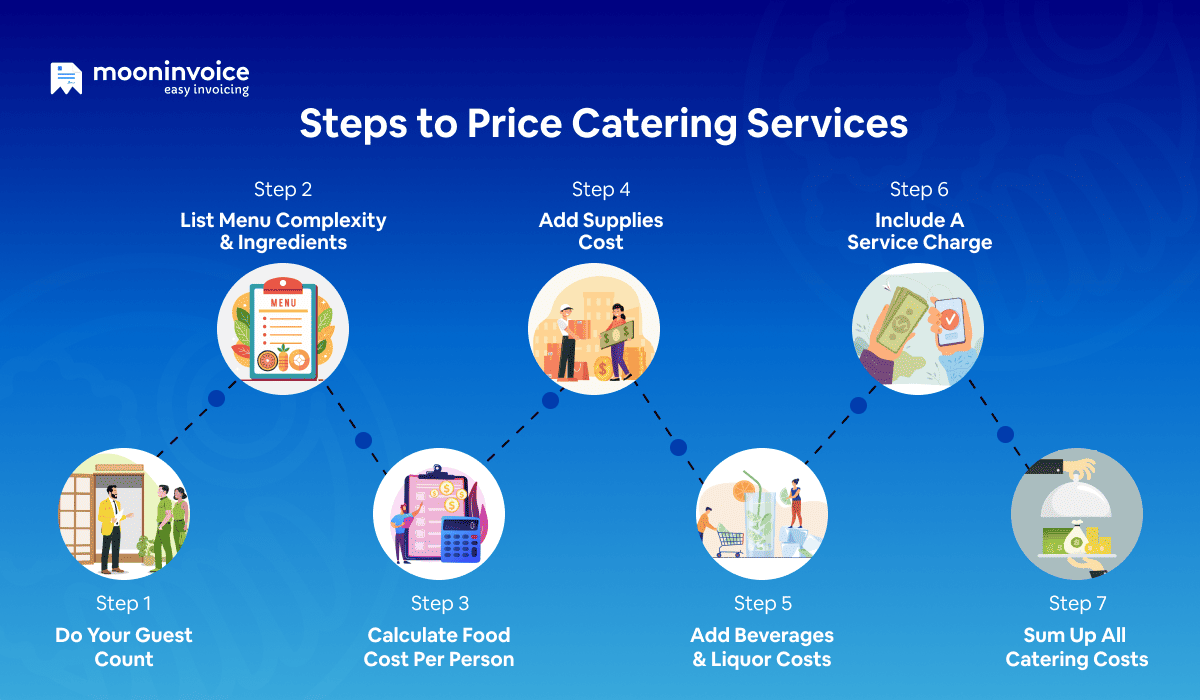
Before pricing your catering services, first find out what type of food or catering services are in demand. Season-wise, latest trends and demands change, so the pricing of your catering services should be done in such a way that it reflects accurate pricing as per market demand. After that, you can follow these steps to price your services effectively.
Step 1: Do Your Guest Count
Find out how many guests are attending the event because that’s what affects your catering prices more than anything else (except the choice of food). At wedding events or festive gatherings, some guests don’t attend even after receiving invitations; some arrive solo; and some bring their entire family. This is why it is always recommended to add terms and conditions in the estimate around changes.
For example, let’s say the expected guest count is 500, but guests arrive more than 600. This unexpected guest count could lead to shortages and extra rush costs.
So, what to do?
You should prepare an estimated guest count and set prices accordingly. Include a buffer (like 5-10%) within the estimate. It assures your profit and protects you from disputes during the payment.
Step 2: List Menu Complexity and Ingredients
Another factor that will affect your catering costs is the client’s menu selection and the complexity of food preparation. Simpler dishes like grilled items keep expenses low, whereas multi-course meals or exclusive platters require premium ingredients, extra time to prepare, and are generally more expensive.
If the client plans an exclusive dinner, premium materials such as glassware, china plates, or porcelain will increase the total cost.
Keep your clients in the loop until the cost for each ingredient is finalized. Ask the client whether they have any special requests or additional items in mind, such as sustainable seafood. Are there any dietary restrictions? Clarify all these before preparing your catering estimate.
Inaccurate Estimates Eating Up Your Profit Margin?
Get Moon Invoice’s free catering estimate templates and create customizable estimates in minutes. Lock in guest buffers and estimate smartly.
Step 3: Calculate Food Cost Per Person
Once the menu is finalized, it’s time to create a detailed list of food costs with quantities defined. You can contact a supplier in case of special food items requested by the client.
A fixed meal is always easier to calculate compared to a buffet, as buffets are not fixed. For a fixed meal, you can calculate the average quantity per person; in a buffet, this is more challenging because guests serve themselves.
According to the Houston Chronicle, your food bill should be 30% of your total price. However, you can attain better profits as a catering business if you aim for 25%-28%.
Let’s take an example of estimated catering prices per person in the US:
| Service Style | Description | Price Range (Per Person) | Examples |
|---|---|---|---|
Step 4: Add Supplies Cost
After calculating food costs, you should next calculate the supplies cost, which plays a major role in operating the catering service. These supplies account for 10-20% of total expenses, so ignoring them could lead to losses.
Here are the following items you must consider:
- Chafing dishes
- Napkins, tablecloths
- Plates, cutlery
- Chairs
- Glassware
- Utensils
- Equipment
- Flatware
For instance, the cost of supplies for a 200-guest wedding could range from $2 to $10 per person, but exclusive events with branded materials or eco-friendly options could cost $15 to $20 per person.
Step 5: Add Beverages & Liquor Costs
In wedding events, clients often spend heavy money on expensive alcohol and beverages. Sometimes clients even pay two or three times higher than the entire food budget. So adding the cost of beverages and liquor is necessary when you are pricing catering services. Include prices for all beverages such as liquor, mixers, soft drinks, cups, ice, garnishes, and bartender services.
According to Draper’s Catering, catering companies in the U.S. generally offer two fee structures for beverages and alcohol. First, only beer (60%) and wine (40%) will be served. Second, beer (35%), wine (30%), and liquor (35%) will be served. Drink per person, per hour will be charged differently.
Bar services add approximately $2 to $4 per person to the overall catering total.
Step 6: Include a Service Charge
In this step, you should finalize the labor and overhead costs for your catering service. For labor costs, identify all staff who will work at the event, including servers and assistants.
For overhead costs, you need to consider all the administrative costs, such as the cost of rent, marketing, utilities, travel costs, fuel costs, insurance, and taxes. Calculate all these and find the average monthly overhead.
If your catering business gets 15 catering jobs per month, divide the monthly overhead cost among these 15 catering jobs to get the average monthly overhead cost.
Assuming your monthly overhead is $9,000 and you complete 15 jobs per month, you should charge $600 per job to cover overhead.
Step 7: Sum Up All Catering Costs
Now, in this step, you need to total all costs associated with the catering service, starting with food, beverages, and liquor, then labor, and overhead.
Suppose your total cost is $12,000. This is not the amount you should be charging the client. You need to add a markup so that your catering business remains financially stable.
Here’s how you can add markup to your total cost:
- Final Price = Total Cost / (1 – Profit Margin)
So, considering the total cost is $12,000, if a 20% profit margin is added, the final price will be:
- Final Price = $12,000 / (1 – 0.2) = $12,000 / 0.8 = $15,000
If you charge $15,000, you will gain a 20% profit margin on the total catering cost of $12,000.
Types of Pricing for Caterers
To calculate catering costs, caterers use different types of pricing models depending on the event size, menu complexity, and client expectations. To ensure the profitability of the catering business, it is mandatory to select the right pricing model.
1. Per-person Pricing
It is one of the most common catering pricing models where the total cost is calculated based on the number of guests. The cost involved in food preparation and basic service is calculated in this pricing model. Events such as weddings, corporate fun parties, and large reunions/gatherings are best for this pricing.
2. Tiered Pricing
Another pricing model is tiered pricing, which comes with multiple package levels such as basic, standard, and premium. Each one offers its own benefits, menu options, serving styles, and add-ons. This pricing model is ideal for catering to low-budget clients. Clients can select a tier based on their budget.
3. Custom Quotes
This pricing model is generally best-suited for clients with unique menu requests or special dietary needs. Here, costs are calculated based on ingredients, labor, logistics, and other requirements rather than predefined packages.
4. Minimum Spend
The minimum-spend pricing model is for a specific type of client who doesn’t have a larger budget. Caterers and clients fix a minimum order value regardless of guest count or menu size. For small events or off-season bookings, this structure is highly profitable for caterers as the operational costs remain the same.
How Much Do Catering Services Cost?
The average catering cost in the US for simple drop-off events starts at $12 to $20 per person. For full-service events such as weddings, the average catering cost per person ranges between $50 – $150+. However, the exact price can’t be specified as it depends on many factors such as location, guest count, and service style (buffet, plated, or food truck catering).
Essential Tips for Optimizing Catering Food Costs
Optimizing food costs is another important factor that decides how effectively you can calculate your catering costs. You should be able to control your catering costs to ensure the event is overall profitable.
Here are the five tips to optimize your catering food cost:
1. Consider Bulk Purchasing
Bulk purchase always has bigger benefits. When you are preparing food for a large number, you will require ingredients in large quantities. In such cases, it is always recommended to purchase from a trusted wholesaler, which will reduce per-unit costs.
2. Plan Menu Season-wise
Your menu options should be managed to keep ingredients fresh and maintain quality for as long as possible. This is why planning a seasonal menu is key. Plus, another advantage is that it is more affordable and readily available in the market. Out-of-season costs are higher and come with no guarantee of quality.
3. Estimate Each Recipe Cost Accurately
Recipe cost must be calculated correctly. Even if it is about $1 or $2, it shouldn’t be ignored. Calculate the cost of each ingredient, portion size, and preparation time required to prepare a recipe. If the recipe is special, such as seafood, additional costs will apply; estimate those costs as well.
4. Reduce Wastage of Food
In catering services, wastage means it is a loss. Lower waste results in higher profits, and vice versa. Ask your client which type of food the maximum number of guests would like, and offer an alternative for those who don’t want the standard food. Use portion control in buffet-style catering to reduce waste. Managing food for everyone is challenging, but the goal should be to minimize waste.
5. Keep Portion Sizes Consistent
To avoid overserving, it is necessary to keep portion sizes consistent across dishes. It helps you plan ingredients, so you don’t run short or buy more than you need. Keeping portion sizes consistent across dishes helps ensure every guest receives a similar serving.
Catering costs in the US range from $10 to $200 (or more) per person. This largely depends on the service style, location, cuisine, and event formality.
Streamline Estimating & Invoicing with Moon Invoice
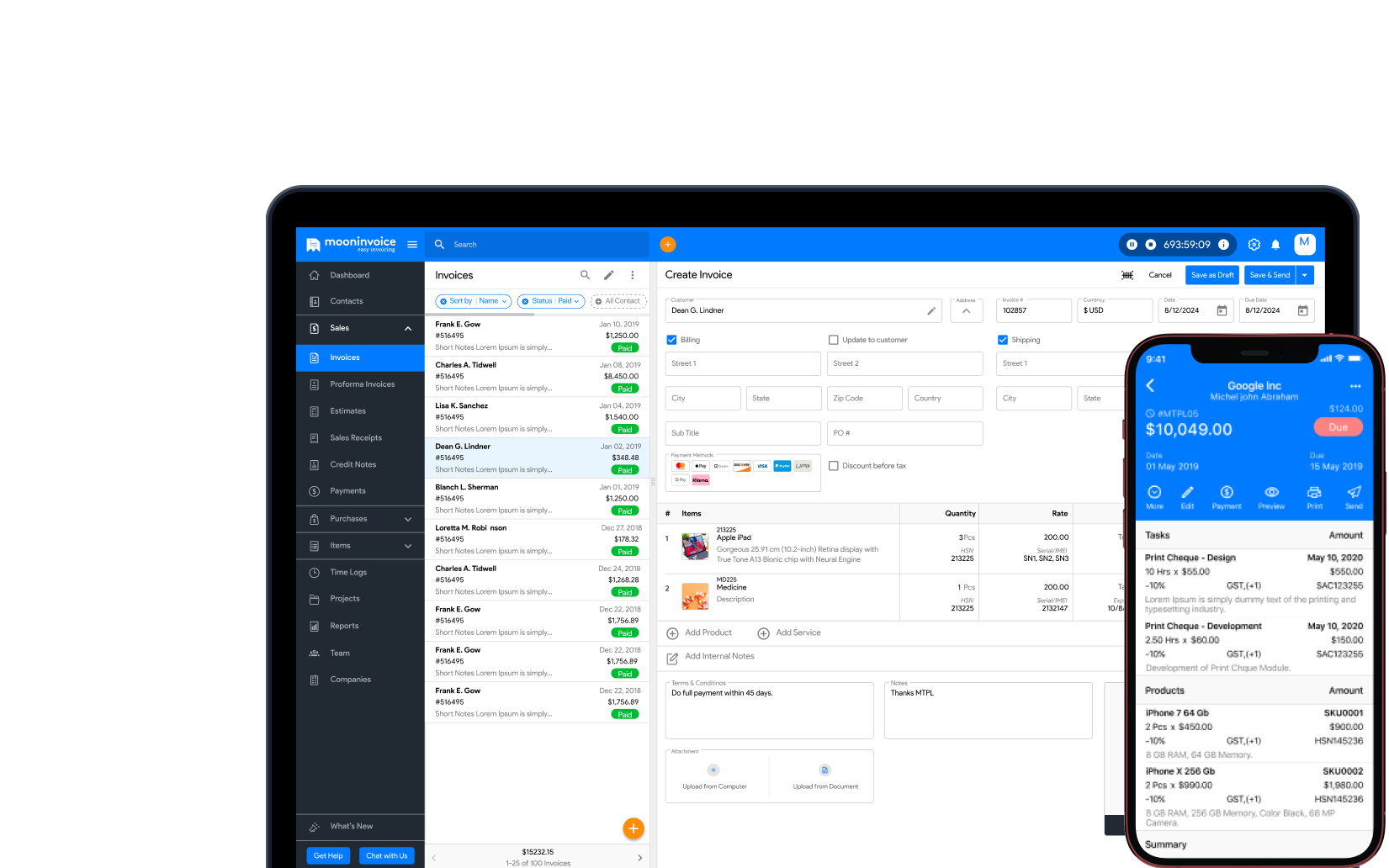
Every time you get a potential client, what’s the first thing you do? You give an estimate of the entire catering service cost, don’t you? To get the deal done, your estimate needs to be clear and price-focused with a detailed itemized list. To put it in simple words, you need software such as Moon Invoice that can help you estimate better.
Paper-based manual estimates could be error-prone and time-consuming, whereas digital estimates are quick, accurate, and build professionalism. Apart from improving your estimation process, Moon Invoice will also help you invoice your clients smartly with features like AI-powered quick scan, which is rarely found in other software.
Key features of Moon Invoice:
- Customizable Templates: Availability of customizable templates for both estimates and invoices to win clients and send invoices.
- Easier Estimation: Create digital catering estimates that quickly get approved by the prospective client.
- AI-powered Invoicing: Helps you avoid the complexity of invoice generation with AI-driven automation.
- Payment Integration: Receive payments faster with 20+ payment integrations.
- Advanced Reporting: Keeps your business tax-ready with a complete overview of financial reports.
Catering Invoicing as Fast as Your Kitchen
Get software that simplifies your catering pricing calculations.

Auto Calculation
1-Min Invoicing
Client Management
Wrapping Up!
Calculating catering food costs and managing them effectively is challenging. You need to be careful with pricing plans and stay up to date on the latest market prices. If you follow the steps mentioned in this complete pricing guide, your overall catering cost calculation process is likely to improve.
To price your catering services accurately, you need to make sure minor details such as reducing waste, opting for bulk purchasing, planning seasonal menus, etc, are not missed.
When the pricing of your catering services is done in the correct way, you can secure more catering jobs. Sharing detailed estimates with potential clients is another way to gain consistent catering jobs.
Wondering how to create estimates that can win multiple catering jobs? Start your free trial with Moon Invoice now!
Most Relevant Questions on Catering Costs
What is the formula for food cost in catering?
How much does catering for 300 people cost?
What is the average cost of a wedding catering buffet?
What is a good profit margin for catering?



Jayanti Katariya is the founder & CEO of Moon Invoice, with over a decade of experience in developing SaaS products and the fintech industry. He holds a degree in engineering. Since 2011, Jayanti's expertise has helped thousands of businesses, from small startups to large enterprises, streamline invoicing, estimation, and accounting operations. His vision is to deliver top-tier financial solutions globally, ensuring efficient financial management for all business owners.