

Liquidity management is instrumental for every small and large business. Failing to oversee it properly can lead to potential payment delays, stalled main operations, or even missed opportunities. This means no business owner can afford to overlook a liquidity management plan.
A well-organized liquidity management process stresses the importance of monitoring both incoming and outgoing funds. The process further aids businesses in meeting their short-term financial obligations. For anyone looking to optimize working capital, management of liquidity is the first step in building financial stability.
This blog will act as your guide to what is liquidity management and its importance. Let’s delve deeper.
What Is Liquidity Management?
Liquidity management is a process to make sure the business has enough funds to meet its financial obligations, like debts (accounts payable), payroll, or expenses. Basically, it’s about learning how much money is coming in and how much is going out, so you don’t face a cash crunch when you really need the money.
This process mainly considers fund accessibility and forecasting rather than just tracking transactions and current balance. It compares incoming cash with outflows in an effort to maintain sufficient company funds, which can be used to perform debt obligations.
In short, it is business practice to optimize working capital in such a way that businesses can continue running their core operations without interruption.
Why Is Liquidity Risk Management Important?
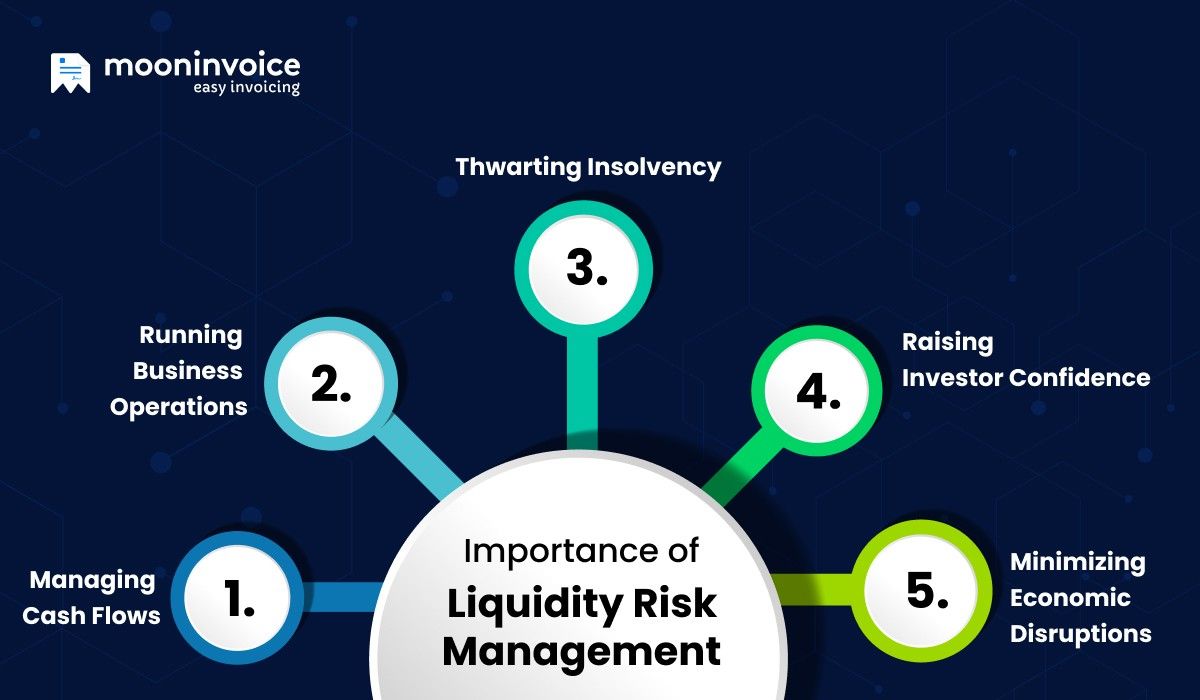
Adopting liquidity management practices is as important as planning for business continuity. Here’s why.
1. Managing Cash Flows
Overseeing liquidity risk management means taking a firm grip on financial control. It aids you in financial forecasting so that you can keep adequate money to clear payment bills, salaries, and handle unexpected surprises. By actively managing liquidity risk, you can get rid of last-minute financial stress and quickly access funds in reserves.
2. Running Business Operations
With liquidity risk management in place, you can come out on top of the cash flow management, which works as the lifeblood of your business operations. This means no disruptions in main operations, even if you face unexpected expenses. Taking care of liquidity risk will help you maintain fund reserves to address unforeseen circumstances.
3. Thwarting Insolvency
Liquidity risk, when efficiently managed, can prevent insolvency by ensuring your business has the cash availability to perform financial obligations. Hence, there are less chances of sudden cash shortfall or mounting debt that could otherwise push your business to the cusp of financial distress.
4. Raising Investor Confidence
Businesses managing liquidity risk well can also increase investors’ or lenders’ confidence by illustrating how the business is capable of fulfilling financial obligations without strain. When investors recognize such capabilities, they feel more comfortable partnering with your business, offering funding that eventually cultivates growth.
5. Minimizing Economic Disruptions
Well-organized liquidity risk guarantees little to no economic and operational disruptions, improving resilience during uncertain market conditions. It allows businesses to manipulate revenue slowdowns, absorb unexpected expenses, as well as continue operations without compromising productivity.
Cash Shortages Disrupting Business Operations?
Start managing your finances with Moon Invoice to keep your operations up and running.
How to Assess Liquidity?
So far, you have an idea of how important it is to manage liquidity risk, but questions may come to your mind about how to assess it. Many financial experts suggest utilizing the liquidity ratio to estimate a company’s liquidity. Below are some ratios to consider in a bid to uncover liquidity.
- Current ratio: The current ratio divides current assets by current liabilities to determine if the company is really capable of paying its dues.
- Quick ratio: It works in a similar manner to the current ratio, but the only difference is that it drops inventory from the calculation to reveal if the business can cover short-term liabilities.
- Acid-test ratio: It mainly focuses on the most liquid assets, such as cash and receivables, in order to find out how well your business can handle urgent financial obligations.
- Cash ratio: The cash ratio is used to gauge your business’s ability to meet short-term liabilities using only cash and cash equivalents without relying on future cash inflows.
This way, regularly performing liquidity assessment will allow your business to stay well prepared for unforeseen events, further maintaining operational stability.
What Are the Factors That Impact Liquidity Risk?
Now, let’s talk about external and internal factors that cloud impact the liquidity risk.
1. External Factors
- Seasonality – Different seasons cause fluctuations in sales and incoming cash flows, which can eventually impact liquidity, making it very difficult for businesses to cover existing dues.
- Disruptions in the Supply Chain – Potential disruptions in your supply chain will also impact liquidity by delaying production and raising costs.
- Investor’s Trust – Investors’ belief remains a significant external factor impacting liquidity risk. Businesses may struggle to raise capital if investors’ trust is undermined.
- Economic Disruptions – Economic uncertainty, like inflation or recessions, can quickly impact the liquidity, which may result in slower customer payments.
2. Internal Factors
- Accounts Payables – Accounts payable, if managed poorly, can increase liquidity risk due to uneven cash outflows. Businesses may face challenges in meeting short-term obligations.
- Inventory – Slow-moving items in the inventory will tie up cash, impacting liquidity in such a way that your business will have a hard time responding to immediate financial needs.
- Inadequate Cash Reserves – Failing to maintain sufficient cash reserves means you are inching closer to liquidity risk. Minor cash disruptions can affect day-to-day operations.
- High Operating Expenses – Operating a business with high costs will no longer provide cash flexibility, which further restricts a business’s ability to manage short-term obligations.
Some Best Practices to Manage Liquidity
Struggling to keep up with liquidity? Here are some actionable tips to follow in your business routine.
- Always keep a close eye on the cash flow movements or instruct your team to do so.
- No matter what, develop a habit to maintain adequate funds in reserves for emergencies.
- Discuss with accounting professionals and forecast cash flow to estimate cash shortages.
- Do whatever is necessary to optimize the accounts receivable process and trim payment delays.
- Refrain from overstocking products/goods, as it can otherwise tie up working capital.
- Ask your team to keep using liquidity ratios periodically to identify cash readiness.
Take the Stress Out of Cash Management
Start using Moon Invoice to efficiently organize liquid cash.
AI Automation
Business Reports
Bank Reconciliation

Manage Liquidity With Moon Invoice’s Unparalleled Automation
Moon Invoice is not just another software, but a virtual assistant equipped with AI-driven automation. Something businesses have long sought as a solution to oversee liquidity.
Moon Invoice consists of paperless vendor invoice processing and 20+ payment gateways to collect payment faster, saving you from cash shortages and increased overhead cost.
The sophisticated invoicing software offers real-time updates about cash flows, enhancing visibility into business operations and expenditure.
With Moon Invoice, you can track accounts payable and receivable easily and forecast finances accurately to stay on top of liquidity assessment.
Managing Liquidity: Final Words
Whether you are starting a new business or already running one, if you are aiming for stability and sustainability, then managing liquidity is crucial. Liquidity assessment promises you keep enough fund reserves to meet financial obligations and also deal with unexpected expenses. Plus, not to mention, it increases investor confidence.
Liquidity management strategies, when combined with a reliable automation tool, can significantly reduce the extra workload. Tools like Moon Invoice bring automation in tracking and managing cash flows in a way that you get complete business visibility. Start using it for free.
General Queries
What is meant by liquidity management?
How do companies manage liquidity?
What is liquidity in simple terms?



We at Moon Invoice, are the best minds behind smarter invoicing and seamless business growth. We love to solve financial problems and keep providing effective tips through our blogs, newsletters, and social media channels. As a team, we continue exchanging ideas about growing financial challenges and smart use of automation tools.