


Ever heard of the term “vendor contract management?”
In B2B transactions, vendors play a massive role in determining the complexity of materials/services required. You could be dealing with professional service providers or suppliers of the raw materials you use for manufacturing. As an owner, it is not easy to track every contract, especially when you regularly deal with multiple suppliers and partners.
So the question here is, in this daily juggles, how do you manage vendor contracts?
In this blog, we will explore vendor contract management, including its importance, key components, challenges, and more!
Let’s get started without any further ado!
📌 Key Takeaways
- The process of establishing a lasting vendor relationship through legal agreements from both the buyer and the seller is known as vendor contract management.
- Reduced financial risks and improved operational efficiency are two major benefits of adopting a vendor contract management system.
- Key components of vendor contract management include a centralized contract repository, performance tracking, renewal management, and compliance monitoring.
- To build an effective vendor contract management process, you must create a structured workflow supported by negotiation stages and approval hierarchies.
- Common challenges include difficulty in tracking contracts, inefficient approval processes, and limited visibility into vendor-related purchases.
What is Vendor Contract Management?
Vendor contract management is the process of creating, negotiating, executing, tracking, and renewing contracts you sign with your vendors. Within this contract, everything, from raw materials to logistics, maintenance, or even software subscriptions, is clearly defined with pricing and expectations.
The goal of vendor contract management is simple: protect the business from risk and ensure both parties deliver exactly what is specified in the contract. When third party vendor management contacts are executed properly, they reduce financial disputes and build stronger vendor relationships.
Many people think of a vendor contract as a simple business document, but it is more than just a document. It covers many aspects of the buyer-seller interaction, including deliverables, timelines, service quality standards, and termination clauses.
Struggling to Manage Multiple Vendors?
Organize every vendor with Moon Invoice. No more juggling messy spreadsheets — the dedicated vendor management system lets you oversee each vendor in one place.
Why Vendor Contract Management is Important?
When you operate a business and are looking forward to long-term growth, you should be familiar with vendor contract management. It is essential as it impacts financial health, operational efficiency, and the stability of your business.
The points below explain why vendor contract management is important:
- Reduces Financial Risks: Transparent and trackable payment terms, pricing, and obligations reduce overbilling and missed payments.
- Ensures Compliance: All agreements comply with legal requirements, internal policies, and industry standards.
- Reduced Administrative Costs: Well-managed vendor contracts reduce manual data entry and legal review time, lowering internal labor expenses.
- Better Vendor Selection: The ability to check quality, on-time delivery, and simplified process flow helps you choose reliable vendors.
- Strengthens Vendor Relationships: Clear goals and expectations lead to smoother communication and long-term partnerships.
Key Components of Vendor Contract Management
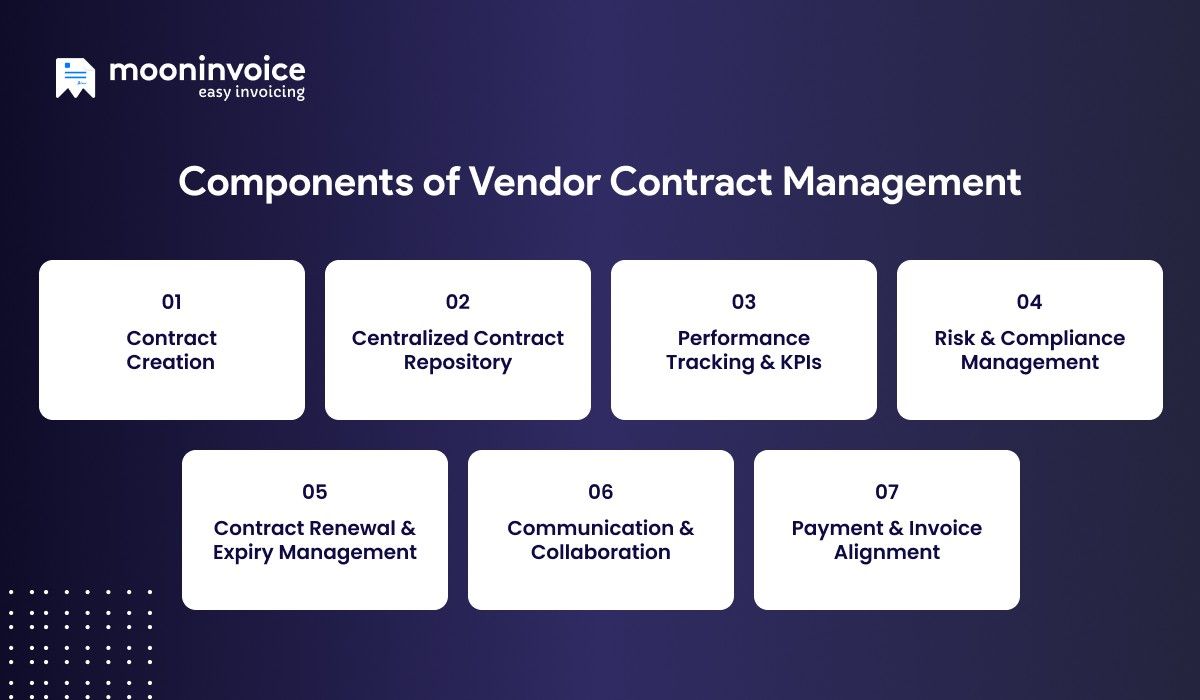
There are multiple components of vendor contract management that bind the entire process together. Let’s explore them one by one:
1. Contract Creation
The contract needs to be prepared with clearly defined expectations, timelines, deliverables, pricing, and payment terms.
2. Centralized Contract Repository
Every contract is stored in one location so that it can be easily accessible by team members. If required, teams can quickly check past records, track versions, and maintain complete visibility.
3. Performance Tracking & KPIs
Monitoring vendor performance against the contract is the core part of managing vendor contracts. Businesses generally track KPIs such as quality of product/service, delivery timelines, compliance rate, etc. Performance monitoring ensures whether the vendor is maintaining service levels or needs correction.
4. Risk & Compliance Management
A contract involves multiple risks, such as financial, operational, reputational, etc. So, vendor contract management must be done properly, i.e., by monitoring vendor compliance with regulatory requirements, industry norms, company policies, etc.
5. Contract Renewal and Expiry Management
When a contract is about to expire, taking action against it one month or one week before helps avoid business disruptions. Based on the past performance and quality of deliverables, a business decides in advance whether the contract will be renewed, extended, or terminated.
6. Communication & Collaboration
Smooth collaboration between both parties is necessary to manage vendor contracts. Performance reviews, scheduled check-ins, and communication in social channels keep everyone on the same page about contract terms and expectations.
7. Payment & Invoice Alignment
This is an important part of managing vendor contracts. Every payment the vendor makes must align with the contractual terms, especially pricing, milestones, and delivery conditions. Some businesses use a vendor contract management system, whereas some use invoicing software or tools to match vendor invoices with the contract.
Vendor Management vs. Vendor Contract Management
Many mistake vendor and contract management as the same thing, but in reality, vendor management is very different from vendor contract management. Let’s understand this, considering the comparison table below:
| Aspect | Vendor Management | Vendor Contract Management |
|---|---|---|
How to Create Vendor Contracts?
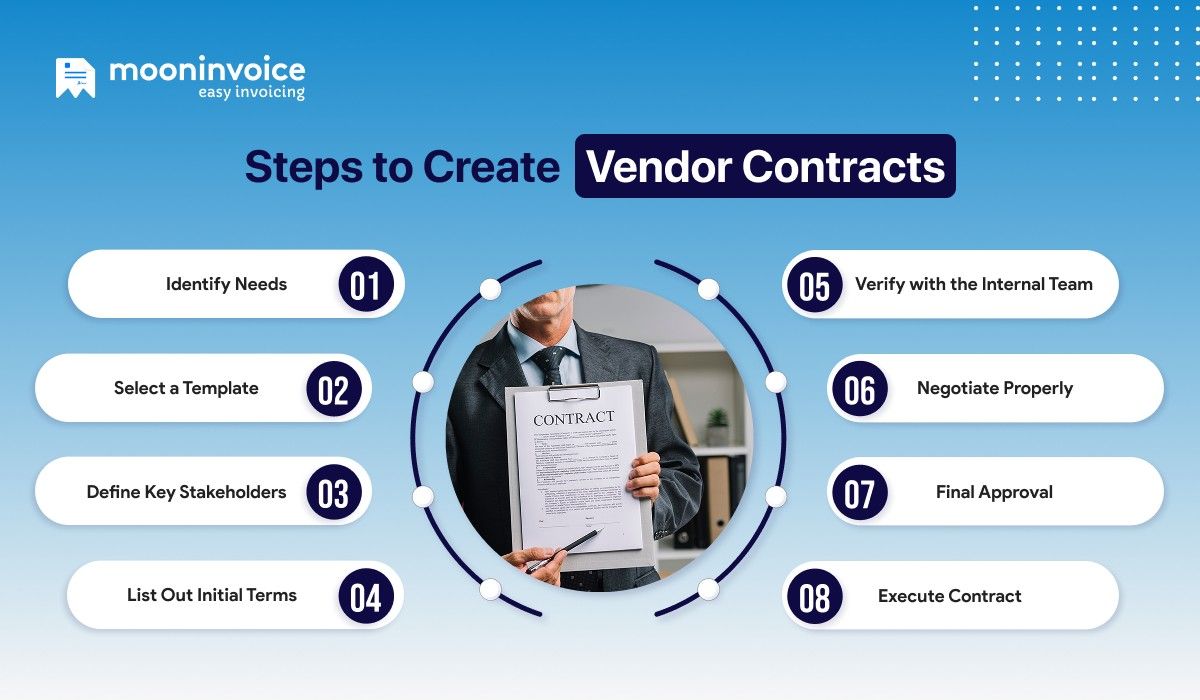
The vendor contract you create should provide value to your business and must not lead to cost complexities. To ensure both, you must follow a strategic approach.
Below are the steps to create vendor contracts:
Step 1: Identify Needs
The first step in creating vendor contracts is to identify what your business is with the supplier. When your needs and expectations are clear, the chances of disputes reduce.
At first, outline the purpose of engagement, i.e., product supply, service delivery, or tech support, etc. Next, you need to define the scope of work, timeline, quality standards, budget limits, and clarity on how you will assess vendor performance. After this, analyze your internal workflow to know if the partnership will affect ongoing operations.
The clarity in the initial stages is the foundation of an accurate supplier contract, where both parties share a common goal.
Step 2: Select a Template
Once you know your needs, the next step is to select a contract template that is reliable and shows professionalism. In the digital age, managing contracts in paper documents can be time-consuming and error-prone. You need a digital solution that is reliable for long-term success.
A contract template should include key details such as scope of work, payment terms, confidentiality, liability, and termination clauses. Also, you need to make sure that the template you choose aligns with your industry standards, internal legal guidelines, etc.
Step 3: Define Key Stakeholders
This is a major step that ensures the right individuals check the contract. You need to list all the internal and external team members who will make decisions and will be accountable for smooth contract execution.
Stakeholders ensure nothing critical is overlooked and reflect more on operational needs, legal expectations, organizational goals, etc. In this step, procurement teams, finance heads, and vendor-side representatives are all involved, which helps build strategic vendor relationships.
Step 4: List Out Initial Terms
At this stage, clarity matters more than perfection, and you should focus on listing out contact terms. Here, clearly define responsibilities, deliverables, timelines, and pricing expectations. Don’t forget to include service level agreements, which play a major role in maximizing performance from the start.
This initial contract term will later be negotiated by both parties to finalize the contract. Initial clarification accelerates internal reviews and ensures smoother discussions.
Step 5: Verify with the Internal Team
Your contract terms are set. The next step is to verify with the internal team. A discussion with the internal team helps you ensure compliance. Every department involved in this contract will review the vendor agreements, and then it will proceed to the next step.
In case of misleading clauses or missing obligations, it will be corrected. If everything is correctly defined, it will move to the next step, which is negotiation.
Key checks during internal review:
- Verify obligations and timelines
- Check risk and liabilities
- Ensure internal approval workflows are followed correctly
- Pricing is correctly specified with terms
Step 6: Negotiate Properly
Negotiation is where your contract truly comes to life. Both the buyer and the supplier discuss the price and focus on how they receive fair value. If you are dealing with multiple vendors, gather data, compare proposals, and prepare alternatives before going into the discussion with the supplier. Some businesses skip this, which symbolises poor contract management practices.
While the negotiation is ongoing, focus on pricing, delivery timelines, compliance obligations, and measurable performance standards. The objective of negotiation is to reach mutually beneficial terms that protect your business.
Don’t let Ordinary Invoicing Halt Your Growth. Explore Free Invoice Templates Now!
Step 7: Final Approval
This is the step that makes the contract officially valid. Every clause mentioned in the contract must meet business goals and operational capacity, which is checked and reviewed by legal, finance, and department heads. The contract goes through a strict review and approval process in which no mistakes, risks, or uncertainties are left unaddressed.
Final approval for the contract means the negotiations are done as per the agreed-upon terms. Once the contract is approved, it is authorized for execution.
Step 8: Execute Contract
Once all approvals are done, the final step is to execute the contract. In this step, both the buyer and the vendor sign the contract, making it legally binding. After execution, the contract can be shared with relevant teams to track performance and fulfill obligations.
Is Slow Billing Eroding Your Profit?
Close the financial loop effortlessly by turning finished contracts into compliant invoices.
Automate Final Billing
Maintain Records
Ensure Compliance
Vendor Management Contracts: Challenges & Solutions
Managing contracts is not an easy job. Sometimes you might think you are managing well, but challenges such as inability to track, poor approval processes, no payment reminders, or limited visibility to purchases are very common.
These challenges could lead to bigger issues in the later stages when the contract ends. The traditional methods of managing vendor contracts are another reason many businesses face challenges. So what’s the solution to all of this? Let’s find out.
Challenge 1: Performance Tracking
Tracking contract performance is a difficult job when a business relies heavily on paper documents. It results in missed milestones, a lack of measurable benchmarks, and unclear KPI (key performance indicator) evaluation.
Solution:
Use a digital solution to keep your vendor details organized. It helps you easily track vendor contract performance.
Challenge 2: Missing Major Timelines
Failure to monitor contract timelines is another challenge businesses face in vendor contract management. They simply forget the renewal dates or notice period, which causes accidental auto-renewals and financial losses.
Solution:
Set automated alerts and payment reminders for every contract so important date is never missed.
Challenge 3: Assessment Gaps
Lack of assessment frameworks increases the chances of risks, and it becomes difficult to identify vulnerabilities. It weakens the overall third-party risk management.
Solution:
Consider using risk assessment tools that make it easy to check the risk metrics of vendors.
How to Build an Effective Vendor Contract Management Process?
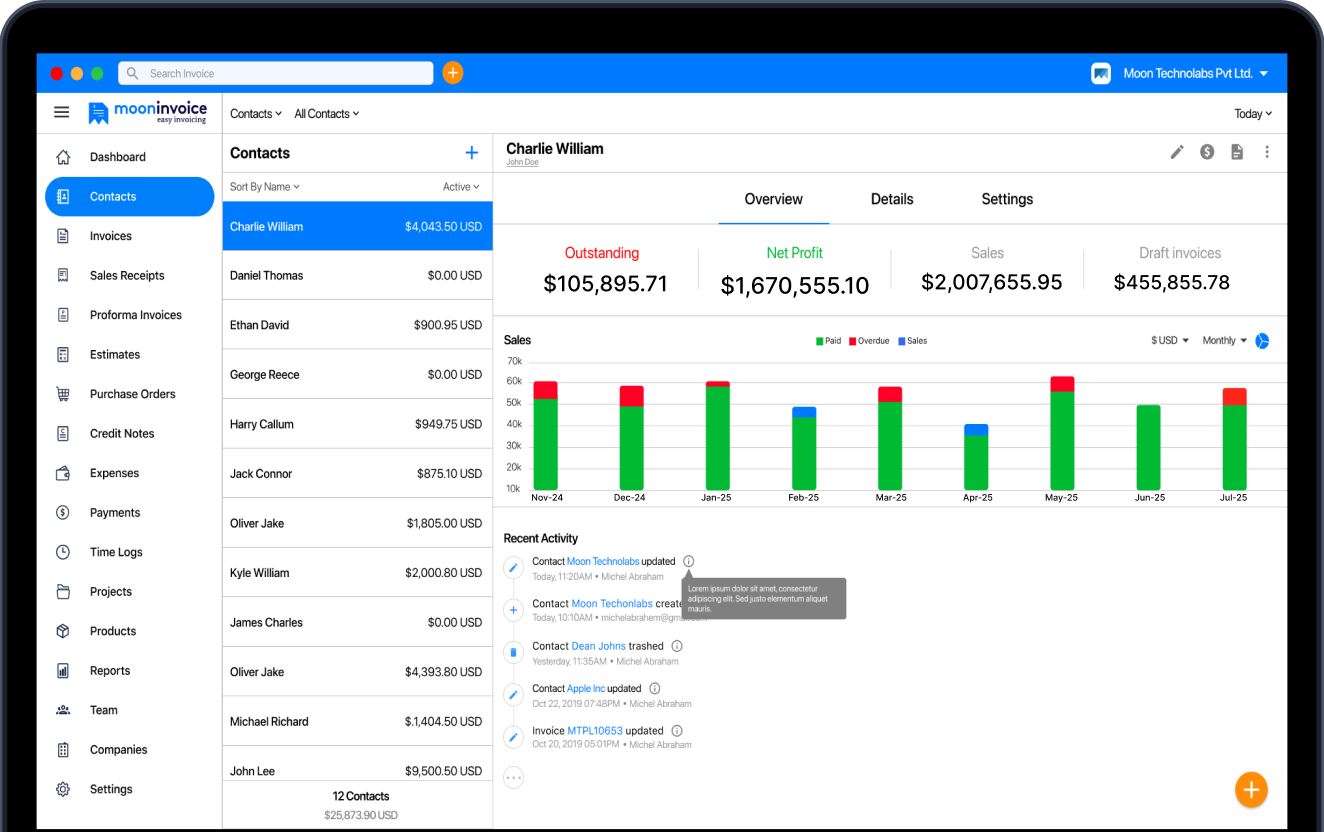
In a business workflow, a strategic vendor contract management process can be facilitated using vendor contract management software or billing software. One such example is Moon Invoice, which not only streamlines billing & invoicing but also comes with a vendor management module.
The dedicated vendor contract module of Moon Invoice allows you to manage vendor details in a single platform. Not only that, while managing vendor contracts, you can also create a new bill, debit note, purchase order, or expense within the same platform.
Plus, the other benefits are payment reminders and the ability to create a statement for a specific period, which makes Moon Invoice a great choice for businesses.
Conclusion
To grow your business in successive years, having a good vendor relationship is necessary, and vendor contract management is the first step to building good vendor relationships. It reduces financial risks and improves the overall efficiency of the business. When you clearly define needs, vendor payment process, set up authorization hierarchies, and audit regularly, you can easily address errors, mistakes, or any kind of mishaps.
If your goal is to keep vendor details and manage the finances of your business in one place, you are at the right place. Select Moon Invoice and handle all of your vendor details with the dedicated vendor portal.
Start your free trial today!
FAQs
What is vendor and contract management?
What is a contract management salary?
What is the average salary for a vendor manager?
What is the purpose of a vendor contract?



We at Moon Invoice, are the best minds behind smarter invoicing and seamless business growth. We love to solve financial problems and keep providing effective tips through our blogs, newsletters, and social media channels. As a team, we continue exchanging ideas about growing financial challenges and smart use of automation tools.


