


Tl;DR
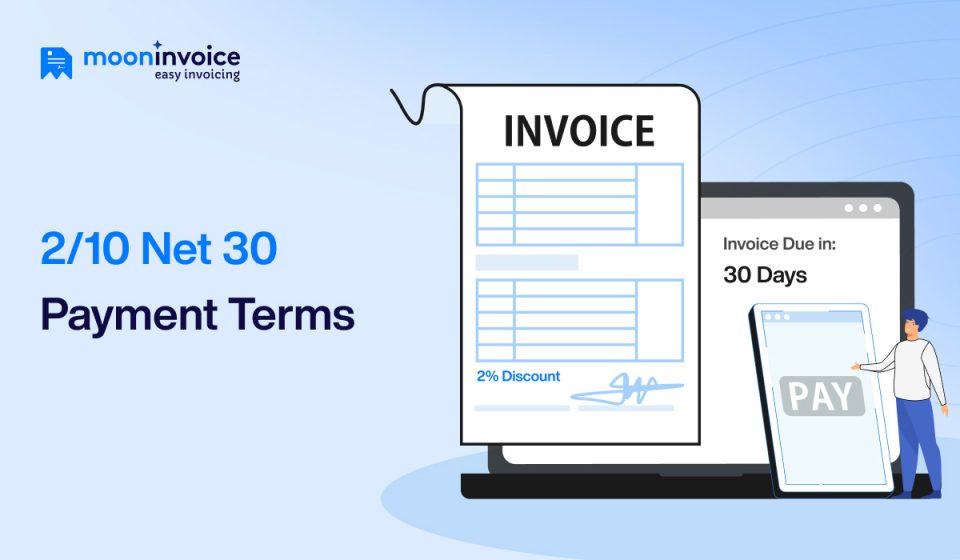
2/10 Net 30 helps businesses get paid faster, improves cash flow, and reduces late payments. A 2% discount will be given to the client when payment is completed within 10 days. A small business owner can benefit from on-time payments, while customers save money. The concept has merits and drawbacks, so one should consider it carefully.
It is not necessary that clearly stated payment terms in your invoice improve your on-time payment rate. You need to be smart and follow the tricky concept to get paid on time.
2/10 Net 30 is a trade credit term you can use to get early payment while offering your customers a discount on credit sales. It lets vendors gain on-time payment without missing them, keeping the client-vendor relationship healthy.
However, before applying this, you need to understand it deeply. To implement a proper strategy for 2/10 Net 30 terms, you must also be aware of its pros, cons, and challenges. Fortunately, you’ll get the right guide here through our words. So read carefully!
📌 Key Takeaways
- 2/10 Net 30 means a 2% discount will be given to the client for making payment within 10 days; otherwise, full payment is due within 30 days.
- It is a form of trade credit that encourages customers to make an immediate payment.
- Offering early payment discounts enhances business cash flow and drives more sales.
- Other useful payment terms include 2/10 net 45, 3/10 net 30, and 3/20 net 60.
- Clear terms and incentives help minimize overdue invoices.
- 2 Net 30 payment terms are widely used for B2B services.
- Using a net 30 calculator is helpful when applying 2/10 Net 30 terms, ensuring the correct 30-day due date and 10-day discount window.
What Does 2/10 Net 30 Mean?
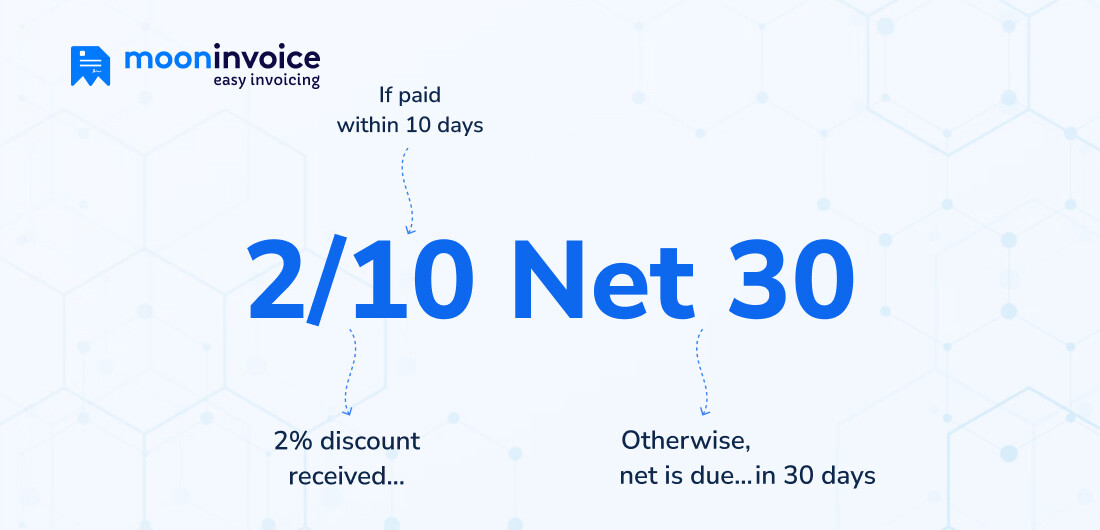
2/10 Net 30 is a specific type of trade credit arrangement that offers an early payment discount. A 2% discount is given to the client when an invoice is paid within 10 days. Otherwise, full invoice payment is applicable for 30 days. 2/10 Net 30 means buyers can save money, and vendors receive on-time payment. It’s a win-win solution for both parties involved in the business transaction.
2/10 Net 30 approach is very common in B2B transactions, wholesale, SaaS, and other digital services. It encourages early payments and lets the vendors boost their cash flow. On the other hand, it enables the client to avail of the discount.
How to Calculate Terms 2/10 n/30?
Calculating the 2/10 Net 30 is straightforward. It doesn’t require any complex formula to apply. Instead of it, you need to understand the term. It means a 2% discount is available on the invoice if payment is made within 10 days. Otherwise, the full invoice is applicable.
Let’s understand it through a real-life 2/10 Net 30 example. Suppose the seller issues an invoice totaling $20,000. We calculate this as follows:
Calculating the 2% discount
$20,000 x 0.02 = $400
Now, when paying within 10 days, the discounted amount will be as follows:
$20,000 – $400 = $19,600
So a customer only needs to pay $19,600 if they make the payment between the 1st and 10th of the month. Otherwise, full payment is required when payment is made from the 11th to the 30th of the month.
Invoice Making is No Longer a Headache
Try our 66+ customized invoice templates. Easily create an invoice in 60 seconds.
How Do 2/10 Net 30 Payment Terms Work?
The working approach for 2/10 Net 30 payment terms is straightforward. It possesses a simple working strategy. Here are the key steps:
1. The Invoice is Issued
The seller/vendor issues an invoice with 2/10 Net 30 payment terms. This is an initialization in the process. The vendor can also communicate directly with the buyer or its AP team to inform them of this payment term.
2. Early Payment Option (Day 1 to Day 10)
This is a discount payment window which is active from day 1 to day 10. Clients can avail of the 2% discount when making a payment during the discount period.
3. Standard Payment Window (Day 11 to Day 30)
When the client misses the early payment option, the standard payment window applies. In this case, the client needs to make the full payment as per the invoice. It means there will be no discount applicable after day 10 passes.
4. After Day 30
Once the actual payment due date passes, it becomes overdue. This results in penalties that vary depending on the company’s policies. So, if the client makes a payment after the 30th of the month, he must pay the total amount plus a penalty.
What Are the Pros and Cons of 2/10 Net 30?
2/10 Net 30 payment terms impact buyers and sellers in both positive and negative ways. Let’s unwrap the benefits and drawbacks below:
Advantages to Buyers
- 2/10 Net 30 is a cost-saving approach. It enables buyers to receive a 2% discount, thereby reducing costs.
- Buyers can also forecast budgets more effectively by making early payments.
- This type of trade credit improves a business’s credit rating.
- It increases the buyer’s income on the income statement by offering a 2% discount, which reduces COGS.
Advantages to Suppliers
- Suppliers also gain the right acceleration of the payment flow.
- It helps the business receive timely payments by encouraging customers to pay on time.
- Suppliers experience reduced bad debt and increased potential customers.
Drawbacks to Buyers
- When making a 2/10 Net 30 early payment, buyers experience an early cash-flow strain. That also affects further financial planning.
- A risk of errors or disputes is high.
- There is limited flexibility because the buyer needs to act quickly, regardless of internal approvals.
Drawbacks to Suppliers
- Suppliers can experience low profit margins because clients pay less than the invoice amount.
- Puts an extra burden on sellers by requiring additional journal entries.
When to Use the 2/10 Net 30 Early Payment Discount?
2/10 Net 30 is not applicable everywhere. There are certain situations where it is worth using. In general, it is good to consider when your business has excess cash, a large invoice amount, & exceeding the cost of capital. Let’s unwrap the right situations where utilizing this payment term is good:
For Vendor/Seller
Faster Cash Inflow is Crucial
Opting for 2/10 Net 30 is valuable when your business needs quick cash inflow for payroll, operations, and suppliers. It means you have enough cash to run your business.
When Managing a Large Volume of Invoices
2/10 Net 30 early payment is a good choice when your business processes a large volume of invoices, including recurring ones. Also, it is a good option when you offer subscription or contract billing.
During High Competition
As a business owner, you might face intense competition, which can make it harder to perform well. Choosing 2/10 Net 30 is a good option when your business needs to stay afloat in a competitive market. It attracts customers and keeps them loyal to your business.
When should a vendor/seller avoid 2/10 net 30?
- When the cost of capital is low, below 2%.
- Cash flow is already strong.
- Customers misuse the discount.
- Businesses rely on stable pricing.
For the Customer/Buyer
During Strong Cash Flow
If the buying company has a strong cash flow, then 2/10 Net 30 works well. It refers to a great opportunity to take advantage of the discount. Thus, the customer takes advantage & save money.
When the AP Process is Fast
When a company’s AP process is quick and automated, it is a good option to choose 2 Net 30 payment terms. The automated AP process offers faster invoice approval process, increasing the likelihood of payment within 10 days.
Avoiding the Late-Payment Risk
While making the payment for your purchase, it is a good opportunity to prevent from late payment excuses. It is because you make an on-time business. Also, it keeps the account clean.
When should buyers avoid 2/10 Net 30?
- When the cash flow is tight & unpredictable.
- Payment approval is quite slow.
- Internal cash return is greater than the discount benefit.
- The invoice is inaccurate.
- The invoice value is very small.
Common Implementation Challenges With 2/10 Net 30
While providing the best opportunity to save money for the buyer, 2/10 Net 30 also presents some challenges.
Limited to the Industry Scope
2/10 Net 30 payment term is not applicable to all industries. Construction and contracting are industries with tight margins and cannot rely on them.
Administrative Burden
The financial team faces an additional administrative burden with an early payment discount offer. This is particularly challenging for companies handling a large number of transactions. The team needs to monitor the payments and maintain accurate records.
Slow Invoicing Process
The financial team needs time to review, approve & process an invoice before making the payment. If this processing is not completed within 10 days, the buyers can miss the discount opportunity. Thus, the team needs to process the invoice early, which creates an additional burden and a tight schedule when choosing 2/10 Net 30.
Inconsistent Terms
The discount terms should be properly communicated to the AP team. If the terms 2/10 n/30 differ from the vendor’s, then it can cause confusion. The best solution to this problem is to maintain a master data file containing the original terms in a clear format.
Streamline Your Invoicing With Automation
Enhance your invoicing with the right automation. Smart, quick & time saver.
Final Words
2/10 Net 30 is the right tool to trigger on-time payment. It is widely applicable where early cash flow is valuable, and payments can be made. While it offers various advantages, it also possesses some limitations. Note that not every industry can use this early payment term. One must consider this concept through a 360-degree lens in business.
By using the right invoicing tool, such as Moon Invoice, you can streamline your invoicing process. The AI-powered platform automates operations, saves time, and enhances productivity. Do you wish to try? Start your free trial here.
FAQs
How do I calculate 2% 10 Net 30?
What is the interest rate for the 2/10 Net 30?
What is an example of terms 2/10 n 30?



We at Moon Invoice, are the best minds behind smarter invoicing and seamless business growth. We love to solve financial problems and keep providing effective tips through our blogs, newsletters, and social media channels. As a team, we continue exchanging ideas about growing financial challenges and smart use of automation tools.