


Managing accounts payable (AP) accurately is a challenging task for accountants. Reviewing each invoice, approving it, and paying it on time is essential because missing due dates could result in penalties and extra charges.
Within an accounts payable workflow, you will receive invoices in different ways, at different times, and from different people. Some arrive by email, some arrive in physical documents. So, you need a proper accounts payable organization in place to manage accounts payable processes effectively. Or else you could be stuck in the AP cycle, clearing dues, and your business will never grow.
Consistently receiving invoices requires a systematic approach to managing them. Therefore, you need to adopt the best practices to organize accounts payable for your business.
Let’s dive in…
📌 Key takeaways
- Organizing accounts payable (AP) involves systematically managing, tracking, and storing all invoices and bills.
- Centralizing invoices in one place and automating invoice capture are among the best practices for organizing AP.
- To avoid late payments and penalties, scheduling automated payments is one of the best practices of an AP organization.
- Key benefits of organizing AP include better cash flow management, on-time payment execution, and clearer financial insights.
- The most common challenges of AP management include manual errors, frequent late fees, and duplicate payments.
What is an accounts payable organization?
Accounts payable organization refers to the dedicated finance team responsible for overseeing vendor invoices, supplier bills, payment records, and other documents. The team takes care of incoming bills, centralizes them in one place, and ensures they are approved and paid before their due dates.
Organizing accounts payable exceptionally well can help your team reduce manual effort, minimize errors, improve visibility into financial obligations, and keep day-to-day operations running smoothly.
10 best practices for accounts payable organization
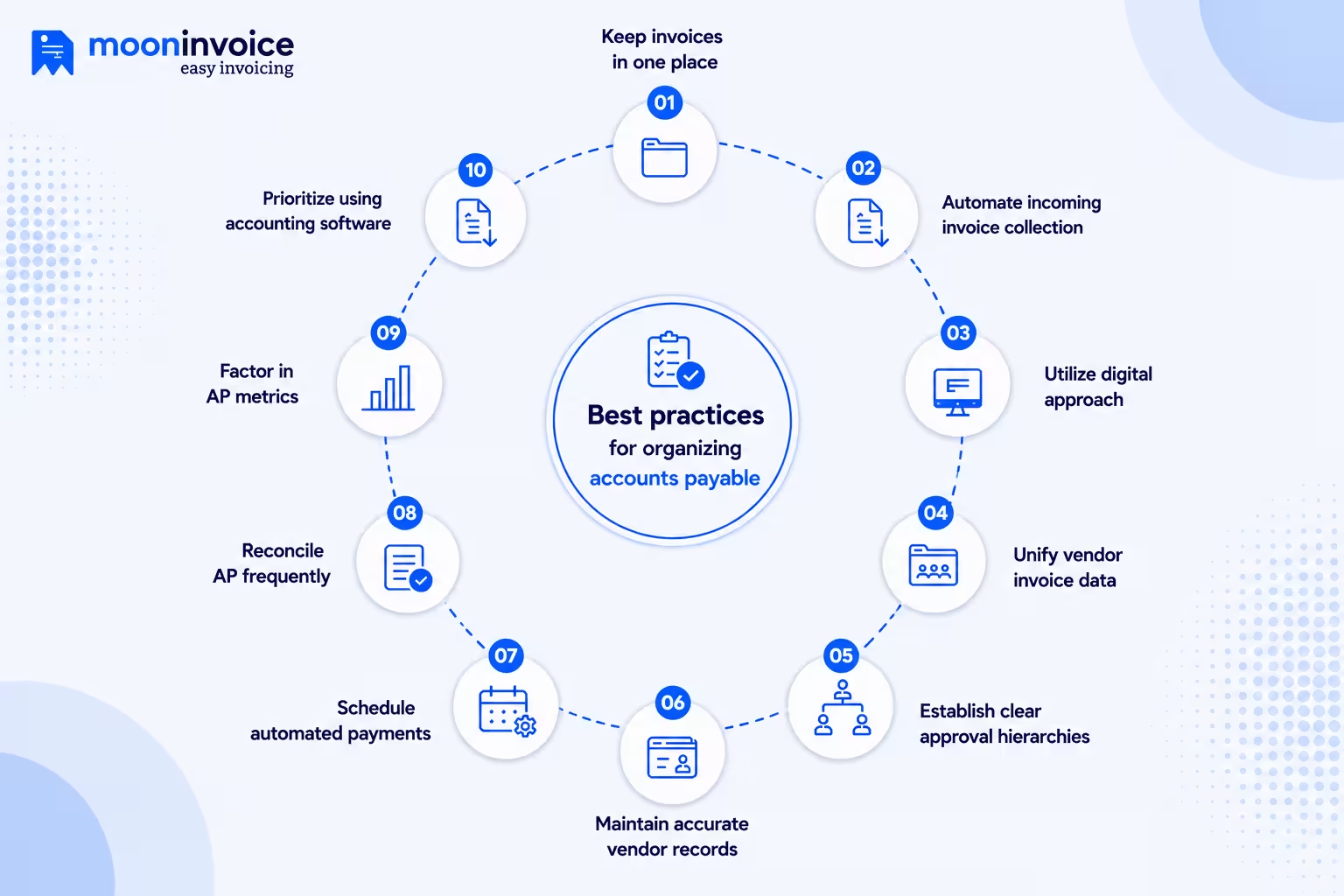
Disorganized AP processes result in compliance risks and audit headaches, not just payment delays. Below are the 10 best accounts payable organization ideas to consider.
1. Keep invoices in one place
Missed payment deadlines or duplicate entries are most likely when your invoices are scattered and disorganized. If you receive paper invoices, don’t store them in different locations, e.g., drawers or file cabinets. Instead, centralize them in a single location where your finance team can access them quickly.
The same goes for digital documents. If you receive invoices through different channels, store them in a single secure location so your finance team can access and manage every invoice more easily.
Scattered invoices resulting in late fees and penalties?
Switch to an advanced accounting software that helps you organize invoices in one place and process payments on time.
2. Automate incoming invoice collection
Your business may receive invoices through multiple channels, and manually checking each source can lead to delayed approvals and unnecessary administrative work. Instead, you can automate invoice collection so that every new invoice is captured and routed to your AP workflow as soon as it arrives.
This way, your finance team will be notified automatically whenever a new invoice is entered into the system. It reduces the risk of invoices being overlooked and speeds up payments, as it doesn’t require manual follow-ups.
3. Utilize a digital approach
In a digitally transforming world, paper invoices are indeed the oldest form of invoice. They are difficult to organize, time-consuming to retrieve when required, and highly prone to damage. Switching from traditional paper-based processes to digital documents is one of the most impactful changes a business can make.
With a digital concept, it is easier to store, search, and share invoices while reducing physical storage requirements. With a digital approach, finance teams and authorized users can access records quickly and keep transaction records accurate and up to date.
4. Unify vendor invoice data
Entering each vendor invoice’s details manually into your books is a repetitive task and can lead to typing errors. Instead, use AI automation tools and unify the invoice data in one platform. This is another common practice that further simplifies your financial hustle.
For example, you can embrace AI-enabled accounting software, Moon Invoice. A reliable tool for accountants like you to centralize vendor bills by directly extracting the information from paper documents. You read it right. It extracts all invoicing details in seconds and provides a digital document, after which you can convert it into bills, POs, credit notes, and more.
5. Establish clear approval hierarchies
Clear approval hierarchies are key to avoiding delayed payments and unnecessary follow-ups. To have clear visibility into your AP and pay invoices on time, you should assign approvers based on factors such as invoice amount, purchase category, or department.
A well-structured approval process in your accounts payable department ensures the financial document reaches the right person quickly, without going through layers of validation. It improves accountability and prevents unauthorized or duplicate payments.
6. Maintain accurate vendor records
To keep your AP processes well-organized, maintain accurate, up-to-date records for everyone your business works with, including vendors, suppliers, contractors, consultants, and other service providers. These records should include names, contact details, payment terms, billing information, tax details, banking information, and any relevant agreements.
Regularly updating this reduces communication issues and payment errors. It also strengthens vendor relationships when records are up to date and transactions are completed on time.
7. Schedule automated payments
Manually dispatching payments for every bill is not only challenging but also overwhelming, and it can lead to missed payments and late fees. This is where scheduling automated payments comes to the rescue. The finance team should schedule automated payments for recurring invoices to ensure they are processed before invoices become overdue.
Automated payments also provide better visibility into your outgoing payments and help you take advantage of early payment discounts whenever possible.
8. Reconcile AP frequently
Accounts payable reconciliation on a weekly or monthly basis has bigger benefits than doing it annually. On a weekly or monthly basis, you can match records such as purchase orders, goods received notes, and identify duplicate payments or billing discrepancies earlier. It also helps prevent costly problems for the business.
When reconciliation is performed consistently, your business’s financial records remain accurate and up to date. It helps create audit-ready financial reports.
9. Factor in AP metrics
Without calculating AP metrics, you would not know how your accounting team is handling the AP process. Tracking key performance indicators is thereby important for your business. Calculate Days Payable Outstanding (DPO), invoice processing cycle time, exception rate, and early payment discounts captured per month.
Uncovering these metrics helps you get rid of potential bottlenecks in your accounting process. On top of that, you can plan financial goals for the next cycle more effectively.
10. Prioritize using accounting software
If you want a more efficient and organized accounts payable process, relying on manual methods isn’t enough. You should consider using accounting software in your workflow to centralize invoices, automate AP tasks, and schedule automated payments in one place.
Prioritizing modern accounting software can significantly reduce your finance team’s workload by automating repetitive tasks and minimizing manual intervention. AI-powered capabilities, such as invoice scanning and automated data capture, help process invoices faster than manual accounting practices.
Importance of AP automation over manual management
If you are unsure whether to choose a manual or automated AP process for your business, you will find your answers here. Below is a quick comparison table of manual and automated AP processes to clearly understand the importance of AP automation over manual AP processes.
| Manual AP processes | Automated AP processes |
|---|---|
| Invoice collection depends on paper documents and employee follow-ups. | Supplier bills are automatically captured from multiple sources and routed into a centralized workflow. |
| The AP department relies on manual data entry for each bill, increasing the risk of payment error. | AI-powered data extraction captures information accurately from paper invoices with zero manual effort. |
| Paper documents are difficult to store, retrieve, and organize efficiently. | Digital records are securely stored, searchable, and accessible whenever required. |
| Invoice approvals often face delays due to unclear or inconsistent approval workflows. | Automated approval routing ensures invoices reach the right approvers without unnecessary delays. |
| Payment deadlines are tracked manually, increasing the chance of missed or late payments. | Scheduling automated payments helps ensure timely payments and improve the business’s cash flow. |
| Detecting duplicate invoices or payment discrepancies requires significant manual effort. | Automated validation and regular reconciliation help identify discrepancies much faster. |
| Managing increasing invoice volumes requires additional staff and administrative effort. | Automation easily scales with business growth without significantly increasing workload. |
Benefits of organizing accounts payable
Organizing your accounts payable in a structured manner helps you prevent fraud and costly errors. Here are the primary benefits of organizing the accounts payable process:
- Save time and money: You will never incur late fees or penalties because organized AP helps you pay on time. Also, you can easily grab small price cuts (if available) when you pay early.
- Helps you improve cash flow management: You can easily manage cash flow of your business by planning when to make vendor payments and tracking all upcoming payments.
- Transactions are made on or before the due date: An organized AP process speeds up payment execution and clears outstanding invoices before they lead to payment disputes.
- Better accounts receivable planning: Organized accounts payable gives a clearer picture of outgoing payments, which makes it easier to balance accounts receivable.
- Strengthens vendor relationships: Organized AP results in timely payments, which helps build trust with vendors. You can often negotiate better prices or delivery terms when your past transactions are on time.
- Helps you stay compliant and audit-ready: With AP documents organized in proper order, your books represent clearer financial insights. It helps meet regulatory requirements and stay prepared for audits.
Common challenges in managing accounts payable
When you don’t have an organized accounts payable process, you are likely to face challenges that can severely affect the financial performance of your business. Here are the most common challenges you should be aware of:
Challenge 1: Manual errors
Managing the business’s entire accounting workflow manually delays invoice processing and increases the risk of human error.
Challenge 2: Incurring late fees
Not scheduling automated payments often leads to late fees and penalties, as the risk of missing due dates increases. You may also miss out on early discounts.
Challenge 3: Misplaced or overlooked invoices
When invoices are received through multiple channels and stored across emails, paper files, or spreadsheets, it’s easy to overlook or misplace them. Without a centralized accounts payable system, supplier bills may be delayed or even processed twice.
Challenge 4: Time-consuming reconciliation process
Transaction reconciliation requires careful attention. Manually matching invoices, purchase orders, and payment records is not only time-consuming but also increases the risk of discrepancies.
Challenge 5: Duplicate payments
Disorganized AP processes or scattered invoices often cause duplicate payments, meaning your finance team may pay the same bill twice. This happens when your team fails to identify the same invoice received in both mail and email.

Organize your AP effectively with AI-powered software
So far, we’ve discussed the best practices for accounts payable organization, along with the common challenges businesses face when relying on disorganized or manual workflows. Even with a well-defined process, manual tasks can slow approvals, delay payments, and make it difficult to stay on top of due dates.
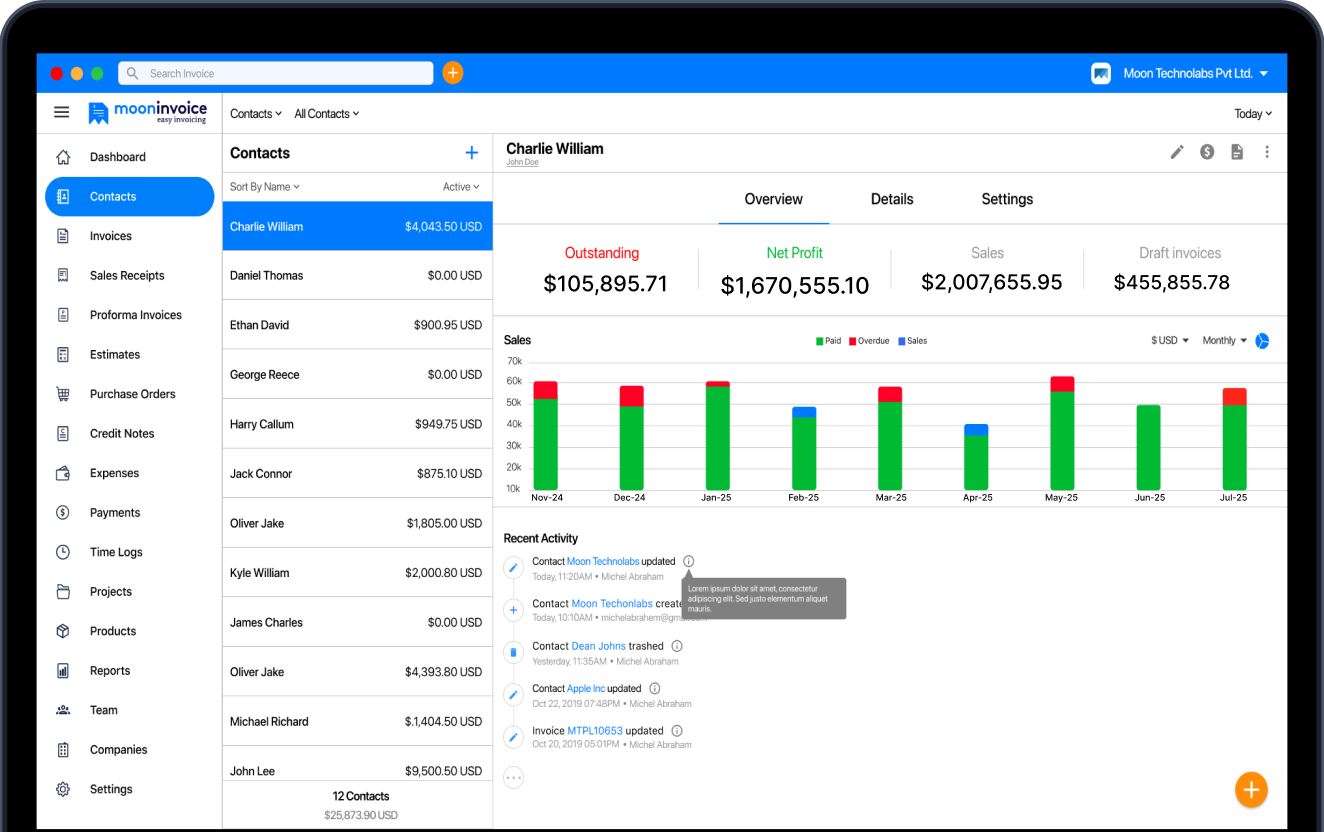
The good news is that many of these challenges can be overcome with the right accounting software. Instead of shuffling spreadsheets and paper records, businesses can automate routine tasks while managing both accounts payable and accounts receivable from a single platform. Moon Invoice is one such solution designed to simplify daily financial operations.
With Moon Invoice, you get AI-powered features such as AI contact creation, purchase order management, a dedicated vendor module, invoice aging reports, payment made reports, and other features that help organize your accounts payable workflow.
Explore Moon Invoice now and manage your AP processes more effectively.
Relevant questions on accounts payable organization
How to organize accounts payable?
What is the best way to reconcile accounts payable?
What software is best for AP management?
What are the golden rules of accounts payable?



We at Moon Invoice, are the best minds behind smarter invoicing and seamless business growth. We love to solve financial problems and keep providing effective tips through our blogs, newsletters, and social media channels. As a team, we continue exchanging ideas about growing financial challenges and smart use of automation tools.