


In nutshell
AIA billing in construction is a standardized invoicing system that contractors use to request payment. It involves systematic documentation of construction work and payments that sets transparency between contractors and owners. This approach reduces confusion, enhances work, and ensures timely payment.
Construction projects are long-term work. In addition to providing quality work, it is important for contractors to ensure timely payment.
AIA billing is one such aspect of financial management that helps construction companies to stay organized in the payment process. Developed by the American Institute of Architects (AIA), this standardized invoicing method helps professionals maintain their work records and payments.
Adoption of this standardized invoicing has had various positive impacts on the construction project. But to understand its components and how it works, you need to go through this guide.
📌 Key takeaways
- AIA billing meaning refers to a standardized progress billing process that construction companies follow for payment requests.
- G702 and G703 are two important AIA documents that include work completed and payment applications.
- It allows contractors to receive periodic payouts throughout the project life cycle and prevents late payments.
- This approach clearly outlines project costs and establishes transparency.
What is AIA billing in construction?
AIA billing (also known as AIA progress billing) is a standardized process that construction companies use to request payment for completed work during a specific billing period. This process allows owners, architects, contractors, and lenders to track the completed work and gain a clear understanding of project progress and payment details. It is widely used in large construction projects.
Key components of AIA billing
Certain AIA billing terminologies are essential to understand its strategy easily:
Financial components
- Schedule of values (SOV)
SOV is an integral and crucial part of AIA billing. This document includes the project’s milestone payment and the total payable amount. It shows the payment breakdown across various phases of the project. This enables both contractors and owners to easily track the progress and relevant payment flow.
- Retainage
Retainage is a small portion of the total project cost that contractors hold. It is a win-win for both the construction company and the client (the project owner). For contractors, it refers to incentives and encourages quality work. For owners, it provides a sense of security that final payment will not be released until satisfactory completion.
- Change of orders
It is referred to as a Construction Change Order (CCO). This formal document records any approved modification to the original construction. The change might be related to material, work schedule, and pricing. It also includes the reason for the change and the signature of the authorized person who approved the change. This recording ensures that contractors receive the amount aligned with any changes to the project.
Material tracking and documentation
- Stored materials
Certain materials in the construction projects are purchased but not used. HVAC equipment, structural sheets, and plumbing fixtures are such materials. These materials are recorded in the G703 Continuation Sheet. This simplifies tracking these materials for the contractors and includes them in an invoice when used in the work. This ensures that the contractor receives the appropriate payment.
- Stored material invoices
Stored material invoices include details of materials purchased but not yet installed. Thus, these invoices are also important supporting documents for payment requests for all purchased materials. Architects, lenders, and owners ensure the requested amount is accurate and confirm the quantity and unit cost.
- Delivery slips
Delivery receipts or packing slips are another supporting document in the process. These are especially helpful when the contractor requests payment for the stored materials. Delivery slips make it easy to verify that materials have been delivered and are subject to payment.
Other supporting documents
Certain other documents are also helpful in the AIA procedure. These are referred to as supporting documents that streamline the overall process.
- Insurance certificate
In the AIA billing process, a Certificate of Insurance (COI) serves as proof that the contractor has the required insurance coverage. Workers’ compensation, liability, and business owners’ policies are types of insurance.
- Lien waivers or releases
Lien waivers are usually submitted along with the payment application. Contractors, subcontractors, and suppliers use this document to agree to give up their right to place a mechanic’s lien on the property. These documents primarily serve as evidence of payment for the materials and services provided.
- Change order log
This document provides details on pending and approved change orders. It is necessary to keep this log sheet up to date. It is useful in the AIA billing for construction because it provides the required information for the change order.
Inaccurate billable hours mean inaccurate billing.
Track every second of your project to ensure accurate billable hours that reflect proper billing.
Important AIA billing forms
There are two important payment application forms. In the construction industry, both these documents are crucial.
1. G702 document: Application and certificate for payment
The G702 document is a payment request that provides a summary of the project along with the requested amount. This comprehensive document covers the following data:
- Worked performed
- Change orders
- Amount given in the past
- Current requested payment
- Retainage
- Total project value
- Period To (end of the billing period)
2. G703 document: Continuation sheet
G703 is a supporting document of G702 and is often referred to as a Continuation Sheet. It provides a detailed breakdown of the construction work performed. The form of this document is in accordance with the SOV and consists of the following details:
- Schedule of values
- Work completed from previous payment applications
- Work completed during the current billing period
- Total work completed to date
- Percentage of work completed
- Balance remaining to complete each work item
AIA billing process: Key steps involved
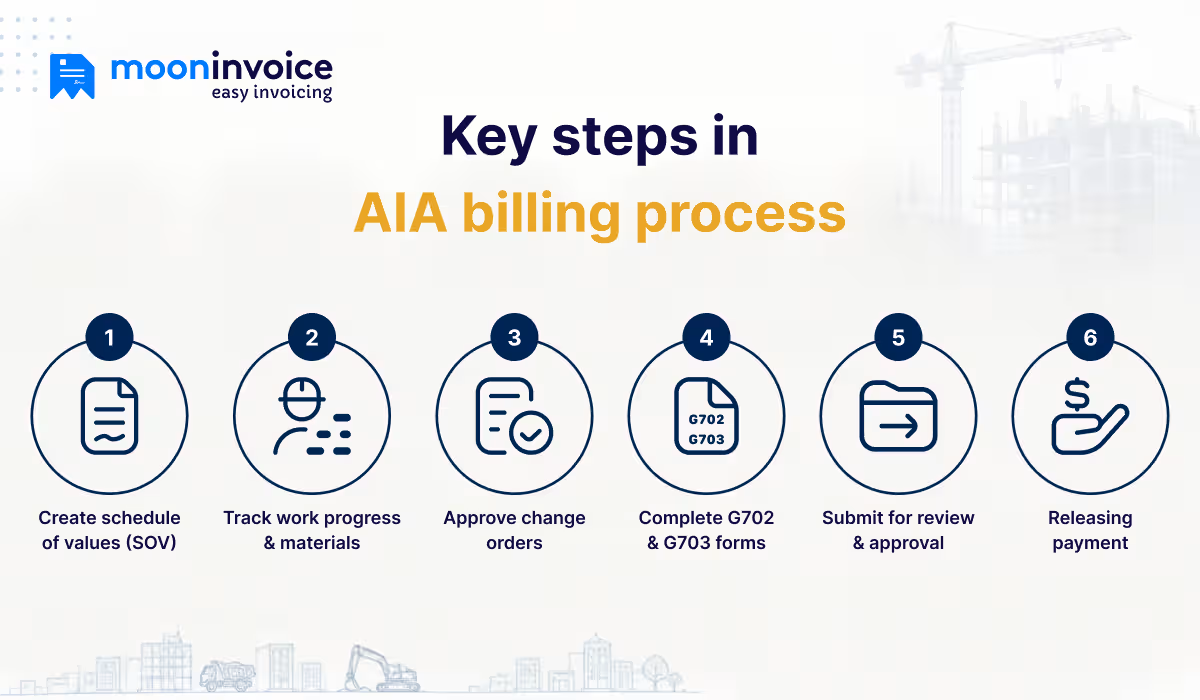
You might be eager to know how AIA billing in construction works. Here are the key steps involved for the successful operation:
1. Schedule of values
The contractor prepares the Schedule of Values (SOV) using the AIA G703 Continuation Sheet, which provides a breakdown of the work and related costs. The architect and owner review this before the billing process begins.
2. Measure the progress and stored materials
The contractor starts recording the portion of work completed (in percentage), change orders, and retainage deductions in the Schedule of Values (SOV). Additionally, he can also cover the retainage, eligible stored materials, or any other adjustments.
3. Approved change orders
Any changes to material, cost, or anything else should be reflected in SOV immediately. Take approval from higher authorities before including these changes in the final payment application.
4. Getting G702 and G703 forms ready
The AIA G703 Continuation Sheet covers all the line items, including current completed work, approved change orders, retainage, and stored materials. Later on, the AIA G702 Application and Certificate for Payment includes the details in summary form and serves as a payment request.
5. Submission and review
The contractor then submits the completed G702 and G703 documents to the architect or the owners. The architect later reviews the payment request and overall things and certifies it when everything is in compliance with the contract.
6. Releasing payment
The owner releases the payment in accordance with the contract terms after the document is approved. The total payable amount reflects the approved stored materials, completed work, retainage, and other approved changes.
Common challenges in AIA billing and solutions
Contractors often encounter various issues when dealing with AIA billing. These circumstances adversely affect the billing process.
- Misunderstanding of G702 and G703 forms
- Insufficient supporting documents
- Review and approval delay
- Work completion percentage errors
- Incorrect retainage calculations
- Manual calculation mistakes
- Schedule of values discrepancies
Solution
- Clarity on Forms 702 and 703 – Always remember that Form 702 summarizes the work and serves as a payment request. Form 703, on the other hand, represents the milestone of work.
- Update schedule of values – Promptly updating the schedule of values throughout the project prevents discrepancies.
- Boost approval rate – Set clear communication with the architect, owner, or other senior professionals to ensure on-time approval. Also, share the supporting documents to expedite the review.
- Ensure the correct work percentage – Perform site verification and track the project regularly to compute the accurate percentage of work completed.
- Automate calculations – Rather than adopting a manual approach, it is better to use invoicing software. This approach automates the calculation and ensures accuracy in the entire payment process.
Why is AIA billing crucial in the construction industry?
AIA billing documents, such as G702 (Application and Certificate for Payment) and G703 (Continuation Sheet), clarify payment requests and approvals. This keeps the contractor, owner, and other involved parties on the same page, reducing confusion and misunderstandings. Contractors experience a smooth payment process, and owners get full transparency into where their payments are going and the status of the work.
Many construction contractors also require lien waivers from suppliers, contractors, and subcontractors before payment. This reduces the legal and financial risk and protects the owner’s property from a mechanic’s lien. It includes clear records of completed work, pending tasks, approved change orders, and overall status, which are useful for tracking project progress.
Overall, this approach promotes transparency and trust among project participants and saves time by streamlining billing. It reduces the risk of disputes and contributes to the success of the construction project.
Role of Moon Invoice in AIA billing
Usually, AIA billing is complex and time-consuming. Activities such as change orders, project progress tracking, retainage, and payment applications make the process long and complicated. That is what requires accurate project tracking, careful record-keeping, and the right calculations.
However, billing software such as Moon Invoice can streamline the overall construction invoicing. It allows contractors to manage projects, track billable hours accurately, and create professional invoices using templates. The system also allows them to create better estimates and easily convert them into invoices with a single click. Similarly, it allows the creation of POs and receipts.
Additionally, its AI-powered features enable it to generate invoices, receipts, and POs using OCR to extract necessary information from scanned documents. This ensures accuracy and speeds up the work. It is also easy to record payment and customer details through AI automation. The system also enables systematic management of vendor details. Construction professionals can easily manage project expenses digitally within a single centralized software platform. They can also generate 15+ financial reports to gain insights into outstanding balances, revenue, and profit and loss.
Overall, Moon Invoice helps make construction billing fast and accurate. Contractors can track project progress, maintain payment details, and manage other records important to AIA billing.
Enhance your construction billing with Moon Invoice.
Create unlimited professional invoices within seconds and ensure on-time payment on every project.
AIA Billing FAQs
What does AIA mean for billing?
Does every construction project require AIA billing?
How often are AIA payment applications submitted?
How is AIA billing different from the standard billing?



Jayanti Katariya is the founder & CEO of Moon Invoice, with over a decade of experience in developing SaaS products and the fintech industry. He holds a degree in engineering. Since 2011, Jayanti's expertise has helped thousands of businesses, from small startups to large enterprises, streamline invoicing, estimation, and accounting operations. His vision is to deliver top-tier financial solutions globally, ensuring efficient financial management for all business owners.