



Bank transit numbers have been a vital part of financial transactions for over 100 years. If you are new to accounting, you may find it a bit more technical, but it is not a new term at all. To ensure seamless transactions between individuals and banks, it is necessary to navigate banking details such as routing numbers and account specifics. That’s where a bank transit number comes in.
A bank transit number acts as a key identifier for financial institutions to move funds accurately between banks during deposits, bill payments, and transfers.
So, how big a role do bank transit numbers play in error-free invoicing and payment processing? And how should you find your own bank transit number?
Let’s find answers to all these questions in detail…
📌 Key takeaways
- In the U.S., a bank transit number is a unique 9-digit identifier used by financial institutions nationwide.
- From the 9-digit number, digits 1-4 represent the Federal Reserve routing symbol.
- Digits 5-8 represent the ABA institution number, and digit 9 is the check digit.
- Bank transit numbers act as the backbone of interbank routing and power everyday business payments.
- With bank transit numbers, cheques are processed faster, and forged cheques are detected quickly.
- In invoicing, bank transit numbers reduce payment failures and simplify bank reconciliation.
What is a bank transit number?
A bank transit number is a unique 9-digit identifier for a specific financial institution in the US. We can say it is the bank’s address in the financial world. A bank transit number tells which bank should send or receive a specific transaction.
In the US, every federally chartered bank, credit union, and financial institution has at least one transit number. It is unique, and no two banks share the same number. This is the reason why the entire operation is reliable and secure.
Another key thing to note, terms such as bank transit number, routing number, and ABA (American Bankers Association) routing number all refer to the same thing. They are used interchangeably in the US across different scenarios.
Facing delays in fund transfers?
Utilize Moon Invoice, where you can choose over 20 payment methods to send or receive money 2x faster.
Breakdown of a bank transit number
We understood the bank transit number meaning, and it’s time to go one level deeper and understand how this 9-digit number is structured. This nine-digit number is not any random sequence; it is divided into three parts and has a specific purpose assigned by the ABA (American Bankers Association).
For example, let’s see this sample transit code for bank to fully understand its structure:
- Sample bank transit number: 0 2 1 0 0 0 0 2 1
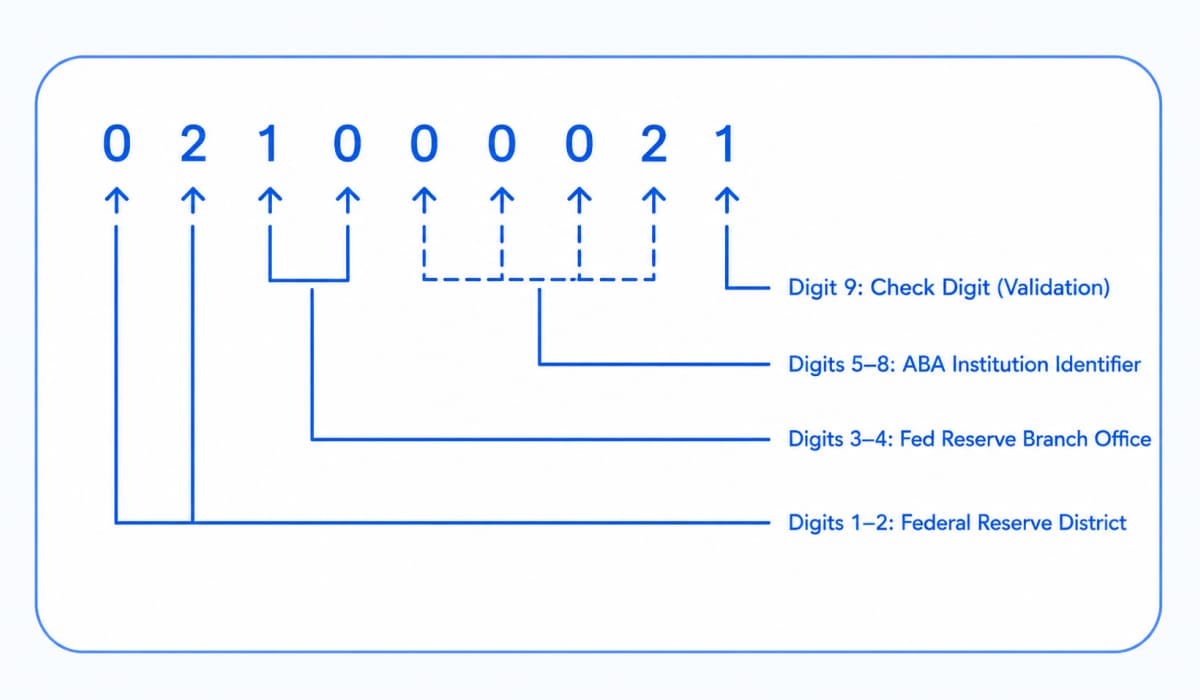
1. Digit 1-4: The Federal Reserve routing symbol
The first four digits of the bank transit number identify two things at once:
Digit 1-2: It indicates the Federal Reserve District from which the bank originates. In the U.S., there are 12 Federal Reserve Districts, each assigned a number from 01 to 12.
Below is a list of 12 Federal Reserve Districts, each with its number.
| Digits 1-2 | Federal Reserve Districts |
|---|---|
| 01 | Boston |
| 02 | New York |
| 03 | Philadelphia |
| 04 | Cleveland |
| 05 | Richmond |
| 06 | Atlanta |
| 07 | Chicago |
| 08 | St. Louis |
| 09 | Minneapolis |
| 10 | Kansas City |
| 11 | Dallas |
| 12 | San Francisco |
Digit 3-4: The next two digits, i.e., 3rd and 4th placed numbers, determine a specific Federal Reserve Bank Office (either main office or a branch) which is responsible for processing transactions. If the digits 3-4 are “00”, it indicates the main Federal Reserve Office for that district and not a branch.
Apart from “00”, all other numbers indicate branch offices. Considering the sample bank transit number, the digits 3-4 are “10”, so it indicates a branch office.
2. Digit 5-8: The ABA institution identifier
Digits 5 to 8 are the core part of the bank transit number. These four digits act as a unique identifier assigned by ABA to a specific financial institution. These four digits separate Chase from Bank of America, or we can say, distinguish a local credit union from a regional savings bank.
In the United States, two active banks or financial institutions never share the same combination of Federal Reserve routing symbol (digits 1-4) and institution identifier (digits 5-8).
3. Digit 9: The check digit
The final digit, known as the check digit, plays a key role in the bank transit number. The last digit is not assigned any value; it is mathematically calculated from the first eight digits using a specific formula established by the ABA.
Role of bank transit numbers in financial institutions
A bank transit number does a lot more than just sit at the bottom of a financial document. Behind every automated billing cycle and payroll run, this 9-digit code also ensures core financial operations such as routing funds accurately across financial institutions, payment networks, and Federal Reserve systems every single day.
Let’s find out what role bank transit numbers play in financial institutions:
1. Acts as the backbone of interbank routing
When money moves from one bank to another, it goes through a structured settlement network operated by the Federal Reserve. A banking transit number comes into play for bank transfers, as it routes the transaction to the correct institution.
Whenever you send a payment, the Federal Reserve’s system reads the routing number, identifies the destination bank’s Federal Reserve district, and routes the funds through the appropriate regional Federal Reserve Bank.
2. Powers everyday business payments
The Automated Clearing House (ACH) network is one of the most commonly used payment systems in the US. It makes electronic payments possible. So when a business sets up direct deposits for employee payroll or receives bank transfer payments from a client, most of the time it runs through the ACH network.
In all of these transactions, the bank transit number plays a significant role. It identifies the ACH network from which funds shall be withdrawn and to which funds shall be deposited. It works alongside the account number to exactly identify the correct destination.
3. Handles wire transfers
The bank transit number plays a major role in processing domestic wire transfers as well. Businesses use wire transfers because they settle bank-to-bank transactions in real time without delay.
In case of international wire transfers, the transit numbers work in combination with a SWIFT/BIC code, a globally well-known identifier that directs cross-border payments to the correct country and institution.
4. Simplifies online banking
The rapid growth of online banking has made transit numbers more readily visible. As a business owner, when you initiate an electronic funds transfer or link an external account, the routing number is a required field.
Transit numbers are also required when:
- You link your account to a payment processor such as Stripe or Square
- Set up automated tax payments through the IRS Electronic Federal Tax Payment System (EFTPS)
- Authorizing a third-party platform to withdraw or deposit funds on your behalf
In each of the above-mentioned scenarios, a bank transit number is required to authenticate and locate your financial institution.
5. Quick cheque processing
Even though the percentage of transactions through electronic payments is increasing rapidly, paper cheque processing can’t be ignored. It is still one of the most reliable modes of processing transactions for many US businesses, particularly in industries like construction, real estate, and legal services.
The bank transit number helps automate the sorting and processing of paper cheques across the country. Whenever a cheque is deposited, the routing number is captured immediately to initiate the interbank clearing process through the Federal Reserve or a private clearing network.
6. Fraud prevention and payment validation
Apart from routing and processing, bank transit numbers also act as an important security function within the financial system. This is because every valid bank transit number goes through the mathematical validation process (check digit formula). Invalid or altered routing numbers are instantly flagged by banking systems before processing the transaction.
The bank transit numbers are crucial in:
- Accidental payment errors, such as identifying mistyped digits before moving funds.
- Addressing fraudulent account setups with mathematical validation.
- Identifying cheque fraud, such as altered routing numbers or forged cheques, is detected during MICR processing.
This built-in validation system is incredibly helpful for business owners who handle a high volume of transactions.
How do bank transit numbers help in payment processing?
Bank transit numbers play a massive role in ensuring payments are processed accurately and reach the correct financial institution without delays. Whether businesses receive payments via ACH transfers, direct deposits, or wire transfers, these numbers help banks determine where to send the funds. A single incorrect digit can lead to failed payments, processing delays, or reconciliation issues, making bank transit numbers an essential part of secure payment processing.
Here’s how they support smooth and accurate financial transactions:
1. Routing payments to the correct bank
Whenever a customer initiates a payment, the banking system first uses the bank transit number to identify the receiving financial institution. This ensures the funds are directed to the correct bank before reaching the intended account.
Without the correct transit number, payments may be delayed, rejected, or sent to the wrong destination. For businesses handling frequent client payments, accurate routing information is essential to maintain uninterrupted cash flow.
2. Reducing payment failures
Incorrect banking details are one of the most common reasons behind failed electronic payments. Bank transit numbers help minimize these issues by ensuring transactions are routed accurately from the start.
Using the correct transit code for bank helps businesses:
- Avoid failure of electronic payments such as ACH and wire transfers
- Prevent payment delays that may come from incorrect banking information
- Reduce manual corrections and administrative work
- Improve payment accuracy for recurring transactions
Accurate banking information ultimately helps businesses maintain smoother payment operations and avoid disruptions in the revenue cycle.
3. Accurately matching records and bank reconciliation
Payment collection is only one part of the financial process. Businesses also need to reconcile transactions with their accounting records to maintain accurate financial reporting.
Bank transit numbers simplify reconciliation for businesses by:
- Verifying the originating financial institution of incoming payments
- Matching transactions with invoices and payment records
- Identifying unexpected or unmatched deposits more efficiently
For businesses managing large transaction volumes, having a transit number can ease the entire reconciliation process and improve overall financial organization.
How to find bank transit number?
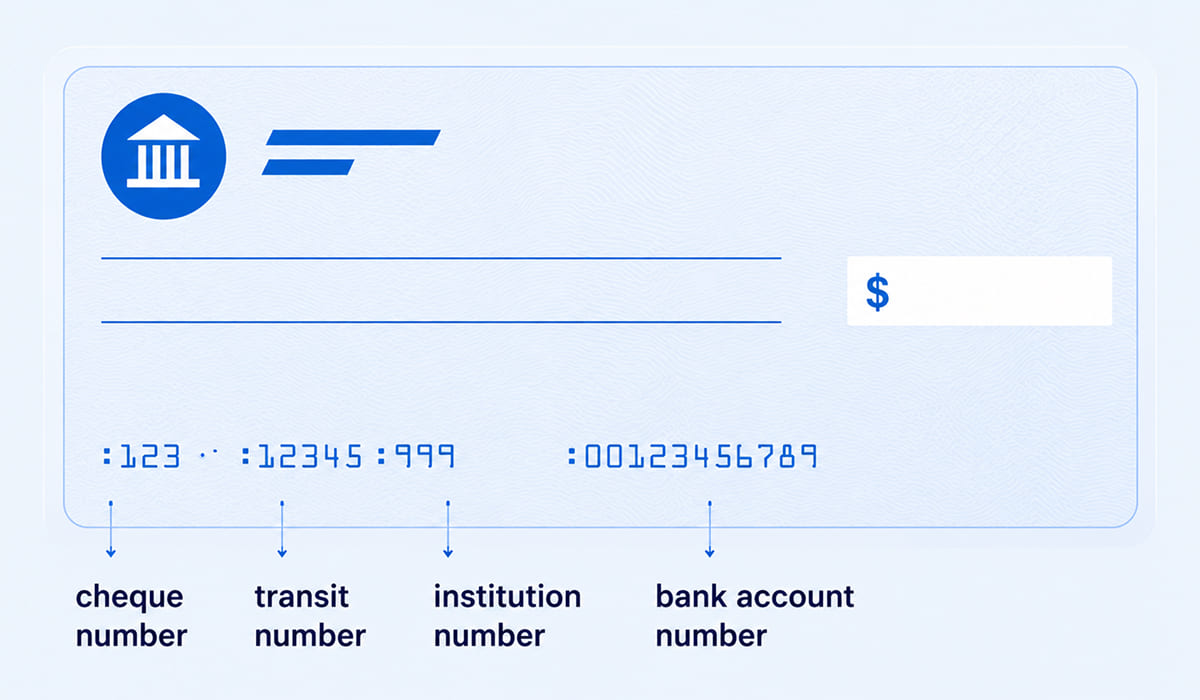
Finding the bank transit number is easier than it sounds. Here are a few methods you can follow to find your bank transit number:
Method 1: Paper cheques
Look at the bottom left corner of your cheque. You will see a nine-digit code printed. That’s your bank transit (routing) number, which is used for electronic transfers.
Method 2: Bank statement
Open your last bank statement (digital or printed). Some banks list the routing number in the account details section.
Method 3: Mobile or online banking
Sign in to your bank’s mobile app or website so that you can easily navigate your account information. Once signed in, head to the account information where the routing number is usually displayed.
Method 4: Bank’s official website
Some banks in the U.S. provide routing numbers depending on the state or transaction type. You need to select the correct state or transaction type for your account to find your bank transit number.
Method 5: Bank’s customer support
If you are confused about your bank transit number, consider calling your bank’s customer support. It is helpful in clearing up confusion and ensuring greater accuracy when other financial institutions are involved.
Reconcile your payments swiftly with Moon Invoice
Stop letting manual delays and interruptions slow down your bookkeeping.

Bank reconciliation
Report generation
Automatic alerts
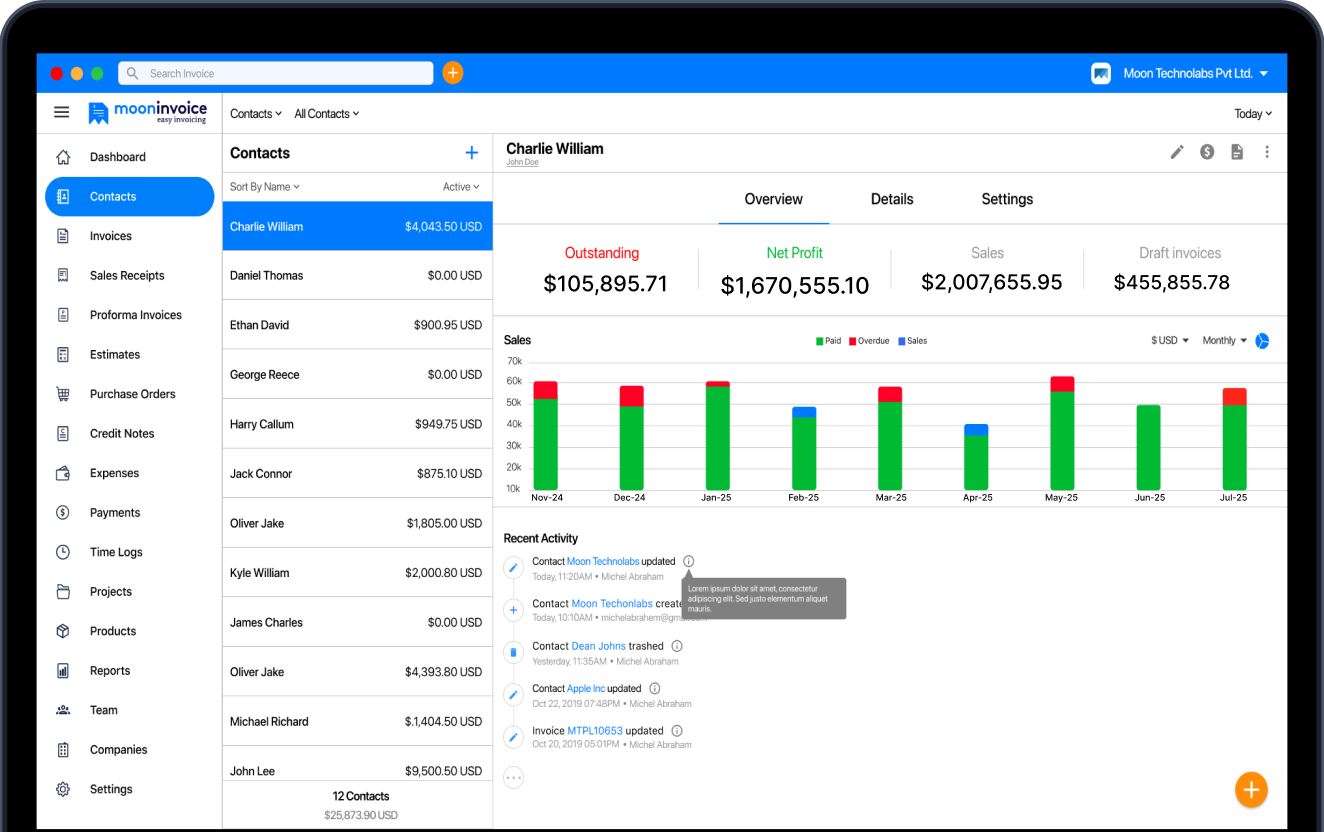
Simplify your financial reporting with Moon Invoice
To sum it up, bank transit numbers play a key role in validating transactions and ensuring funds are routed accurately between financial institutions. Multiple transactions, however, when managed manually, can increase the risk of errors, missing records, and reporting issues.
Even worse, you don’t get a clear view of all business transactions and financial records unless you are using accounting tools.
That’s where accounting software like Moon Invoice can help. The AI-driven accounting software with a variety of features, including detailed reports and bank reconciliation, eliminates manual dependencies. Businesses can monitor transactions in real time and maintain accurate financial data in one place. Start your free trial today.
Relevant questions on the bank transit number
What is the transit number of a bank?
Is a transit number the same as a routing number?
What does transit mean for direct deposit?
How do I see my bank transit number?
What does transit mean for banking?



We at Moon Invoice, are the best minds behind smarter invoicing and seamless business growth. We love to solve financial problems and keep providing effective tips through our blogs, newsletters, and social media channels. As a team, we continue exchanging ideas about growing financial challenges and smart use of automation tools.