


Net profit margin definition:
Net profit margin is a financial ratio, revealing how much profit a business earns after taking off expenses. It represents a percentage of total revenue.
Businesses generate thousands or even millions in revenue, but that’s not something we call success.
What truly matters is how much profit remains after covering all operational expenses. Yes, after deducting all of your taxes, salaries, rent, and other expenses.
This is where net profit margin plays a central role, unraveling the actual financial performance of your business.
Net profit margin, when determined accurately, not only demonstrates a picture of financial health but also reveals whether the efforts are being made in the right way. If you identify a really good profit margin, it means you are organizing expenses very effectively.
But the question is, how to calculate net profit margin? What’s the net profit margin formula?
Let’s dig deeper to find the answers.
Did you know?
NVIDIA leads US companies with an exceptional trailing twelve-month (TTM) net profit margin of over 53%, as of May 2026.
📌 Key findings
- Net profit margin is the financial ratio of profit a business retains after keeping aside all expenses.
- A healthy net profit margin indicates stronger profitability. Plus, better financial management.
- Profit margin, when tracked regularly, enables businesses to control expenses and boost financial performance.
- Moon Invoice can help businesses automate invoicing and monitor expenses to improve profit margin.
What is net profit margin?
Net profit margin is a specific portion of your profits that you keep after taking off all kinds of expenses, including rent, utilities, taxes, and other such expenses. Sometimes also known as net income margin, it is basically a financial ratio that gauges the business’s profitability. It is like disclosing the amount you settle with after subtracting all your business expenditures. And that’s what we refer to as net profit margin.
The higher the profit margin, the better the business profitability. But if it plunges, the company is making a loss. Due to its ability to show the actual profit retained, it emerges as a top pick among other ways to assess profitability.
Net profit margin example
Let us assume a physical retail store generates $80,000 in monthly revenue by selling groceries. But, like other such businesses, they also incur unavoidable expenses like store rent, local taxes, water or electricity bills, amounting to the total of $19,000. Separating them, $61,000 (after subtracting $19,000 from $80,000) is what comes out as the net profit.
Using the formula for net profit margin, that’s 76.25% of net profit margin, which your retail store retains from its total revenue. A higher margin signifies greater profitability as well as better control over finances.
Financial mismanagement causing profit leaks?
Organize and track finances using a single invoicing platform and avoid expenses that quietly eat your profits.
How to calculate net profit margin?
Net profit margin calculation is not a complex process. First, you need to find out two key factors:
- Net Profit: It refers to the leftover amount after removing all business expenses, taxes, interest, salaries, rent, and operational costs.
- Total Revenue: It refers to the total income produced through sales before deducting expenses.
Both figures are essential to explore the profit you are accumulating after separating all expenses. Once both figures are available, the calculation becomes pretty much easier.
Assuming you have discovered both – net profit as well as total revenue, let us jump into how to calculate using the right formula.
Net profit margin formula
The following formula helps calculate the percentage of revenue a business keeps as profit after deducting all expenses. The result is expressed as a percentage, which makes it easier to evaluate profitability and compare financial performance over different periods, of course.
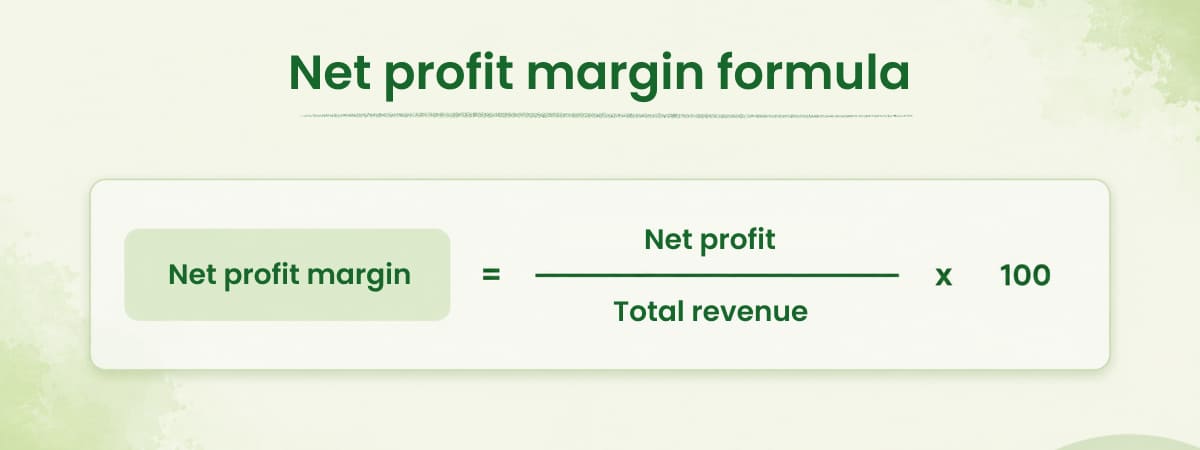
Say, your business generates, for example, the total revenue of $120,000 in a quarter. But, when we deduct all business expenses, the company settles with a net profit of $24,000.
- Net Profit = $24,000
- Total Revenue = $120,000
Calculation: (24000/120000) X 100=20%
As a result, the business retains 20% of its revenue as net profit. That means for every $1 earned in revenue, the company keeps $0.20 as actual profit after covering all expenses.
Why is net profit margin so important?
Below are a few reasons why calculating profit margin matters for any size of business.
1. Evaluating profitability
Calculating profit margin matters because it discloses how much profit you are generating in a defined period. You can evaluate how much of the amount can be kept aside from the total revenue. The same approach is also important in comparing performance with other businesses or previous periods.
2. Identifying current trends
Profit margin, when determined accurately, can also reveal ongoing financial trends. Which means you can see whether profits are growing, declining, or stable. These trends allow you to spot changing patterns and, accordingly, make adjustments to budget plans or operational strategies to mitigate any financial issues.
3. Financial projections
Net profit margin also comes in handy when predicting finances for the future. Because it utilizes both past and current profit margins to project your future earnings. That way, you can make robust budget plans and seize the right investment opportunities, aiding you in accomplishing financial goals early.
4. Decision-making
Since profit margin indicates the overall profitability of your business, it is way easier to make data-backed decisions. This also includes deciding whether to cut off some hard-hitting expenses or revise pricing strategies. That means you no longer have to rely on guesswork whenever making important decisions.
Improve your net profit margin with smart invoicing software
Calculating net profit margin is definitely important, but let’s not forget that improving it also matters even more. Today, businesses struggle to maintain healthy profit margins because of delayed payments, inaccurate invoicing, no track records, and scattered expense reports.
An accounting and invoicing software, Moon Invoice, can make a significant difference.
True. Designed for freelancers and small businesses, Moon Invoice facilitates the entire invoicing process, tracks expenses, and manages financial records.
Instead of manually managing spreadsheets or financial paperwork, businesses can automate daily billing operations and focus more on revenue growth. A key to maintaining a stronger net profit margin.
Moon Invoice’s features to gain better control over cash flow and profitability.
- Customizable invoice templates
- Smart expense tracker
- Online payment integration
- Financial reporting
- Tax-compliant invoices
- Recurring billing
- Bank reconciliation
Looking to maintain healthier profit margins?
Simplify your invoicing and expense tracking with Moon Invoice
AI invoicing
Accurate reports
Real-time sync
FAQs on Net Profit Margin
What is a good net profit margin?
What are the factors affecting the net profit margin?
Is a 30% profit margin too much?
What does a 20% net profit margin mean?
Is there any online profit margin calculator?


Jayanti Katariya is the founder & CEO of Moon Invoice, with over a decade of experience in developing SaaS products and the fintech industry. He holds a degree in engineering. Since 2011, Jayanti's expertise has helped thousands of businesses, from small startups to large enterprises, streamline invoicing, estimation, and accounting operations. His vision is to deliver top-tier financial solutions globally, ensuring efficient financial management for all business owners.