


Quick summary:
Pressure washing job pricing depends on factors such as property size, surface type, labor requirements, equipment costs, cleaning complexity, and profit margins. In the U.S., the average cost of a pressure washing service starts at $150, depending on the type of washing required and the surface material. Contractors can use flat-rate, hourly, project-based, or per-square-foot pricing models.
Spray water, rinse it off, and done. Most of us think this is how pressure-washing jobs work, but that’s not entirely true. Sometimes pressure washing jobs are completed within a few hours, while others take longer due to deep-seated oil or staging.
So, how should you price pressure-washing jobs to keep your business profitable?
You need to consider all your cost factors, such as the quality of materials used, the time required to provide the service, labor costs, and current competitive rates.
Below is a detailed pressure washing pricing guide for contractors looking to price their services accurately and win more projects.
Let’s jump straight in…
📌 Key Takeaways
- The average cost of pressure washing services in the U.S. ranges between $150 to $500.
- Flat-rate, hourly, and per-square-foot pricing are the most common strategies for pressure-washing jobs.
- Inspecting the location and identifying the scope of work is the first step of pricing a pressure washing job.
- Measuring the surface area and evaluating the cleaning requirements are key steps of pricing a pressure washing job.
- Accurate pricing of pressure washing jobs vastly depends on the labor, equipment, and materials costs.
- Offer limited-time deals to customers to stay competitive in the pressure washing industry.
What are pressure washing services?
A pressure washing service refers to using high-pressure water spray, i.e., a PSI (Pounds per Square Inch) range between 1,300 and 2,000, to clean exterior surfaces from dirt, mold, algae, grime, and other contaminants. Generally, pressure washing services are used to clean sidewalks, driveways, fences, roofs, and exterior surfaces of buildings to restore their appearance and extend their lifespan.
As a contractor or pressure-washing service provider, when pricing, you need to consider several factors, such as the type of surface and the level of dirt buildup. labor requirements, and the equipment required to clean the area.
Losing jobs due to slow estimates?
Speed up your quoting process and deliver accurate estimates to customers without the paperwork.
Average pressure washing prices for 2026
In 2026, the average cost for pressure washing jobs ranges between $150 to $500, depending on the type of washing requirement.
In the U.S., the power washing prices for smaller projects such as sidewalks or driveways are quoted by the project, whereas larger commercial concrete areas are often priced by the square foot, ranging between $0.10 to $0.50.
Common pricing strategies for pressure washing jobs
There are no fixed prices for pressure washing jobs, and different power washing jobs require different strategies to stay competitive in the market.
If you’re new to the industry, you’ve probably asked yourself questions like, “how to price pressure washing jobs” or “how much to charge for pressure washing.” The answer to these questions always varies because each project has unique requirements, such as property size, surface type, labor needs, and cleaning complexity.
Here are the four effective strategies you should follow:
1. Flat-rate pricing
Flat-rate pricing refers to charging a fixed amount for a specific service regardless of the time or labor requirement. For example, contractors may charge a fixed cost for cleaning a driveway or patio.
A flat-rate pricing strategy suits many customers, as they know the total cost before the work begins. Newly started businesses or pressure washing service providers that focus on limited services generally use flat-rate pricing estimates, as it is much easier to create than other pricing strategies.
2. Hourly pricing
When customers are billed based on the amount of time spent to complete the job is called hourly pricing. This pricing strategy for pressure washing jobs is utilized when the scope of work is not clear, or cleaning conditions change from one place to another (in the same project).
Hourly pricing helps contractors cover costs for unexpected challenges such as heavy stains, thick, oily surfaces, or difficult-to-access areas. However, customers may hesitate to accept hourly estimates if the cost feels slightly higher.
3. Per square foot pricing
It is one of the most commonly used pricing strategies for estimating pressure washing costs. In per-square-foot pricing, contractors charge customers based on the total area to be cleaned.
This pricing strategy is ideal for large surfaces where measurements can be accurately calculated. When estimates are prepared using this pricing strategy, customer get better clarity of their charges as the cost is tied directly to the size of the area.
4. Project-based pricing
Project-based pricing is one of the most complex strategies because multiple factors are considered, such as labor, equipment usage, cleaning solutions, overhead expenses, and the desired profit margin. Contractors share a complete project estimate, including an itemized list, with the customer rather than an hourly or unit-based rate.
Project-based pricing applies to large residential and commercial cleaning projects where greater pricing accuracy is a priority. This pricing strategy helps pressure washing companies generate a consistent profit margin across different types of pressure washing services.
Steps to price a pressure washing job
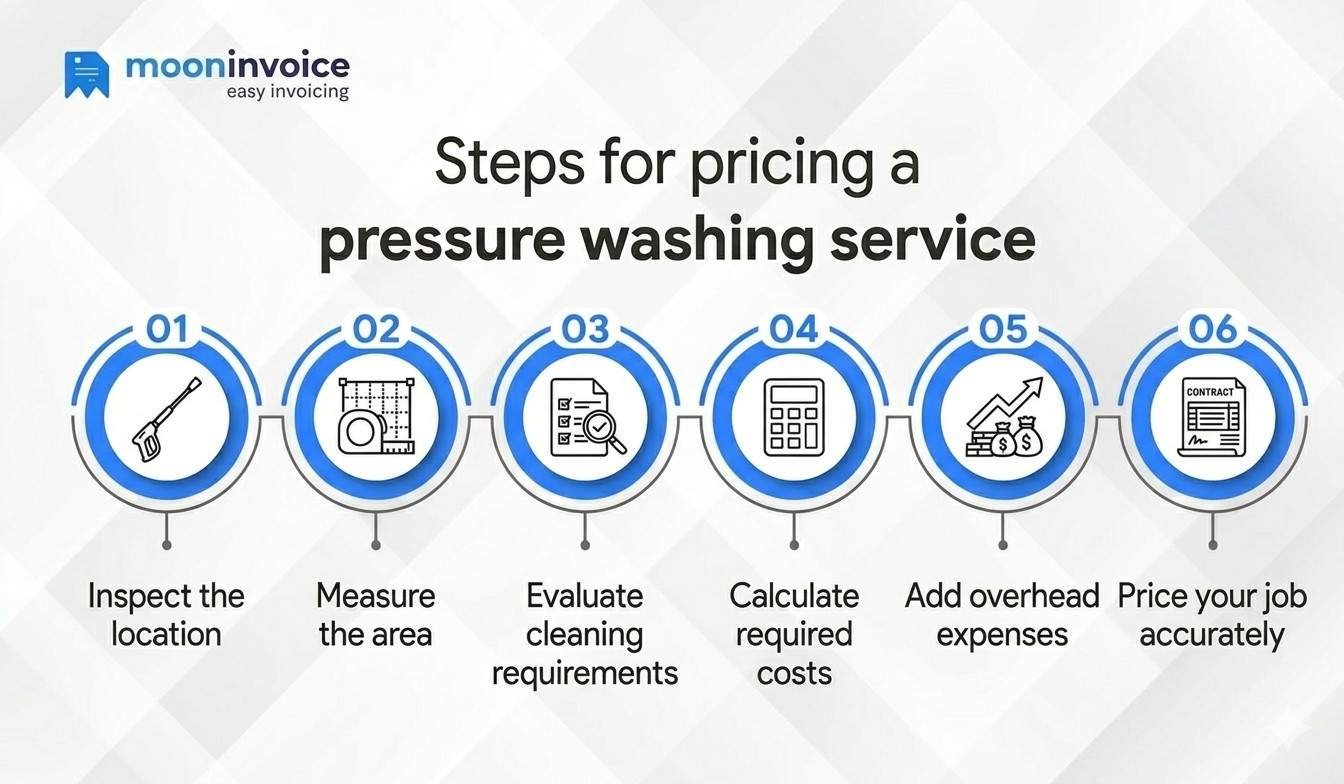
Pricing a pressure washing job may seem simple at first, but determining an accurate rate involves much more than estimating the time required to complete the work.
To price your pressure washer job accurately, below are the steps you must consider:
Step 1: Inspect the location
Before preparing power washing estimates for your business, first, you need to visit the location and identify where exactly cleaning is required. Pay attention to the surface, such as sidewalks, driveways, decks, roofs, building exteriors, etc., so that you can assess properly. This inspection is key to determining the size of the job, the level of dirt or stain, or any obstacles that may appear during the cleaning process.
During the inspection, make sure you note key factors such as algae buildup, mold growth, oil stains, and hard-to-reach surfaces, which may require specialized cleaning methods. Once you get complete clarity on the scope of work, you can create estimates that help you get the client’s approval easily.
Step 2: Measure the area
After inspecting the area thoroughly, the next step is to measure the entire area that needs cleaning. If you are estimating with per-square-foot pricing, this step becomes even more crucial as inaccurate measurements will result in unjustifiable prices. You need to measure the length and the width of the entire surface, and then calculate the total square footage.
When your measurements are correct, you will be easily able to estimate cleaning solution consumption and overall project duration more effectively. This way, you reduce the risk of underquoting or overcharging customers.
Step 3: Evaluate cleaning requirements
Once you correctly measure the cleaning area, determine all the area’s cleaning requirements. Every pressure washing job won’t require the same amount of effort, equipment, or cleaning solutions. Some surfaces won’t require much effort and only need basic cleaning, whereas others may require specialized cleaning to remove stains.
Consider the following when you evaluate cleaning requirements:
- Surface types such as concrete, wood, brick, marble, or any other type
- Level of contamination, such as heavy dirt, mold, oil stains, algae, and rust marks
- Level of difficulty to reach the cleaning area, such as multi-story exteriors or rooftops.
- In case it requires a special type of cleaning, such as soft washing, pre-treatment chemicals, or post-cleaning protective coatings.
Evaluating these factors helps determine the amount of resources required for the job.
Step 4: Calculate required costs
After having clarity on cleaning requirements, you need to calculate all direct costs involved in completing the job. These costs include labor, equipment, fuel, water usage, and cleaning solutions. Calculating these expenses is key to covering operational costs involved in the pressure washing job.
Considering the size of the surface, find out how many workers are required and how long the job will take to complete. After that, calculate equipment-related expenses such as fuel, maintenance, and depreciation. In case the project requires specialized soft-washing chemicals or degreasers, include those costs as well.
Calculating labor, equipment, and material costs while preparing the estimate highlights the true cost of the job and reduces the risk of getting unexpected expenses in the ongoing project.
Step 5: Add overhead expenses and a profit margin
Once you know your direct costs, next you should calculate the overhead expenses of your pressure washing job. Overhead costs are not the expenses that are directly connected with the project, but are necessary to keep the business operations going. It includes vehicle expenses, marketing costs, office supplies, licensing fees, etc.
After you determine the overhead cost, next you need to add a profit margin that helps your business grow and sustain in the long-run. Calculating profit margin is a complex task, and there is a chance you may commit errors. To add a profit margin more accurately, you should consider using a profit margin calculator. It will help you find the appropriate markup based on your total costs and desired earnings.
This step ensures you maintain a healthy profit margin for your pressure washing business.
Step 6: Price your job accurately
The final step is to price your pressure washing job accurately. You can consider using an online estimate generator to avoid messy paper-based work and create digital estimates effortlessly. With power washing estimate templates, you can create quick, error-free estimates that increase your chances of securing approval from potential customers.
So, if you want to create a pressure-washing estimate that helps you acquire pressure-washing jobs without much hassle, the section below is for you.
How to estimate pressure washing prices?
You can estimate your pressure washing prices by following the steps below:
- Find a reputable online estimate generator
- Add your business name, logo, and contact information
- Include the customer’s name, address, and contact details
- Must add estimate number and issue date
- Fill in a detailed description of all services to be performed
- Clearly specify itemized costs for labor, materials, and additional services
- Double-check the auto-generated estimated price for the pressure washing job
- Lastly, include payment terms and special notes related to the estimate
After creating an estimate, review all details carefully and make sure there are no unnecessary costs that can reduce your chances of approval. When the customer clearly understands the scope of work and pricing, you are most likely to win the job.
Commercial pressure washing vs. residential pressure washing
Commercial and residential pressure washing are very different, and so are their prices.
In the U.S., the average residential pressure washing pricing ranges between $150 to $900 per project, depending on the surface material and local labor rates.
On the other hand, commercial pressure washing jobs generally cost between $0.10 to $0.50 per square foot or $75 to $150 per hour. For commercial projects, factors such as the type of property, the level of stain buildup, and accessibility may influence pressure washing prices.
The comparison table below explains how commercial and residential pressure washing services differ.
| Basis of comparison | Commercial pressure washing | Residential pressure washing |
|---|---|---|
| Property type | Office buildings, warehouses, parking lots, retail stores | Homes, driveways, patios, decks, fences |
| Job size | Large-scale cleaning projects | Small cleaning areas |
| Pricing strategy used | Mostly project-based or per-square-foot pricing | Flat-rate, hourly, or per-square-foot pricing |
| Equipment requirements | Commercial-grade equipment and specialized tools | Standard pressure washing equipment |
| Labor needs | Mostly requires a larger crew | Usually 2-3 workers |
| Time required | May take several days depending on project scope | Typically completed within a few hours |
| Profit potential | Higher revenue and profit opportunities per project | Consistent but comparatively smaller profits per job than commercial pressure washing |
Cost of pressure washing jobs
Generally, small business owners prefer flat-rate pricing for the clarity it provides without requiring complex calculations. However, there are two other strategies for pricing pressure washing jobs that small business owners choose: hourly pricing and per-square-foot pricing.
Let’s understand the price range of these two pricing strategies.
1. Pressure washing cost per hour
The average hourly pressure washing cost in the U.S. starts from $50 to $100 or more, based on labor needs, location, and surface material.
Hourly pressure-washing rates vary across cities in the U.S.
- New York City: $79 per hour
- Boston: $70 per hour
- Chicago: $66 per hour
- Miami: $56 per hour
- Los Angeles: $52 per hour
- Seattle: $52 per hour
- Denver: $49 per hour
2. Pressure washing cost per square foot
The cost of pressure washing jobs in the U.S. ranges from $0.10 to $0.50 per square foot, with a national average of $0.20 to $0.40 per square foot. In most pressure washing projects, the total cost usually falls between $150 and $500, depending on the location, surface material, and severity of the grime.
Different surface types have different prices per square foot.
- Driveways, walkways, and patios: $0.10 to $0.35 per square foot
- House siding (Vinyl, Brick, Stucco): $0.15 to $0.40 per square foot
- Decks and fences: $0.35 to $1.50+ per square foot (due to soft washing of wood)
- Roofs: $0.30 to $1.00 per square foot (also requires soft wash to protect shingles)
Quick tips to offer competitive pressure washing rates
Here are a few tips you should consider to offer competitive pricing for your pressure washing job:
- Offer limited-time deals: You can offer discounts or flat-rate deals for customers to engage and book your services quickly. This strategy especially works well for the off-season.
- Bundle packages: Individual pricing may not attract a large customer base; instead, create bundled packages that offer greater value. For instance, you can combine driveway, patio, and fence into a single package at a discounted price.
- Research local market rates: To thrive and gain more projects in the pressure washing job, you should closely monitor what your competitors are charging for similar services. When you know local market prices, you understand whether you have priced too high, too low, or accurately.
Smartly estimate pressure washing jobs with automation software
Whether you are a startup or a well-established business, one thing you can’t ignore is providing accurate estimates to your potential customers. If your pricing is inaccurate and details are not mentioned properly, you will lose more projects than you win. And slowly, your business could collapse due to a shortage of funds or incoming cash flow.
So, what should you do to consistently win projects? The simplest answer is to create professional estimates using the right estimate software.
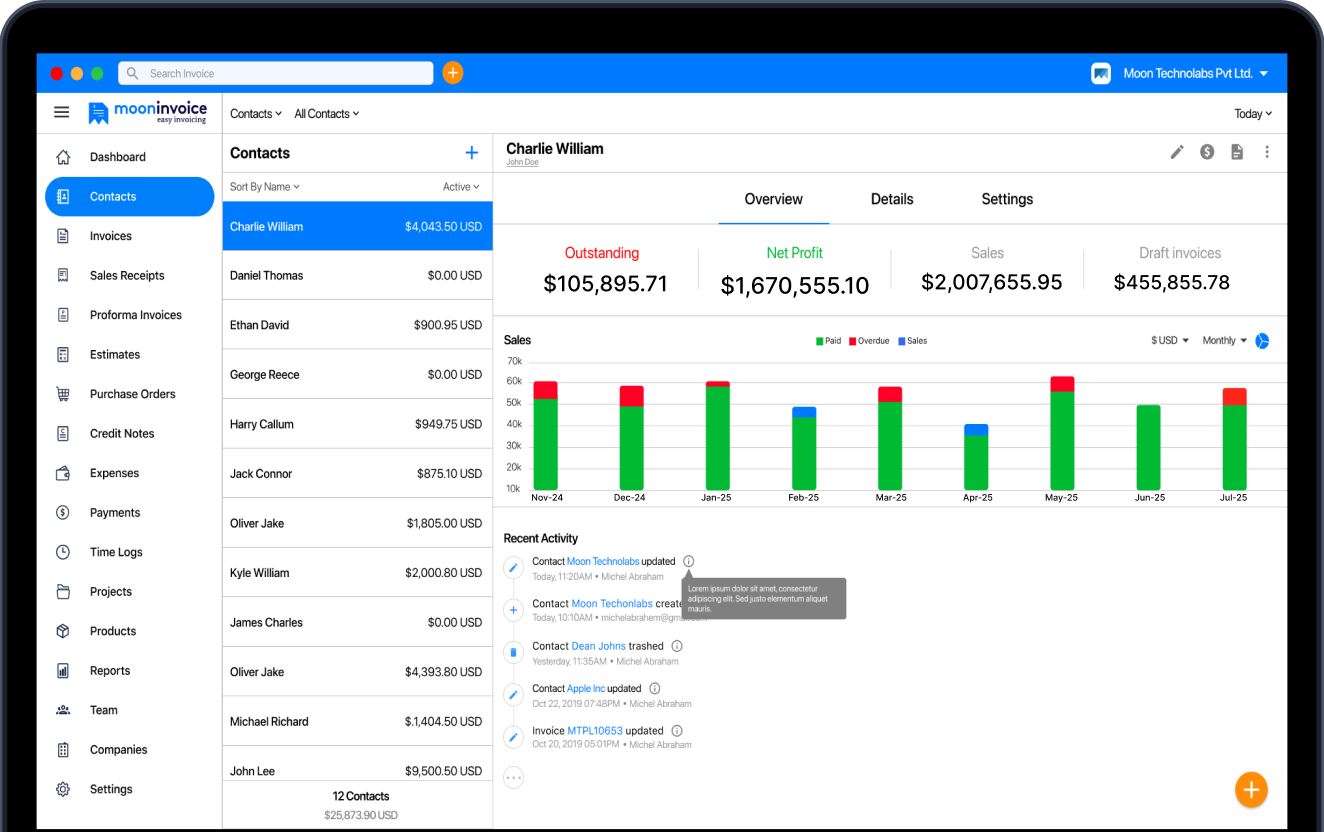
You can consider Moon Invoice, an AI-powered estimate software that helps you choose from over 66 customizable templates to create pressure washing estimates. Once the potential customer approves the estimate and you finish the project, you can quickly convert the same estimate into an invoice with a single click.
Sign up today and create estimates with the 7-day free trial now.
Additional Questions on Pressure Washing Prices
How much should I charge for pressure washing per hour?
What is the average pressure washing price per square foot?
How do I estimate a pressure washing job accurately?
What factors affect pressure washing pricing the most?



Jayanti Katariya is the founder & CEO of Moon Invoice, with over a decade of experience in developing SaaS products and the fintech industry. He holds a degree in engineering. Since 2011, Jayanti's expertise has helped thousands of businesses, from small startups to large enterprises, streamline invoicing, estimation, and accounting operations. His vision is to deliver top-tier financial solutions globally, ensuring efficient financial management for all business owners.