

TL;DR
Markup and margin are two related but different concepts of profit. Markup is the amount that is added to the cost price to determine the selling price. Margin, on the other hand, is the percentage of profit earned from the selling price. Business professionals can easily evaluate the profitability and set accurate pricing.
Do you often get confused over markup vs margin? The two terms are interrelated but differ in their use.
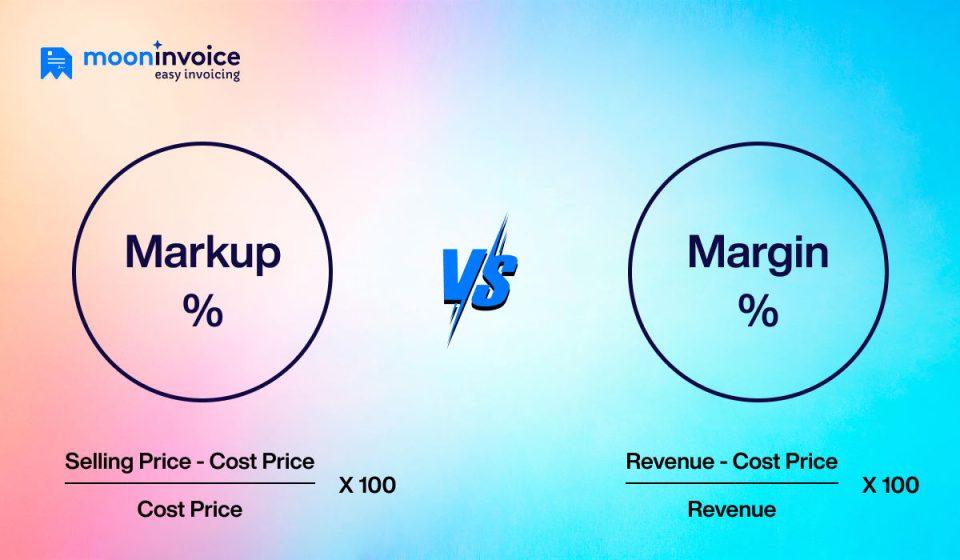
Markup is the percentage of the profit based on the cost price, while margin is the percentage of profit based on the selling price. Also, markup is based on the cost, and margin is based on the selling price.
Understanding markup and margin differences is crucial, as it helps set clear pricing strategies for your products and services. Additionally, it also contributes to cost control, better financial decisions, and maintaining a healthy profit level.
📌 Key Takeaways
- Markup vs profit margin refers to two different ways of measuring & understanding the profit.
- Markup is the percentage difference between the cost of goods sold and the selling price.
- Margin is the percentage difference between the selling price and the profit.
- Markup is primarily used to set product prices, whereas margin measures a business’s profitability.
- Markup and margin are calculated differently.
- Understanding the profit margin vs markup helps achieve accurate pricing and better profit management.
- The markup percentage is usually higher than the margin percentage for the same product.
What is Markup?
Markup is the amount that is added to the cost of a product or service to determine its selling price and earn a profit. In simple terms, markup is the extra amount that is added to the cost to make a profit.
It means that, through markup, you specify how much extra you are adding to the charge. Companies use markup percentages to maintain profitability. Industries such as construction, retail, or service-providing companies use markup.
What is Margin?
Margin or gross margin profit is the percentage of the profit that a business earns from its selling price after deducting all expenses. It means the profit the company makes from selling a product or service, after deducting its costs.
Thus, it shows how much profit the company makes per sale. Margin represents the percentage of the selling price that is actual profit.
Markup vs Margin: Know the Difference
Let’s understand the difference between markup and margin. However, before digging into the concept, you need to understand the following terms.
Cost of Goods Sold (COGS): The cost incurred to manufacture a product or provide a service.
Revenue: It is the income that the company earns by selling the product or service before any deduction. Revenue is always reported on the top line of the income statement.
Gross profit: The net revenue/profit that the company earns after deducting COGS from the total revenue.
Difference Between Markup and Margin On Various Aspects
Definition
Markup is the percentage added to the cost of goods or services. Margin refers to the profit percentage the business owner earns on a product or service.
On the Basis of the Calculation
Markup is calculated from the cost and represents the profit added to the cost to arrive at the selling price. On the other hand, the margin is calculated as a percentage of the selling price to determine the profit component.
Impact on the Pricing Strategy
Margin versus markup also highlights the effect on the pricing strategy. Markup is useful for
setting the selling price by adding an amount to the cost price. Margin, on the other hand, represents how profitable the pricing decisions are.
Financial Reporting Effect
Stakeholders primarily focus on margins to assess the business’s overall profitability. Markup percentages are less valuable to them for financial reporting and understanding the business’s financial health.
Effect on the Profitability
A higher markup does not necessarily result in a higher margin. It is because both are calculated differently. For instance, if you set your markup to 100%, the margin will be 50% (the markup-to-margin conversion formula is explained below). Also, one cannot set a very high markup. It can lead to low sales volume, further reducing overall profitability.
Markup vs Margin – Comparison
| Aspects | Markup | Margin |
|---|---|---|
| Definition | The percentage that is added to the cost price to set the selling price. | The percentage of profit gained from the selling price. |
| Calculation base | The calculation is based on the cost. | The calculation is based on the selling price. |
| Purpose | It is useful for pricing products or services. | It is useful to measure profitability. |
| Formula | (Selling Price – Cost Price)/Cost Price x 100 | (Selling Price – Cost Price)/Selling Price x 100 |
| Usage in business | Professionals use markup for pricing strategies and quotations. | Professionals use margin for financial analysis and reporting for their business. |
| Value Difference | Markup is always higher than the margin for the same product. | Margin will always be lower than the markup. |
| Used by | It is used by the sales department and purchasing departments. | It is used by external departments like investors and bankers. |
Stop Guessing & Send an Accurate Estimate
Choose our 66+ customized templates for fast & accurate estimating.
How to Calculate Markup? Step-By-Step Guide With Example
Calculating markup is essential for businesses to develop better pricing strategies. Also, it ensures the business achieves strong profitability and covers the additional costs. It also improves financial planning.
Before we understand how we calculate the markup, we must understand its formula, which is explained below:
Markup Formula
or
Step-by-Step Margin Calculation
1. Identify the Cost Price
The initial step is determining the cost price. The price will include all the direct costs (material or labor) and indirect costs (overhead or shipping).
2. Determining the Selling Price
Next, the selling price is the price you charge the customer for the product or service. Include all costs, including materials, overhead, and labor. The selling price should be in line with market prices and competitors’ pricing.
3. Calculating the Profit
Once you determine the cost price and selling price, you can compute the profit. Easily determine the profit by subtracting the cost price from the selling price.
4. Find the Markup Ratio
Next, find the markup ratio using the markup formula. Simply, divide the profit by the cost price to find the markup ratio.
5. Converting to a Percentage
To convert the result to a percentage, multiply it by 100.
Example of Markup to Understand the Calculation
Let’s understand the calculation through the markup example. Suppose a seller bought the product at $600 and wants to sell it at $1000.
Selling price = $1000
Cost price/COGS = $600
Determining the profit = Selling Price – Cost Price
Profit = $1000 – $600 = $400
Now, applying the markup formula
Markup = [(Selling Price – Cost Price)/Cost Price] x 100
= (Profit/Cost Price) x 100
400/600 x 100 = 67%
So the markup percentage is 67%.
How to Calculate Margin? Step-By-Step Guide With Example
Calculating the margin means you determine the percentage you earn on your selling price. A higher margin means good profit, while a lower margin means small profit. Before calculating the margin, you need to understand its formula as follows:
Margin/Profit Margin Formula
or
The formula can also be written as
or
Step-by-Step Margin Calculation
1. Determining the Revenue
The first step in calculating the margin is to identify the product or service’s total selling price (revenue). It clearly means considering the earnings before any deductions are made.
2. Find the Cost Price
Once you determine the revenue, the next step is finding the cost. The total cost that is incurred in producing the product or the service.
3. Calculate the Profit
Determine the profit by subtracting the cost price from the selling price (or revenue).
Profit = Selling Price/Revenue – Cost Price
4. Calculate the Margin
Once you have all the values, the next step is to determine the margin. The simple calculation is dividing the profit by the selling price.
5. Converting to a Percentage
Once you determine the margin, express it as a percentage by multiplying it by 100.
Margin Example to Understand the Calculation
Taking the same example above, we now understand the practical, real-life scenario. Here,
Selling price/ Revenue = $1000
Cost price/COGS = $600
Profit = Selling price – cost price
= $1000 – $600
= $400
Now, to calculate profit margin, you need to use the following formula
Margin = Profit/Revenue x 100
= 400/1000 x 100
= 40%
So the profit margin percentage is 40%.
Markup Margin Conversion Chart
The table below shows the relationship between markup and margin. It represents that the margin is always lower than the markup. As the markup increases, the margin value increases at a slower rate. Additionally, you can quickly use this table to find the margin for a given markup.
| Markups | Margin |
|---|---|
| 15% | 13% |
| 20% | 17% |
| 25% | 20% |
| 30% | 23% |
| 33.33% | 25% |
| 40% | 28.6% |
| 43% | 30% |
| 50% | 33% |
| 75% | 42.9% |
| 100% | 50% |
But what about any other percentage that is not mentioned in this table? Here, you need to use the conversion formula as follows:
Markup to Margin Conversion Formula
Suppose your product margin is 40% and you want to know the markup. You can know that straightforwardly by using the above formula:
Markup = [0.4/(1-0.4)] x 100
0.4/0.6 x 100 = 66.667 =~ 67%
So, to achieve 67% of the gross profit margin, you need to set up a 40% margin.
Margin to Markup Conversion Formula
Let’s assume you set a 30% markup on your product and want to know what margin it will yield. Simply put it using the above formula:
Margin = [0.3/(1+0.3)] x 100
= 0.3/1.3 x 100
= 23%
So, you will get a 23% margin when setting up the markup of 30%.
When to Use Markup and Margin?
Choosing the markup and margin depends on the business context.
When to Use Markup
- Whenever you want to decide how much percentage you want to add to the cost price of the product or the services.
- When there is a need to prepare the sales quotes or the proposals quickly and accurately.
- To ensure that expenses like material, shipping, and labor are covered before calculating the net profit.
- Markup is also useful when a fast method is needed to convert cost to selling price.
When to Use Margin
- To evaluate profitability, because it shows the percentage of sales that is actual profit.
- To analyse the financial reporting to track the gross, operating, and net profit.
- Business professionals can use margin to adjust the pricing.
- Margin is also useful in determining which product is working well.
Opt for Transparent Billing for Greater Reliability
Create error-free invoices with the auto-calculation feature of our customized invoice templates of Moon Invoice.
Last Remarks
Markup and margin are two related but different terms. Markup primarily focuses on the cost price and is used to determine the selling price. Margin, on the other hand, focuses primarily on revenue when determining profitability. You must understand the markup vs margin explained above because it helps analyze a business’s profitability and financial performance.
FAQ
What is the difference between 30% margin and 30% markup?
A 30% margin means 30% of the selling price is profit. Similarly, a 30% markup means you add 30% to the item’s cost price.
Is 30% profit margin too high?
A 30% profit margin is not considered too high, but it is considered healthy and strong. It indicates strong cost management.
Should I use markup or margin?
It all depends on what you want to do, either pricing or profit analysis. Markup is the right choice when you know the cost and want to add the profit percentage. It means it helps to analyze how much to charge. Margin is the right measure for understanding how much profit is actually generated from sales.
What is a good markup percentage?
A good markup percentage ranges from 50% to 100%. However, it all depends on the industry, cost & competition. A good markup should cover all the costs and provide a healthy profit. Higher markup doesn’t always lead to higher profit margin.
Which is better for pricing: markup or margin?
It depends on the need. Markup is better for creating estimates, quotes, and consistent price setting. It is because you add the desired percentage to the cost in order to cover the profit. Margin is better for analyzing the actual profit earned from the sale. It is calculated based on the revenue.



We at Moon Invoice, are the best minds behind smarter invoicing and seamless business growth. We love to solve financial problems and keep providing effective tips through our blogs, newsletters, and social media channels. As a team, we continue exchanging ideas about growing financial challenges and smart use of automation tools.