


What is a recurring expense?
Recurring expenses are ongoing costs that businesses incur at regular intervals and are necessary to run their daily operations.
Every business runs into money troubles now and then. Some expenses are predictable while others hit out of the blue. Either way, you have to keep enough funds handy to cover the essentials that keep your business running.
The cost that comes due every month is what deemed as recurring expenses. Well, it feels like never-ending chaos (much like your financial stress). The more you try to manage them manually, the more difficult it becomes. Isn’t it?
That’s exactly why businesses are adopting expense management tools. a market that is growing rapidly and is poised to reach USD 17.26 billion by 2034.
Here, we will walk you through what is a recurring expense, its impact, common examples and top expense management solution.
Want a TL;DR before we dive in? Here you go.
- Recurring expenses are consistent on a routine basis and are essential for your daily operations.
- The best way to track recurring costs is to perform audits regularly, or else it can result in revenue misalignment.
- Employees’ salaries, the company’s insurance, and utility bills are some recurring cost examples.
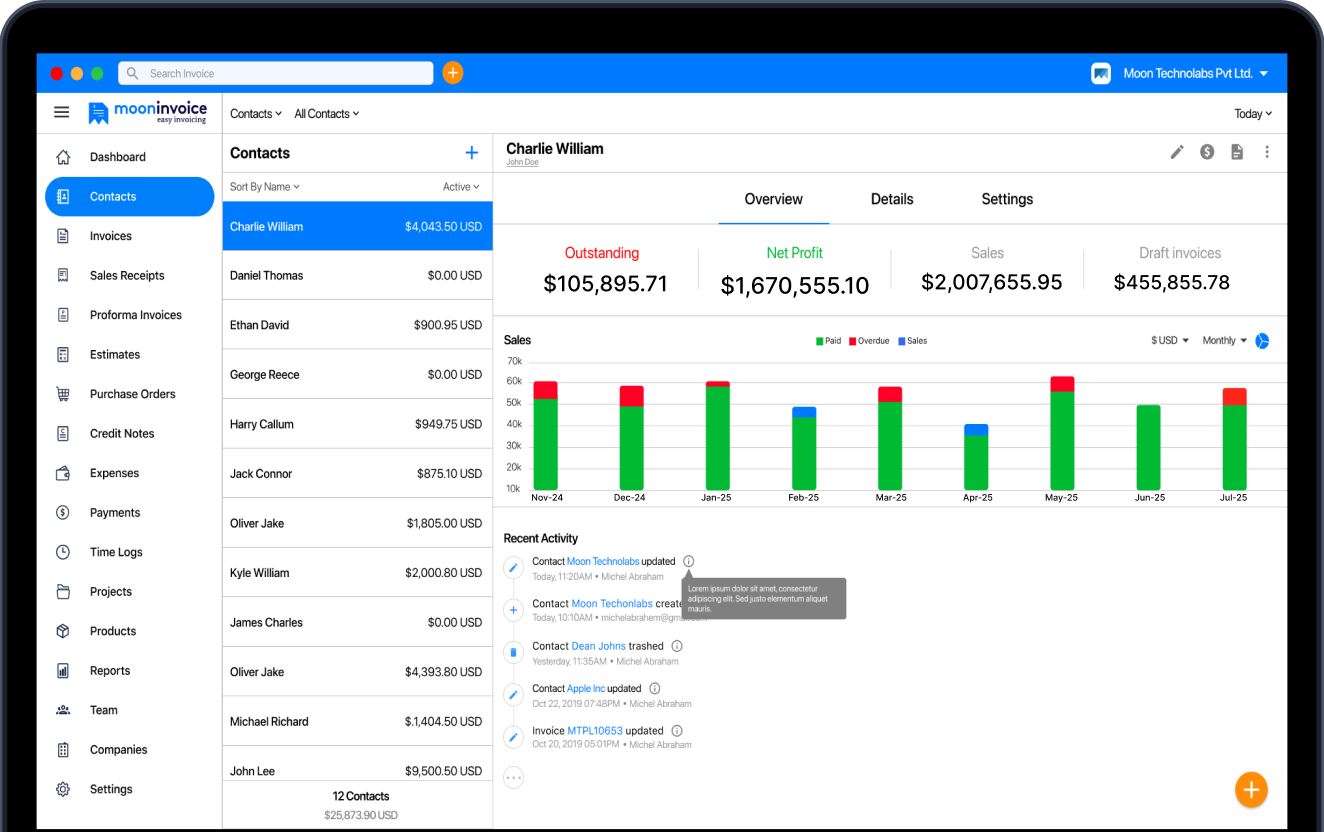
- Moon Invoice can let you categorize and manage expense logs so easily that you can track them on the go.
What Are Recurring Expenses?
Recurring expenses are foreseeable costs that enable businesses to run their preliminary operations without any disruptions.
These expenses are due on a monthly or yearly basis, which means businesses have no choice but to pay them. They can plan their finances in advance to ensure sufficient funds are available to perform financial obligations.
Suppose you own a marketing agency in downtown Chicago, where you need to pay $3000 in office rent every month. Now, this isn’t something that is part of your business revenue, so no matter what your net revenue is, you need to pay $3000 to continue operating your business from the office in Chicago. Here, the rent payment collected every month is classified as a recurring cost.
Sick of Managing Expenses on Spreadsheets?
Automate managing expenses with Moon Invoice and ensure your team doesn’t get burned out quickly.
Now that you know recurring expenses definition, let’s check out the impact of recurring expenses.
What’s the Impact of Recurring Expenses?
Sure, these expenses are predictable, but they can soon take a toll on your budget because they can quietly eat a significant portion of the total revenue. Consequently, you might miss out on growth opportunities and long-term investments. This means what once felt affordable can later turn into a heavy financial commitment.
Below are the factors that may disrupt financial stability if recurring costs are not monitored carefully.
1. Subscription Overload
Buying multiple software subscriptions at once can impact the company’s overall budget. Chances are, you might end up paying for subscription plans that you may rarely use or may not use at all.
2. Revenue Gaps
No matter if you are dealing with seasonal or temporary dips, recurring payments can create an imbalance between your income and expenses. This unwanted mismatch can drain your reserve funds and put immense pressure on your cash flow.
3. Long Commitments
Sometimes you may have annual agreements or contracts that you no longer need or that no longer deliver value. Continuing to pay for such long commitments can be a reason behind reduced profitability.
How to Categorize and Track Recurring Expenses [Best Practices]
Managing recurring expenses may seem straightforward, but here’s the catch: inconsistency can disrupt your entire budget plan. So, below are some best practices to categorize and track them effectively.
1. Conduct Audits Religiously
The foremost way to track recurring expenses is to perform audits on a regular basis. Ask your team to keep an eye out for bank statements, corporate cards, and expenses reports as well. This practice will help you spot changing patterns in recurring costs.
2. Prioritize Digital Receipts
Save digital expense receipts instead of paper copies, which often disappear when you need them the most. Make a habit of logging expense receipts in software, which not only aids you in categorizing them but also in tracking expenses without any hassles.
3. Review Subscriptions & Contracts
Keep reviewing current subscriptions and contracts that are still in use. Check whether multiple teams are paying for similar services. If so, urge them to use a single shared tool. A practice that will aid in tracking and deciding if you really need to renew them.
4. Set up Expense Policy
Seek an expert’s advice and create an expense policy that everyone must comply with. Defining a clear policy will surely prevent overspending and make it easier to track recurring costs. Also, it will list out potential consequences, so there will be no policy violations.
Common Examples of Recurring Expenses
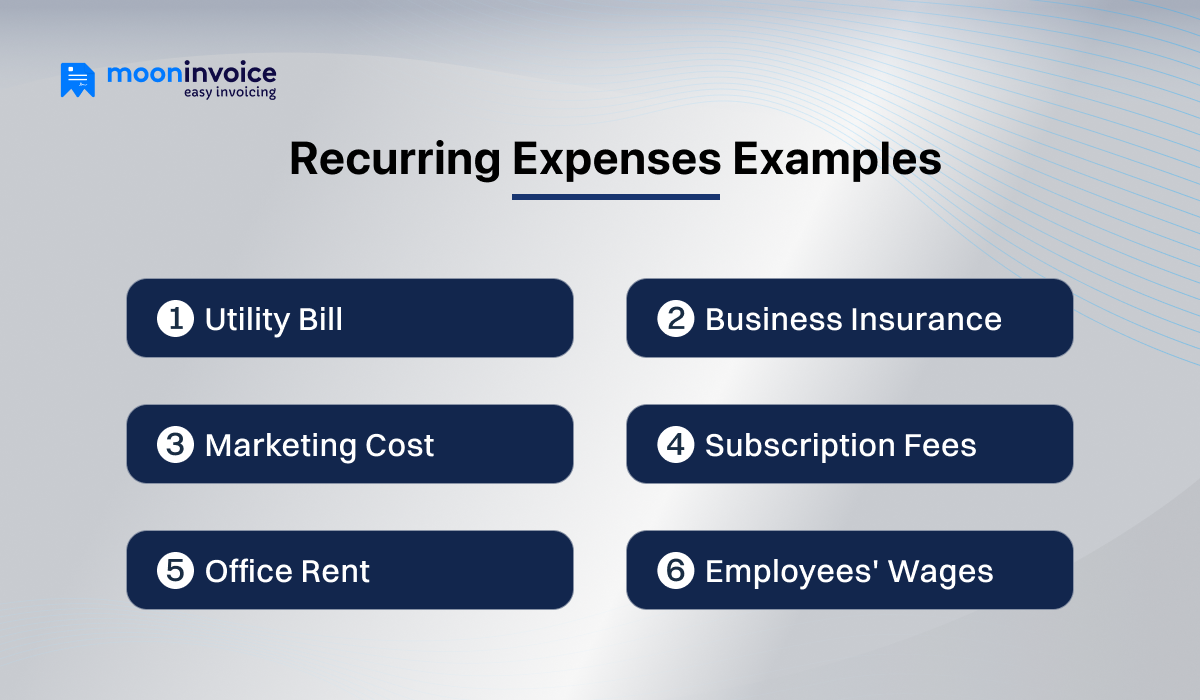
Below are some recurring expenses examples that businesses usually encounter:
1. Utility Bill:
Electricity, or internet bills that are much-needed to operate your daily activities, are recurring expenses.
2. Business Insurance:
Insurance premiums you pay to shield your business from unwanted liabilities are referred to as recurring costs.
3. Marketing Cost:
If you have hired a marketing agency to advertise your services, you need to pay monthly charges, which are recurring costs.
4. Subscription Fees:
In case you have tools like design tools or HRM software, the money you pay regularly is a recurring expense.
5. Office Rent:
Lease payments for office space are an essential part of business operations and count as recurring expenses.
6. Employees’ Wages:
The paychecks you give to the employees every month also fall under recurring expenses.
Manage Recurring Expenses Tirelessly With Moon Invoice
Trust us. Whether it is recurring expenses or non-recurring expenses, you can manage all with Moon Invoice. Unlike manual expense tracking, you only need a few clicks when it comes to tracking recurring expenses or non-recurring expenses. But, how? Here’s the detailed explanation.
1. Record an Expense
Soon after you log in to Moon Invoice, start storing expense receipts digitally instead of making handwritten receipts on paper. Vendor name, currency, date, payment method, and necessary documents are a few things you need to enter whenever you create an expense receipt. Here are the quick steps you need to follow.
- Launch Moon Invoice App
- Purchases > Expenses
- Click on the “Create an Expense” button or the “+” icon
- Include necessary details, along with required documents
- Save changes to record the expense.
Similarly, you can add as many expense receipts as you want and centralize your business spending in a single invoicing platform.
BONUS:👉You can even add specific expense categories on Moon Invoice.
2. Generate Expense Report
No matter how many expense receipts you save, you can generate a comprehensive expense report in a couple of steps. For that, you need to go to the “Reports” tab from the main menu and find the expense report under “Purchases & Expenses”. By tapping on it, you can see all expense reports on a single screen.
3. Track Recurring Costs
Once the expense report is ready, you can use the smart filtering option to find the desired expense record. You can either choose date-wise or category-wise filter options to quickly get recurring expenses (and even non-recurring expenses). If required, you can also search expense records by vendor’s name.
Is Manual Tracking Holding You Back?
Moon Invoice takes a lot of stress out of expense management.
Categorize expenses
On-the-go tracking
Detailed reports
Final Thoughts About Recurring Costs
Simply put, recurring expenses are consistently occurring costs associated with your business activities. Whereas, non-recurring ones come out of nowhere and are not linked with any operations. Knowing the difference between these two is as important as sketching out your financial plan. After all, they offer a bigger picture of your business’s financial health.
Adopt tools like Moon Invoice and start managing recurring expenses without any extra effort. It not only lessens your administrative burden but also centralizes your tax data, helping you cope with the tax season with ease. Ditch paper-based receipts and embrace Moon Invoice by grabbing a free 7-day trial.
Recurring Expenses FAQs
What happens if I don’t review my expenses?
How often should I update my budget?
Can recurring expenses be tax-deductible?
Why are recurring expenses important to track?
Can recurring expenses be automated?



Jayanti Katariya is the founder & CEO of Moon Invoice, with over a decade of experience in developing SaaS products and the fintech industry. He holds a degree in engineering. Since 2011, Jayanti's expertise has helped thousands of businesses, from small startups to large enterprises, streamline invoicing, estimation, and accounting operations. His vision is to deliver top-tier financial solutions globally, ensuring efficient financial management for all business owners.