

Depreciation Definition:
Depreciation is the systematic allocation of an asset’s cost over its useful life that allows businesses to gradually reduce its value and accurately record expenses through depreciation accounting.
Driven by a digitally accustomed world, do you think business accounting has become easier?
When we say “accounting,” many people think of terms like revenue, expenses, or cash flow, but they often overlook one of the key accounting methods: “depreciation.”
It is one of those accounting methods that quietly shapes every business’s financial health, yet confuses many. Over time, the value of assets decreases, and this gradual loss in value of assets such as apartments, vehicles, or equipment is analyzed using depreciation methods.
So, how should you calculate depreciation, and most importantly, how many types of depreciation are there? Let’s find out all of these in this detailed blog.
📌 Key Takeaways
- Depreciation is a non-cash expense that is calculated for business assets.
- There are four major types of depreciation in business accounting.
- Depreciation is applicable only to tangible assets of the business, and intangible assets are amortized.
- To manage the expenses of your business, you should look for a reputable expense tracking software.
What is Depreciation in Accounting?
In business accounting, depreciation refers to the gradual reduction in the value of tangible assets of the business over time due to continuous usage, wear and tear, or obsolescence. Depreciation can also be defined as the process of allocating the cost of an asset (such as machinery or equipment) over its useful life instead of recording it as a one-time expense.
For example, if a business purchases a machine for $5,500 that is expected to last 6 to 7 years, depreciation allows the cost to be allocated over those 6 to 7 years rather than deducting the entire $5,500 in the first year.
A business records depreciation for multiple reasons, such as:
- Measuring profit more accurately
- Matching revenue with expenses
- Reducing taxable income
- Simplifying asset valuation
- Planning future asset investments
Depreciation ensures financial statements present a more realistic view of a business’s financial health.
Types of Depreciation
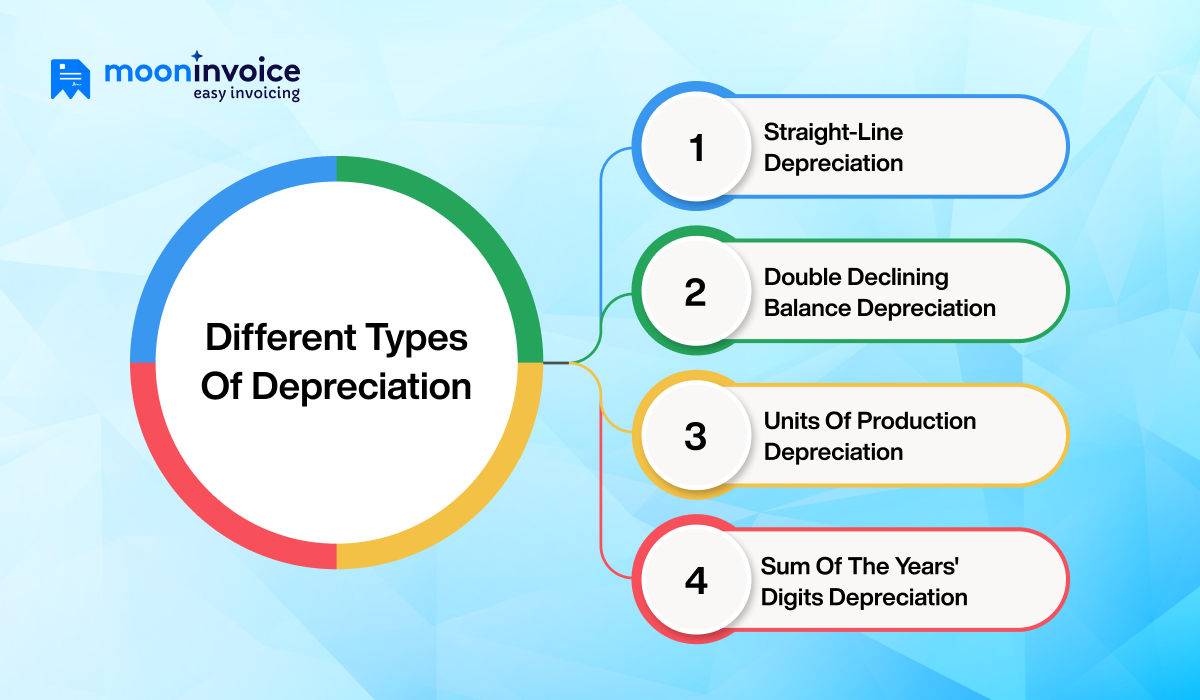
A business asset can be depreciated in multiple ways, and a business should choose the right depreciation method by correctly evaluating its asset usage, value decline, and financial goals. Each method differs from the others and has a different impact on asset depreciation.
Let’s find out the most common depreciation methods below:
1. Straight-line Depreciation
It is one of the most commonly used depreciation methods, where the primary goal is to calculate an asset’s depreciation cost by evenly spreading it over its useful life. Businesses using the straight-line depreciation method find it easier to allocate expenses each year.
Simplicity and clarity are among the top reasons why many businesses use this method in their accounting practices.
Formula:
Commonly used for:
Furniture, buildings, equipment; say assets that lose value steadily over time.
Expense Tracking Becoming Overburdening?
It shouldn’t be. Track the expenses of your business assets by just rolling over your fingers with Moon Invoice.
2. Double Declining Balance Depreciation
The double declining balance method is an accelerated depreciation method in which a larger portion of an asset’s cost is depreciated in the early years and a smaller portion in later years.
This method is not applicable to all assets except those that lose value quickly or become obsolete sooner. With this depreciation method, businesses match higher initial usage with higher expenses.
Formula:
Commonly used for:
Assets that lose value quickly, such as vehicles, electronics, and technology-based equipment.
3. Units of Production Depreciation
The units of production method differ from the other two methods. It calculates an asset’s expense based on actual usage or results rather than depreciating over time. It is particularly well-suited to wear and tear, depending on production levels.
The units of depreciation method provides a more accurate allocation of depreciation expense for assets that are heavily used in operational activities.
Formula:
Commonly used for:
Manufacturing assets or machinery where usage is based on output or operational demand
4. Sum of the Years’ Digits Depreciation
It is a fast-forward depreciation method that allocates higher depreciation in the initial years and gradually decreases over time. You might think this is similar to the double declining balance method, but it doesn’t depreciate an asset as quickly as that method does.
Following this method, the annual depreciation expense is calculated as a fraction of the asset’s remaining life. As time passes, accumulated depreciation increases as the asset ages.
Formula:
Commonly used for:
Assets that lose value quickly in the early years, such as leasehold improvements.
How Does Depreciation Work?
Depreciation works by allocating the cost of a tangible asset over its expected useful life in a systematic order. In depreciation, asset usage is matched to revenue generation, ensuring that financial statements present a realistic profit picture.
Let’s understand this step by step:
Step 1: Asset Purchase
When a business buys an asset, it records the total cost, including purchase price, shipping, installation, and taxes. This complete amount becomes the asset’s initial value for depreciation calculation.
Step 2: Annual Depreciation
The business subtracts the scrap value from the asset’s cost and spreads the remaining amount over its useful life using the selected depreciation method each year.
Step 3: Book Value Tracking
After recording yearly depreciation, accumulated depreciation increases while the asset’s carrying value decreases. This updated book value appears on the balance sheet for accurate financial reporting.
Step 4: End of Life
Depreciation continues until the asset’s book value reaches its scrap value. At this stage, no further depreciation is recorded, even if the asset is still in use.
How is Depreciation Calculated?
You can calculate depreciation expense of your business assets based on their type and usage. Below, we will explore an example of depreciation for each method and how it is calculated.
1. Using Straight-line Depreciation
Let’s assume a U.S.-based business purchases mandatory office equipment for $15,000 with a scrap value of $1,500 and a useful life of 7 years.
Using the straight-line method, this is how the cost will be evenly spread across all years:
- Cost of Asset = $15,000
- Scrap Value of the Asset = $1,500
- Useful Life of Asset = 7 Years
We will use the formula:
So, depreciation expense will be:
- Depreciation Expense = ($15,000 – $1,500) / 7 = $1,928.571
So, the annual depreciation expense is $1,928.571 per year. It means the business will deduct $1,928.571 every year for 7 years until the asset reaches its scrap value.
2. Using Double Declining Balance Depreciation
To calculate depreciation using this method, let’s consider a company that purchases a transportation vehicle for $45,000 with a useful life of 10 years.
Here, calculation is done on the book value, which starts as the asset cost and reduces every year.
We have:
- Book Value = $45,000
- Useful Life of the Asset = 10
Using the formula:
So, depreciation expense will be:
- Depreciation Expense = 2 x (1 / 10) x $45,000 = $9,000
So, for this method, the depreciation for the first year is $9,000. The book value is now $9,000, and next year’s depreciation will be calculated using this reduced amount.
3. Using Units of Production Depreciation
For units of production depreciation, let’s assume a business purchases a machine for $25,000, with a scrap value of $2,500. The machine is expected to produce 95,000 units over its lifetime. In a given year, it produces 19,000 units.
For this example, we have:
- Number of Units produced = 19,000
- Life of Asset in Units = 95,000
- Cost of Asset = $25,000
- Scrap Value of Asset = $2,500
Using the formula:
So, the depreciation expense will be:
- Depreciation Expense = (19,000 / 95,000) x ($25,000 – $2,500) = $4,500
So, the depreciation expense for that year is $4,500. This method gives more clarity on the actual usage of the asset rather than time.
4. Using Sum of the Years’ Digits Depreciation
Suppose a business invests $13,000 in leasehold improvements with a scrap value of $2,500 and a useful life of 5 years. The sum of the years’ digits is 1 + 2 + 3 + 4 + 5 = 15.
For the first year, the remaining life is 5.
Here, we have:
- Remaining Life of the Asset = 5
- Sum of the Years’ Digits = 15
- Cost of Asset = $13,000
- Scrap Value of Asset = $2,500
Using the formula:
So, the depreciation expense will be:
- Depreciation Expense = (19,000 / 95,000) x ($25,000 – $2,500) = $4,500
So, the total depreciation expense for the first year is $3,500. Each year, the remaining life reduces, which leads to lower depreciation over time.
Is Depreciation an Expense?
Yes, it is true that depreciation is considered an expense. However, it is recognized as a non-cash expense, meaning it doesn’t necessarily need a cash outflow but has a major role in reducing an asset’s value over time.
Generally, depreciation is recorded on the income statement as an expense and on the balance sheet as accumulated depreciation. It helps businesses maintain accurate financial records and cross-check if expenses are matched with the revenue generated by the asset.
For example, suppose a business purchases an asset for $12,000 with a useful life of 6 years. Here, the entire $12,000 won’t be recorded as an expense in the first year. Instead, a portion is recorded annually as depreciation expense, which reduces reported profit gradually.
Can Intangible Assets be Depreciated?
No, intangible assets can’t be depreciated. Only tangible assets depreciate, i.e., assets you can physically see, such as buildings, machines, furniture, and tools. Intangible assets that do not have a physical form can’t be depreciated.
Unlike depreciation, intangible assets are amortized, a process similar to depreciation but applied only to non-physical assets such as copyrights, trademarks, and licenses.
Create Tax-ready Expense Reports in Seconds.
Automatically generate expense reports in just a few clicks
Track Expense
Generate Reports
Automate Workflow
Common Depreciation Calculation Mistakes
Errors and mistakes in depreciation lead to unclear financial statements and inaccurate taxable income, which creates audit risks. You should avoid these common depreciation calculation mistakes in order to have a more accurate financial overview of your business.
Here are the common depreciation calculation mistakes to avoid:
- Many businesses fail to choose the correct depreciation method for their assets and, as a result, move forward with an incorrect asset value over time.
- Selecting the wrong asset lifespan is another mistake found in many businesses, leading to overstatement or understatement of depreciation expense.
- New businesses or startups often mix book value with asset cost, which leads to incorrect depreciation amounts.
- Ignoring depreciation on assets purchased mid-year distorts financial statements.
- Depreciating non-depreciable assets, or certain intangible assets that should not be depreciated, is often done by mistake.
Manage Your Expenses Smartly with Moon Invoice
Calculating the depreciation of your business assets provides a more realistic view of your business’s financial health. The right depreciation method for your assets helps you generate accurate financial statements for tax purposes.
However, manual expense tracking can lead to errors and missed calculations. To manage expenses effectively, consider using expense-tracking software like Moon Invoice.
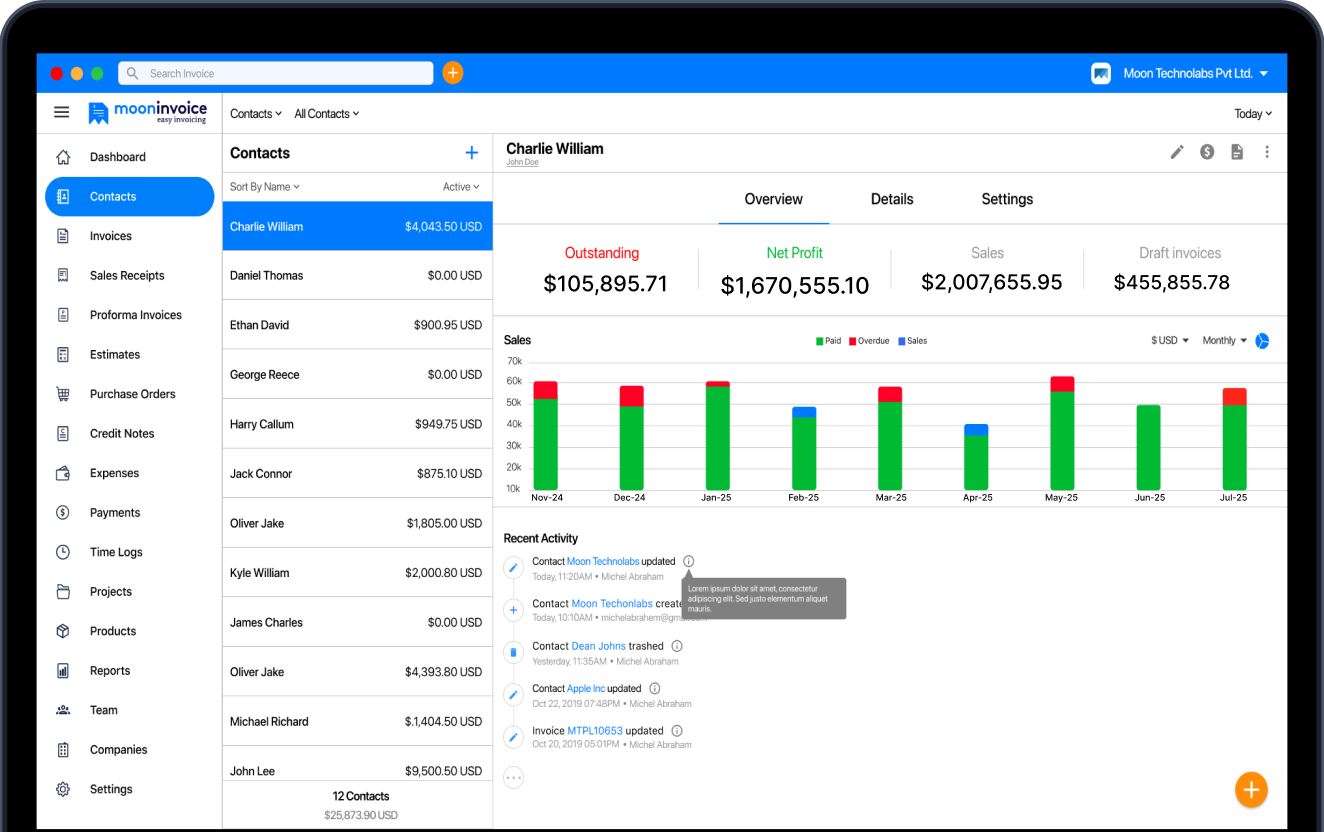
The expense tracking software helps you record purchase costs, categorize asset expenses, create your own expense categories, and monitor value changes over time without manual calculations. It correctly reports depreciation as an expense on the income statement while reducing the asset’s value on the balance sheet through accumulated depreciation.
So, are you in search of expense tracking software? Consider your search is over.Start your free trial now!
Relevant Questions on Depreciation
How does depreciation work for businesses?
What's the best method to calculate depreciation?
What is tax depreciation?
Is depreciation an expense or a liability?
Is depreciation a cost or income?



We at Moon Invoice, are the best minds behind smarter invoicing and seamless business growth. We love to solve financial problems and keep providing effective tips through our blogs, newsletters, and social media channels. As a team, we continue exchanging ideas about growing financial challenges and smart use of automation tools.