


Billing and invoicing are an important part of any construction company. The way you issue a bill or invoice determines how quickly you will get paid. Construction companies have various projects to work on; some may require upfront payment, while others may not.
According to the project work, the construction company can bill its clients and receive construction payments. However, you must know the ideal construction billing process for your construction company before billing clients.
With the right construction billing method, you can not only bill clients without surprises but also maintain a perfect record of bills and invoices. If you are still figuring out which billing method is right for you, here’s our detailed guide to help you finalize your choice. So, let’s get into this topic to understand what construction billing is and the various construction billing methods.
📌 Key Takeaways
- Deciding the right billing method depends on the project’s size, its complexity, and scope.
- On-time, accurate billing maintains positive cash flow and strong client relationships.
- A detailed breakdown in billing enhances the client’s understanding and prevents confusion.
- By using construction billing software, professionals can reduce human error and ensure accurate, quick, and efficient billing.
What is Construction Billing?
Construction billing is the process of collecting payment for products or services rendered during a construction project. You can include labor or material costs along with the client’s details when preparing a bill or invoice. So, basically, construction billing means invoicing clients when you have completed the construction project and requesting money for your services.
Invoicing clients on time, without errors, is one of the best construction billing and invoicing practices to ensure your bill is paid instantly. This way, you can keep clients posted about associated project costs and build lasting relationships with them.
6 Construction Billing Methods in the Construction Industry
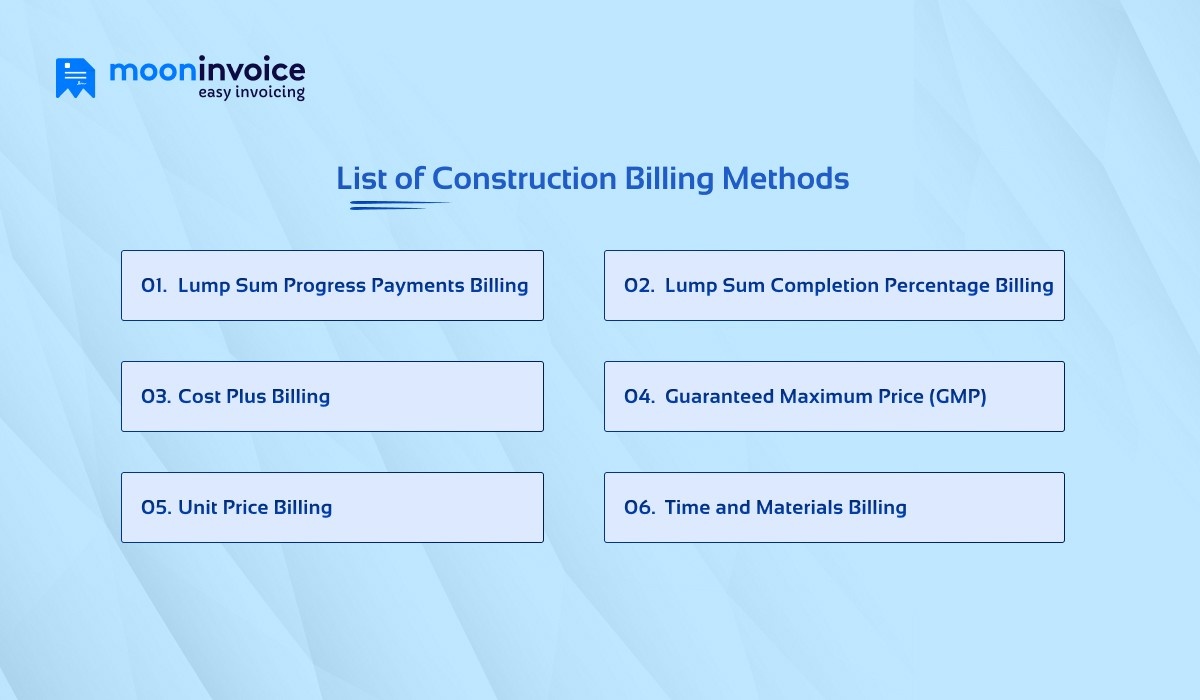
Here are a few billing methods for construction projects to receive payment for what you deliver.
1. Lump Sum Progress Payments Billing
A fixed price that must be paid up front or upon completion of the project. In this method, you will brief the client on the necessary project work and the associated costs to be paid upon project completion.
So, lump-sum progress payments are collected at different stages to purchase the required materials to complete the ongoing project works. For example, if the builder has completed half of the construction project, then they might request payment for what’s been completed before starting the remaining work.
| Pros | Cons |
|---|---|
 It is easy to manage. It is easy to manage. |  Lack of flexibility. Lack of flexibility. |
| This method gives clear client expectations. | There is a risk of overpayment. |
| It encourages timely completion. | Not ideal for complex projects. |
2. Lump Sum Completion Percentage Billing
Lump-sum completion percentage billing is an AIA-style progress billing —a structured payment method that differs from lump-sum progress payments. With this method, the contractor is paid based on the percentage of work completed relative to the total lump sum contract value.
However, the contractor needs to submit the progress report to the client. Thereafter, the client will assess the project status and then proceed with payment. If the project is 50% completed, the contractor will get 50% of the lump sum. This construction method is best suited for those working on long-term projects.
How to fill AIA G702 application?
| Pros | Cons |
|---|---|
| Payment reflects the actual work status. | Needs continuous monitoring, which adds additional burden. |
| It is an ideal method for large & complex projects due to its flexibility. | Financial planning is hard due to fluctuating construction payments. |
| The client easily justifies the invoices to the clients. | A dispute may arise between the client and the contractor over the exact progress. |
3. Cost Plus Billing
When contractors send high-quality reports to clients to offer insights into rising project costs, it is considered a cost-plus billing method. In simple terms, the client needs to pay the actual project cost, along with additional fees for profit.
Whether it is a material cost or wages of laborers, you need to list them out along with the profit margin when generating a new bill. Therefore, this is a great way to mitigate the risk associated with the project’s scope and cost.
Further, it would not be difficult to adjust costs later in the project. For example, if there is a sudden increase in material or labor costs, they need to inform the client by creating a project report. That’s how you need to clearly state the rise in project costs and obtain client approval before moving ahead.
| Pros | Cons |
|---|---|
| Flexible and easily adaptable to changes. | It needs a detailed accounting. |
| It offers transparency due to a detailed cost breakdown. | There is a risk of disputes over project expenditures. |
| Ideal for large & complex projects. | It is harder to budget precisely. |
Construction Billing & Invoicing Made Simpler
Use Moon Invoice to streamline invoicing, delight your clients, and collect payments faster.
4. Guaranteed Maximum Price (GMP)
With GMP, contractors cap costs to ensure construction projects are completed without exceeding the client’s budget. This is particularly appealing to clients, as financial security is a top priority. This contract billing method ensures the project is completed within the pre-agreed cost (GMP), so clients don’t have to worry about overspending.
On the downside, guaranteed maximum price billing offers limited flexibility and carries certain risks for contractors. Under this method, project changes or additional work cannot be accommodated. Additionally, if the actual costs exceed the estimated price, the contractor or construction company must cover the extra expenses.
| Pros | Cons |
|---|---|
| It reduces the financial risk. | Complex structure due to detailed cost-tracking requirements. |
| Provides transparency for cost tracking. | There is a higher initial cost. |
| It prevents unexpected expenses, reducing the risk of cost overruns. | It is not suitable for all project types. |
5. Unit Price Billing
Methods of payment in construction, unit price billing, is one of the most preferred ones. In this contractor’s bill, clients are only for completed unit work. With unit price billing, contractors can bill clients for completed work by the square foot or by specific item. For instance, the contractor may ask for $25 per square foot to complete the kitchen area in your ongoing construction project.
Such a method can be effective for projects with repetitive tasks or unit-based work, such as roof installation or floor installation. That’s how it allows both parties to manage the project budget efficiently. Some construction companies also use unit-pricing alongside the time-and-materials billing method. Using construction apps for contractors is quite helpful in this approach.
| Pros | Cons |
|---|---|
| Highly flexible regarding quantity changes. | Quantities need to be carefully measured, which is time-consuming. |
| It is easy to track the quantity. | It is not ideal for the varying projects. |
| Establish transparency between the client and contractor. | The risk of disputes is high due to disagreements over quality and quantity. |
6. Time and Materials Billing
It is a construction billing method in which contractors bill their clients based on the time spent and materials used to complete the work. Such a construction method can be beneficial for certain projects where determining the estimated cost is difficult. Unlike GMP, time-and-materials billing for construction projects allows changes or additions.
At the same time, unforeseen events may delay the project. If labor costs are hiked for any reason after the contract is signed, contractors will need to pay additional costs. As a result, you might fall short of achieving the desired profit in the construction project.
| Pros | Cons |
|---|---|
| It offers flexibility for large and complex projects. | Frequent invoicing and reporting add to the workload. |
| Clients get clarity over what they are paying for. | Time-and-material tracking is required, which increases the level of detail. |
| There is no requirement to pay a large fixed price upfront. | There is a cost uncertainty because time and materials may fluctuate. |
8 Best Billing Practices for Construction Businesses
Billing your client may be easy, but adhering to these best practices for construction billing will ensure you receive on-time payments for what you deliver.
1. Select the Right Time
Generate and send construction project bills on time to avoid further delays. Help your clients understand why you created a bill and enable them to make the payment conveniently. This is an excellent way to maintain healthy relations and get yourself paid.
2. Clarify the Payment Terms
Emphasize the construction payment terms and conditions to make them easy to read. Describe the delayed payment charges according to your company’s policy, and what the accepted payment methods are. Don’t make things messy by writing lengthy paragraphs.
3. Manage Bills Online
Utilize a cloud-enabled invoicing platform to manage your bills online without fear of misplacing them. This practice of managing construction bills online will help maintain accurate records. Similarly, your client will find it easier to organize bills if you present them in paperless form. It is also helpful in maintaining a payment schedule.
4. Choose Politely-worded Templates
Prioritize downloading invoice templates from online software like Moon Invoice rather than generating poorly written hard copies. The software will ensure you maintain accuracy and professionalism, no matter how hurriedly you create a bill. Once generated, send it using online platforms.
5. Regular Progress Tracking
Always track the project progress by using the site report and metrics. Following this practice helps ensure the correct billing for construction projects. Thus, it prevents errors and lowers the chances of disputes. Additionally, it enhances your reputation and goodwill.
6. Make Early Communication
For any billing change, you must communicate with your client before sending the invoice. Discuss everything clearly and establish proper transparency about price changes and late payment charges. This prevents disputes and keeps the contract billing process on track.
7. Review Before Billing
Always review the invoice before sharing it with the client. This ensures that your billing is correct and your client is making the correct payment. Additionally, it is useful for tracking and correcting errors or omissions in an invoice.
8. Mention the Payment Method
Clearly state the payment method you accept. This practice provides the client with clarity on how to pay for construction work. As a result, transparency will be there, and it’ll also have a positive impact on your billing. Offering multiple payment options adds extra value to your billing.
How to Choose the Right Construction Billing Method?
There are too many construction billing options—so which one is the perfect choice? It is a common question among various professionals.
Every billing method has its own advantages. However, one should understand the project’s scope, complexity, and payment flow requirements.
For instance, it is better to go with a fixed-price (lump-sum) contract for a small project. In contrast, a milestone payment method is ideal for large-scale projects. Similarly, for simple projects, it is ideal to consider the fixed-price method. In contrast, time-and-materials or cost-plus billing methods are ideal for complex projects.
Choosing the construction billing method depends on the individual project’s type. Also, the business policies affect the justification. However, professionals should ensure that both clients and contractors remain on the same page.
Use the Right Construction Billing Software
When coupled with the right construction billing software, the construction billing process streamlines bill generation.
Regardless of which construction billing method you choose, invoicing or accounting software for contractors like Moon Invoice ensures accurate calculations and attention-grabbing bills and invoices.
The invoicing software includes 66+ ready-made templates to help you create professional construction bills in any format. The software also provides a payment reminder feature that prevents overdue charges for your client and lets you take advantage of on-time payment.
Further, it offers plenty of online payment methods to help you get paid promptly, so you don’t need to exchange cash. In addition to invoices and bills, you can create estimates using a construction estimate template, receipts, and expense reports. This AI-powered platform is meant to save your time and make your construction billing super smart.
It centralizes all your important business documents in the cloud, enabling you to generate comprehensive reports to refine your strategies and win more work.
As a result, Moon Invoice could be your go-to billing software to enhance customer satisfaction and cultivate desired growth.
Accurate Bills are Just a Few Clicks Away
Choose customizable templates from Moon Invoice to create professional bills, estimates, and receipts in < 2mins.
Conclusion
The above-mentioned construction billing methods are quite valuable for keeping your billing process smooth.
By now, you must have decided which construction billing method from the above list best suits your business. Use it whenever you want to bill your clients, and remember to follow best practices for construction billing. The construction billing process can be streamlined with sophisticated billing software such as Moon Invoice.
It assures seamless bill management across all devices and excellent customer satisfaction. It is an all-in-one software for estimators and contractors to manage important documents and finances.
On top of that, you can convert an estimate into an invoice with a single click, simplifying your workflow and freeing up hours for core activities. So, brush aside your paper bills and migrate to Moon Invoice by starting a 7-day trial at $0.
FAQs
What is the billing process for construction?
How can construction invoicing software help contractors?
How often should I send invoices for a construction project?
What is the most common method of payment for construction?
What are the 5 essential elements of a construction contract?



Jayanti Katariya is the founder & CEO of Moon Invoice, with over a decade of experience in developing SaaS products and the fintech industry. He holds a degree in engineering. Since 2011, Jayanti's expertise has helped thousands of businesses, from small startups to large enterprises, streamline invoicing, estimation, and accounting operations. His vision is to deliver top-tier financial solutions globally, ensuring efficient financial management for all business owners.