




Revenue Definition:
Revenue is the total money a business earns entirely from selling goods or services before subtracting expenses, allowances, discounts, returns, taxes, etc.
Revenue is undoubtedly the lifeblood of any business. It is the total money a business earns from selling products or services before subtracting all necessary expenses. When calculating your business’s revenue, many financial factors come into play, including financial statements, revenue, gross revenue, net revenue, P&L statements, etc.
So, if you are wondering how is revenue calculated, you are at the right place.
In this blog, we will explore what is revenue in business, how to calculate revenue, and the formula for revenue in detail.
Let’s get started…
📌 Key Takeaways
- Revenue is the total money a business earns from selling goods or services before deducting expenses.
- Net revenue is the money left after deducting returns, allowances, and discounts from gross revenue.
- Product-based businesses calculate revenue by multiplying the number of units sold by the selling price.
- Service businesses calculate revenue based on billable hours, project fees, or retainers.
- Revenue is a critical part of your business, especially if it is in a growth phase.
What is Revenue in Business? (Revenue Meaning)
Revenue is the total money a business earns from its core operations before any expenses are deducted. It is the top line of an income statement, and the business revenue showcases how much value a business generates by selling products or delivering services.
Simply, we can say that revenue is the income a business earns from customers in exchange for goods or services during a specific period (monthly, quarterly, or annually).
Revenue formula:
Some owners often use revenue and profit interchangeably, but in reality, they are very different. Revenue is the total earnings of the business before deducting costs. On the other hand, profit is the amount remaining after deducting costs and expenses such as salaries, rent, materials, taxes, and overhead.
Different Types of Business Revenue
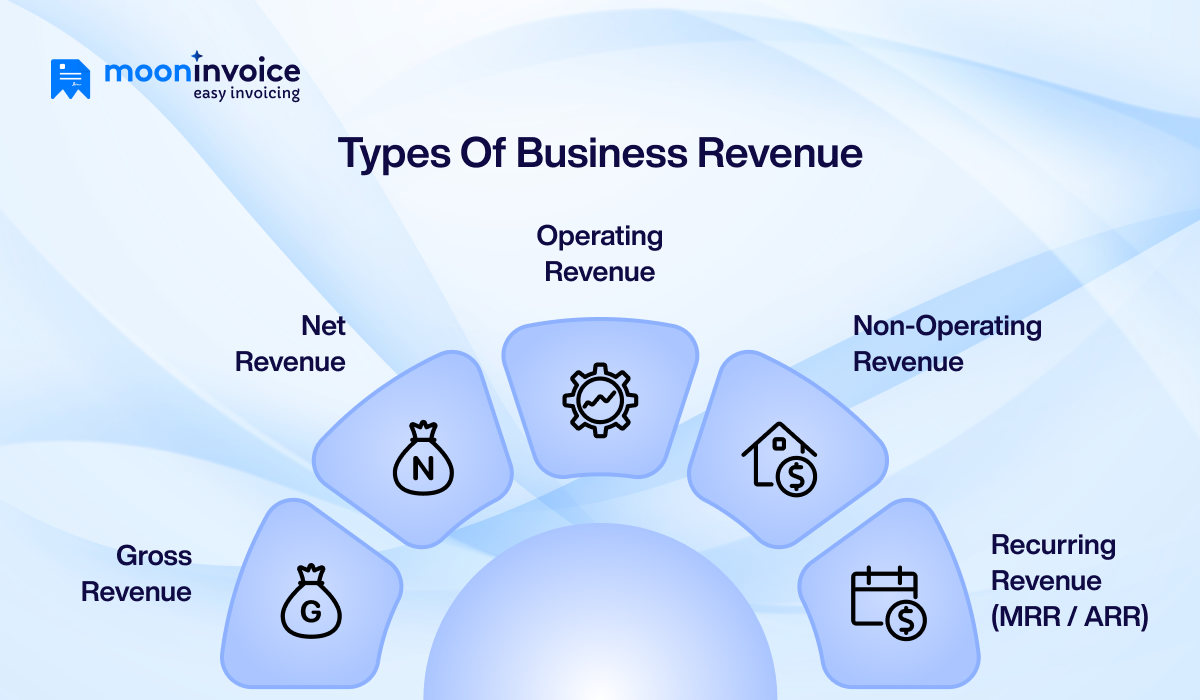
Business revenue is not limited to only one type. There are multiple types of revenue that provide unique financial insights and help businesses accurately measure performance.
Let’s explore different types of business revenue below:
1. Gross Revenue
When a business owner or an accountant often says revenue, this is exactly what they are talking about: the gross revenue. As explained earlier, it is the total income a business generates before deducting any expenses, discounts, returns, or allowances. It highlights the full value of each transaction made with customers in a given period.
Fed Up With Calculating Your Revenue Manually?
Skip traditional revenue calculation methods and jump over to Moon Invoice, where your revenue is calculated automatically.
2. Net Revenue
Net revenue is the amount left after deducting discounts, refunds, returns, and allowances from the gross revenue. It represents the real amount a business earns and provides a clearer picture of the operational performance.
3. Operating Revenue
Operating revenue is the income that comes from the business’s primary, day-to-day activities. Revenue earned from selling core products or services, excluding any secondary or one-time income sources, falls under operating revenue. By calculating operating revenue, businesses can analyze how well the company’s core business model is performing.
4. Non-operating Revenue
Non-operating revenue, as the name suggests, is the income a business earns from secondary activities, i.e., activities outside its core operations. It includes every one-time or irregular gains that are indirectly related to selling the company’s primary products or services. It is always good to separate non-operating revenue from operating revenue, as mixing them can distort cash flow.
5. Recurring Revenue (MRR / ARR)
Recurring revenue is the predictable income a business earns at regular intervals from subscriptions, contracts, or ongoing services. Recurring revenue is calculated in SaaS, membership-based, and service-retainer business models where customers pay consistently over time. Calculating recurring revenue is necessary because it provides visibility into future earnings and financial stability.
Struggling to Create Financial Reports? Switch to Financial Reporting Software Now!
How to Calculate Revenue for Different Business Types?
The revenue calculation method varies depending on the type of business model. Calculating your business’s revenue, gross income, and sales revenue helps ensure accuracy and profitability.
Let’s explore how different business should calculate their revenue:
1. Product-based Business
A product-based business or company primarily generates revenue by selling physical or digital goods. Here, revenue is calculated by multiplying the number of units sold by the selling price. For returns, discounts, or promotional offers, necessary adjustments are made. In product-based businesses, calculating revenue is easier as each sale represents a clearly measurable transaction.
Revenue formula for product-based businesses:
Example of Revenue Calculation:
Let’s consider an electronics retailer that sells 900 units of bulbs priced at $27 each during a month.
- Total sales = 900 x $27 = $24,300
- Customer returns = $1,200
- Promotional discounts = $800
So, here, the revenue will be:
As shown in this example, the electronics retailer’s revenue is $22,300.
2. Service-based Business
A service-based business is very different from a product-based business, as it earns revenue by providing expertise, time, or professional services rather than selling physical products. Here, revenue is calculated based on billable hours, project fees, retainers, or performance-based charges. As services vary, accurate time tracking and billing documentation are necessary for precise revenue recognition.
Revenue formula for service-based businesses:
Example of Revenue Calculation:
Let’s assume a consulting firm charges $250 per hour and records 340 billable hours in a month.
- Billable revenue = 340 x $250 = $85,000
- Additional project fee = $8,000
- Client credit adjustment = $2,500
So, the net revenue will be:
Considering this example, the consulting firm’s revenue is $90,500.
3. Subscription-based Businesses
A subscription-based business earns the majority of its revenue by charging customers a recurring fee in monthly, quarterly, 6-monthly, or annual basis for continued access to a product or service. This is commonly found in SaaS platforms, streaming services, membership programs, or even maintenance firms. Compared to one-time sales, subscription revenue is more predictable, and all active subscribers, pricing tiers, upgrades, downgrades, and cancellations are taken into account.
Revenue formula for subscription-based businesses:
If case of pricing models:
- MRR = Sum of (Subscribers in Each Plan x Plan Price)
- Annual Recurring Revenue (ARR) = MRR x 12
Example of Revenue Calculation:
Let’s assume a streaming platform offers three subscription plans:
- 1200 subscribers on the basic plan at $12 per month
- 840 subscribers on the best-value plan at $20 per month
- 510 subscribers on the premium plan at $29 per month
Considering this:
- Basic plan revenue = 1200 x $12 = $14,400
- Best-value plan revenue = 840 x $20 = $16,800
- Premium plan revenue = 510 x $29 = $14,790
Now, the monthly recurring revenue will be
- Total MRR = $14,400 + $16,800 + $14,790 = $45,990
So, the annual recurring revenue will be:
- ARR = $45,990 x 12 = $551,880
Considering the above example, the steaming platform earns a monthly recurring revenue of $45,990, totaling $551,880 annually.
How to Calculate the Annual Revenue of Your Business?
Annual revenue is the total revenue your company has earned over the last 12 months. The simplest way to get annual revenue is to add up all the monthly revenue figures from January to December.
If your revenue is unstable and shows noticeable seasonal fluctuations, calculating annual revenue can be challenging. Instead of multiplying a single month’s data by 12, you should review historical data to understand seasonal patterns and project revenue more accurately.
If you need an estimate in the middle of the year, it is best to multiply revenue by 12 for a rough projection. Similarly, quarterly revenue can be calculated annually by multiplying it by 4. These methods are best suited for businesses with consistent year-round revenue.
Annual revenue formula:
If revenue remains consistent throughout the year, it can also be calculated as:
Stable Revenue Example
If a company generates a consistent monthly revenue of $45,000, the annual revenue will be:
This calculation method is applicable for businesses with predictable and steady sales throughout the year.
Mid-year Projection Example
Suppose a company requires annual revenue for the year as of April.
Revenue from January to April totals $200,000
Step 1: Calculate average monthly revenue
- $200,000 / 4 = $50,000
Step 2: Estimate annual revenue
- $50,000 x 12 = $600,000
So, the projected annual revenue here is $600,000.
Where to Find Revenue on Financial Statements?
Revenue is the most important financial number of your business because it shows the company’s ability to generate income from its operations. You must have clarity on which financial documents revenue appears in to accurately assess your company’s financial health.
You can find revenue on the income statement, or P&L statement, of your business. Revenue appears at the top of the income statement, which is why it is called “top line.”
Why is Revenue Important?
Revenue is sometimes neglected by business owners who are entirely new to the market, and that’s the first mistake they make while running a business. Revenue is not just your total earnings; it indicates market demand, provides operating cash, and gives an indication of whether your business is growing. There are multiple reasons why revenue is important for your business.
Let’s explore them below:
- Business Valuation: Investors and lenders use revenue figures to assess company size, scalability, and investment potential.
- Strategic Planning: Revenue trends guide decisions related to pricing, marketing, expansion, and resource allocation.
- Growth Tracking: Comparing revenue over time helps measure business expansion and year-over-year progress.
- Sales Insight: Revenue reflects how well your products or services are selling in the market during a specific period.
- Financial Stability Assessment: Consistent revenue generation indicates operational sustainability and long-term viability.
Simplify Your Business Reporting with Moon Invoice
Revenue growth is undoubtedly one of the best signs that your business is growing and that you can expand further. But, how do you track your revenue and prepare reports?
Believe it or not, if you are still stuck with the traditional method of paper-based report creation, your business may not grow effectively. Manual methods not only take time, but they also lack accuracy and are error-prone. Frequent changes delay report preparation and affect your credibility.
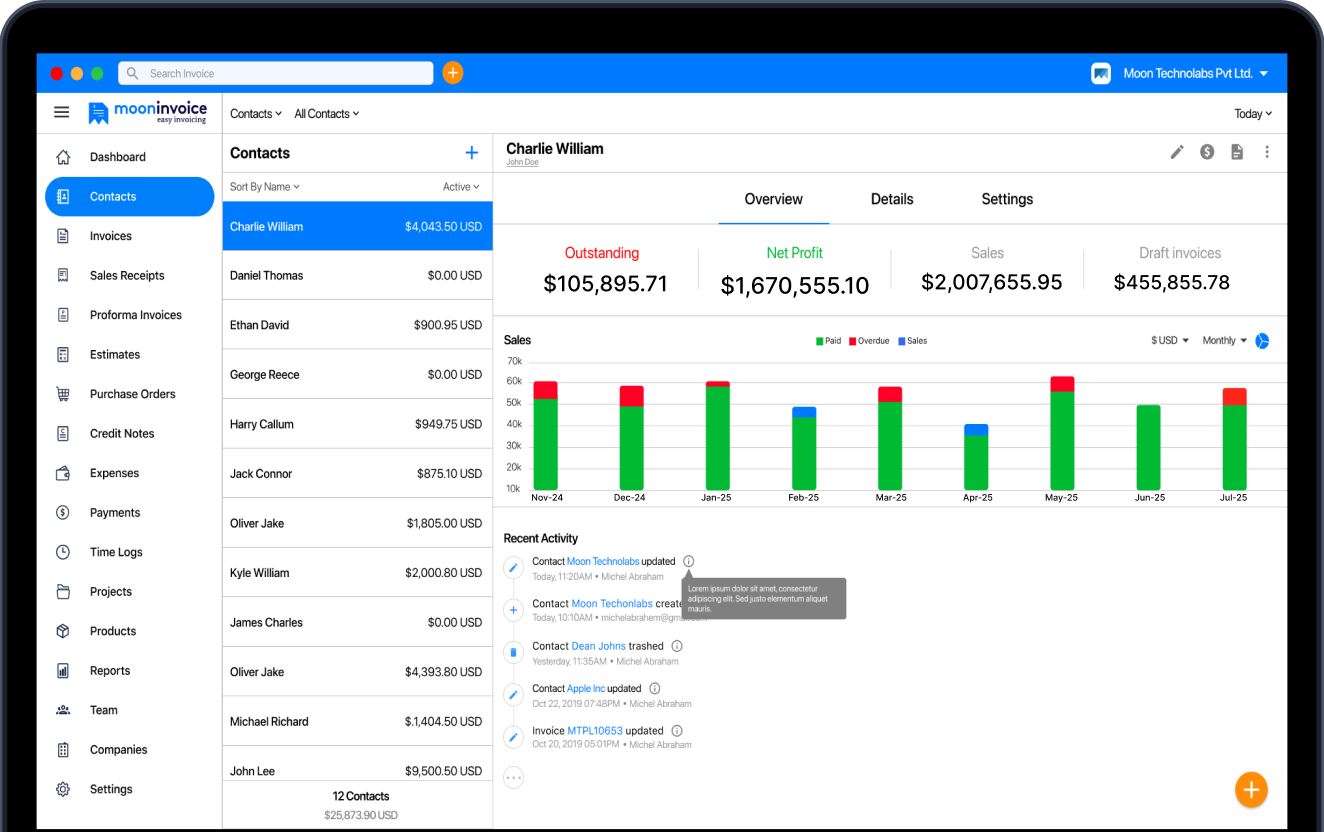
On the other hand, when you choose invoicing software such as Moon Invoice, you can maximize your productivity as it simplifies report generation. With Moon Invoice, you can easily check your P&L statement, sales report, quarterly report, expense report, and plan whether you want to expand your business or launch new products or services.
Another feature of Moon Invoice is its support for tax-ready reports. It automatically generates tax-compliant reports, so you don’t need to prepare separate reports manually during tax season.
Calculate Revenue with Zero Efforts
Ditch manual report calculation and get a 360 view of your business health.
P&L Statement
Expense Tracking
Tax Reports
Wrapping Up
Calculating your business’s revenue is not optional; it is your priority. It should be done accurately, covering gross revenue, net revenue, operating revenue, non-operating revenue, and recurring revenue.
Some businesses are solely product-based, some are service-based, and some are subscription-based, but the revenue calculation methods differ for each. So, in the huddle-muddle of products and services, would you still consider calculating the revenue of your business manually? We hope not.
Get rid of the overwhelming burden of revenue calculation and reporting by using Moon Invoice in your workflow. Don’t miss out on the free trial.
Frequently Asked Questions
What is revenue vs profit?
Is revenue recorded before or after tax?
Can a company have high revenue but low profit?
Is revenue the same as profit?
How many times is a company's revenue worth?



We at Moon Invoice, are the best minds behind smarter invoicing and seamless business growth. We love to solve financial problems and keep providing effective tips through our blogs, newsletters, and social media channels. As a team, we continue exchanging ideas about growing financial challenges and smart use of automation tools.