



While running a business may not seem so difficult for others, it actually requires close attention to how and when money is recorded. Business owners, agree? Things like rent, insurance, or subscriptions often need to be paid in advance, but as we know, the benefit of these payments doesn’t come all at once.
Prepaid expenses, here, act as a financial buffer because payments are made in advance for goods or services you will utilize later. Though the payment is made upfront, the benefit is still received only gradually over time. Expenses, prepaid or incurred later, directly impact your cash flow, making it essential to keep a close eye on them.
Among various business expenses, prepaid expenses require your special attention. Below, we explain the prepaid expense definition and its significant role in terms of accounting.
Interestingly, 60% of businesses applied for financing within a year, with 56% needing funds just to cover operating expenses.
What are prepaid expenses?
Prepaid expenses refer to the advanced payments for services that you will receive in the future. Basically, it is a “pay now, use later” model, which states that payment should be completed upfront, but services are utilized gradually over time.
In simple words, you pay cash right away, but you enjoy the services slowly and until the expiration of the validity.
Prepaid expenses, in accrual accounting, should be recorded in the same period. Suppose your business purchases a 1-year subscription plan for a marketing tool by paying $2,400 upfront, then you need to record the same amount for a particular month.
Here, the expense is spread over a period of 12 months, meaning it will be recognized as $200 each month. This way, you get the advantage of availed services, but not immediately.
Adopt the stress-free way of tracking expenses
Make the most of Moon Invoice’s AI-powered automated expense tracking that doesn’t suck your time.
Prepaid expenses examples
Following prepaid expenses meaning, let us now check out the best examples of prepaid expenses, unraveling how completing advance payments works in reality.
1. Business insurance
Prepaid Insurance premiums often require upfront payment to lock in better pricing as well as uninterrupted coverage for your business. The payment is made immediately, but the benefit extends across the entire year. It applies to all insurance, including property coverage, professional liability, and employee-related policies.
2. Rent payments
Rent and lease payments also fall into the prepaid expenses category, particularly when businesses want to secure a property or asset. The company pays upfront for a one-year office lease at once, but the space is used over the next 12 months, setting a perfect example of prepaid expenses.
3. Subscriptions
Whether you are a new player or already in an established business, at some point, you will need software subscriptions. Billed monthly or annually, these payments are usually made in advance, even though the services are used afterward. So, subscriptions are also another common example of prepaid expenses.
4. Equipment maintenance
The advance cost you pay to keep equipment in working condition is also treated as a prepaid expense. An annual maintenance contract pulls the money first. Nevertheless, it provides services throughout the year. This approach mirrors the concept of prepaid expenses and is widely used for machinery servicing.
5. Bulk orders
When you order office supplies in bulk, it is also counted as prepaid expenses. Here, you pay for goods in advance to place bulk orders, but use them gradually as required. This practice ensures costs are properly matched with the period in which the goods contribute to the sales.
6. Taxes
Taxes paid in advance for the upcoming fiscal year are also a part of prepaid expenses. That’s right, because even though taxes are paid upfront, the obligation it covers relates to future income periods. Hence, no wonder that advance tax payment is also considered as prepaid expenses.
How to Record Prepaid Expenses on Balance Sheets?
In case you wonder where to add these types of expenses on the balance sheet, here are a couple of steps to follow.
1. Recording as an asset
First, start recording prepaid expenses as an asset on the balance sheet in a particular column. The practice aims to confirm that these payments are upfront, but the benefits are claimed in the near future, not immediately. Therefore, when you pay for rent, insurance, or subscriptions in advance, it is first recorded as an asset on the balance sheet, reflecting that the value is yet to be utilized.
2. Service recognition & adjustment
Next is recognizing the service and pushing some portion of that prepaid amount from the asset into the expense section. Since you are utilizing services gradually, you must move the recognized portion of the amount to the expense column.
The practice, which is usually followed on a monthly basis, aims to adjust the cost evenly over time. Likewise, this adjustment process continues until the expiration of the service validity.
If the prepaid balance goes to zero at any point, it means the full cost has to be reflected as an expense. Notably, the same thing appears on your income statement as well.
How to Record Expenses Without Receipts
Tips for organizing prepaid expenses
Here are expert-approved best tips to oversee prepaid expenses and make sure you stay on top of your business spending.
1. Don’t skip monthly checks
Instruct your team to never skip the monthly audit process. A practice that ensures you record the correct portion as an expense month by month, and nothing is overlooked. Such things also prevent last-minute confusion.
2. Initially record as assets
Always record prepaid expenses as assets first and then gradually move it to the expense column as time passes. Treating them as assets initially means no chance of incorrectly logging as immediate expenses.
3. Say no to lump-sum expensing
There is no point of recording the lump-sum expenses in the balance sheet. Lump-sum recording can distort your financial data by showing higher costs in one specific accounting period. Therefore, you should never do it.
4. Invest in expense tracking tools
Get professional expense tracking software, so that you don’t have to track prepaid expenses manually. What’s interesting is that if you invest in reliable tools like Moon Invoice, you can even convert paper expense receipts into a digital document instantly with AI-enabled automation.
5. Keep tracking
Prepaid expenses play a role in orchestrating next year’s financial budget. So, you should never lose sight of prepaid expenses, miscellaneous expenses, and even non-miscellaneous expenses. If tracked properly, together, they help you develop a robust fiscal plan.
Manage & track expenses with Moon Invoice’s AI-powered automation
So far, you know what are prepaid expenses and how painful it is to organize them. On one hand, you are paying upfront, and on the other hand? You are trying to figure out how that cost should be spread over time. While you do so much to organize expenses, the stress of manual calculations and scattered records only makes things complicated.
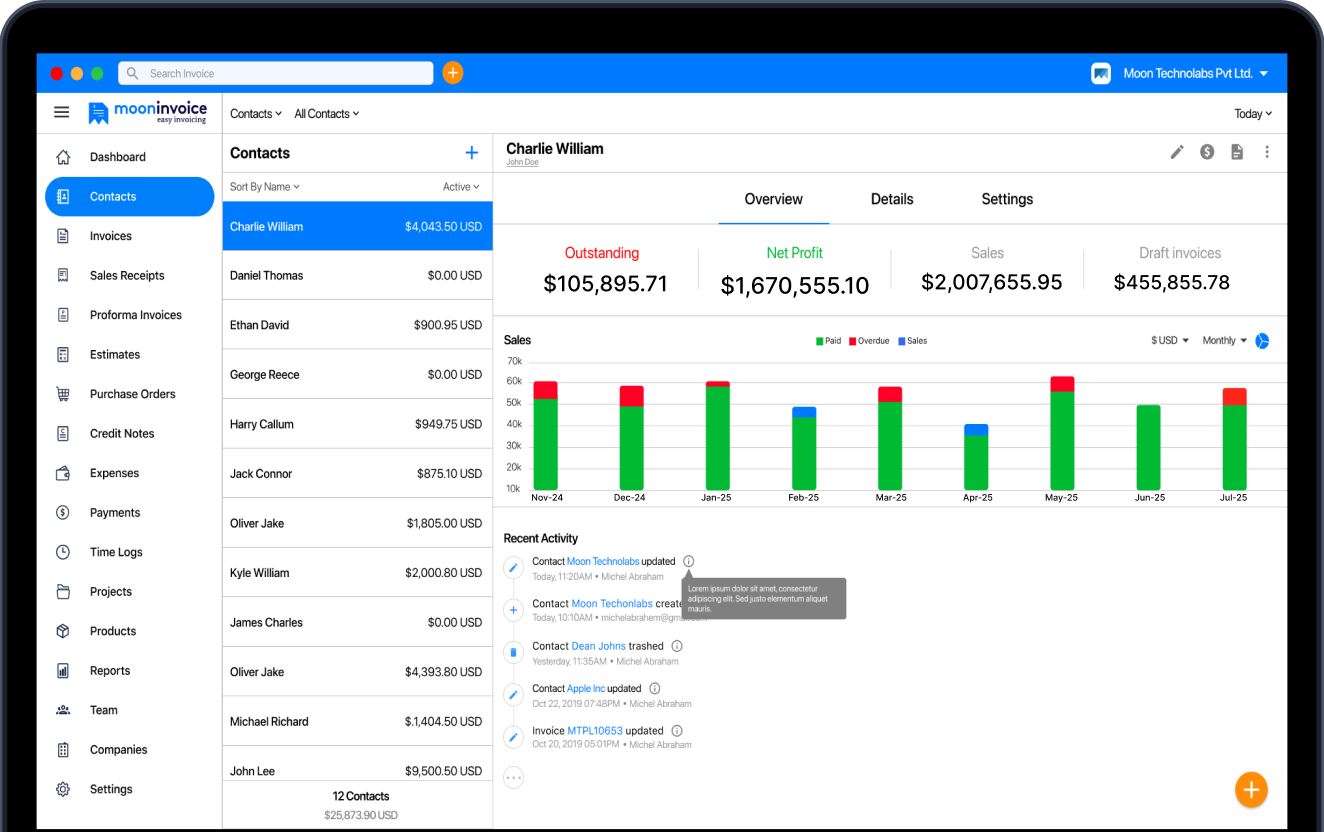
But what if all of this could be handled automatically? A sophisticated estimating software, Moon Invoice does it all at once. Powered by AI automation, Moon Invoice lets you scan the paper expense copies and convert them into digital receipts, keeping expenses organized under one roof.
Expenses that feel handled, not haunting
Try effortless & painless expense management with Moon Invoice
Expense reports
Bank reconciliation
Offline accessibility
General Questions Answered
Are prepaid expenses a current asset?
Is prepaid expense a debit or credit?
What is the journal entry for prepaid expenses?
What falls under prepaid expenses?



Jayanti Katariya is the founder & CEO of Moon Invoice, with over a decade of experience in developing SaaS products and the fintech industry. He holds a degree in engineering. Since 2011, Jayanti's expertise has helped thousands of businesses, from small startups to large enterprises, streamline invoicing, estimation, and accounting operations. His vision is to deliver top-tier financial solutions globally, ensuring efficient financial management for all business owners.