
TL;DR
Procurement and purchasing are two crucial business terms. Procurement focuses on sourcing and managing suppliers, while purchasing is a transactional activity involving the buying of goods and services.
Often, people get confused between procurement and purchasing. The two terms are closely related but distinct in many ways you might not be aware of.
So, if someone asks, “Is procurement the same as purchasing?” The answer is No!
For all kinds of businesses, especially manufacturing units, construction, etc, these two terms play an important role. Procurement is a comprehensive process of sourcing products & services, including supplier selection & sourcing. Purchasing primarily focuses on ordering products/services, settling the price, and ensuring on-time delivery.
Understanding the difference between procurement and purchasing is crucial for managing costs, allocating resources, and mitigating risk. Additionally, a clear distinction is helpful in running the business smoothly and leverages better outcomes.
This article will serve as the definitive guide to procurement vs. purchasing. Explore the definition, the key steps that each process includes, and the differences between the two.
Let’s dive into the insights of the procurement and purchasing differences.
📌 Key Takeaways
- Procurement is a strategic process, and purchasing is a transactional activity.
- Procurement is a future-oriented operation, while purchasing is a short-term process.
- A clear understanding of procurement and purchasing helps control costs and improve overall business efficiency.
- Procurement always comes first, and purchasing comes after procurement.
- Professionals can smooth the procurement & purchasing process by using a purchase order generator.
What Is Procurement?
Procurement is the process by which organizations acquire goods, services, or raw materials on a large scale for their operations. Suppliers, external sources, or manufacturers are major sources through which companies purchase goods and services. Following this process, the organization fulfills its operational needs.
Procurement is the first step when a business plans to buy raw materials, products, or services. It is a strategic, long-term procedure for the company. It covers a series of steps, from requirement analysis to payment process. In the middle, bid solicitation, contract negotiations, and transaction actions are the key activities.
Is It About Generating a Purchase Order? It’s a 1-Minute Task!
Choose Moon Invoice to digitize your purchase order processing — accurate, fast & effective!
Key Steps in the Procurement Process
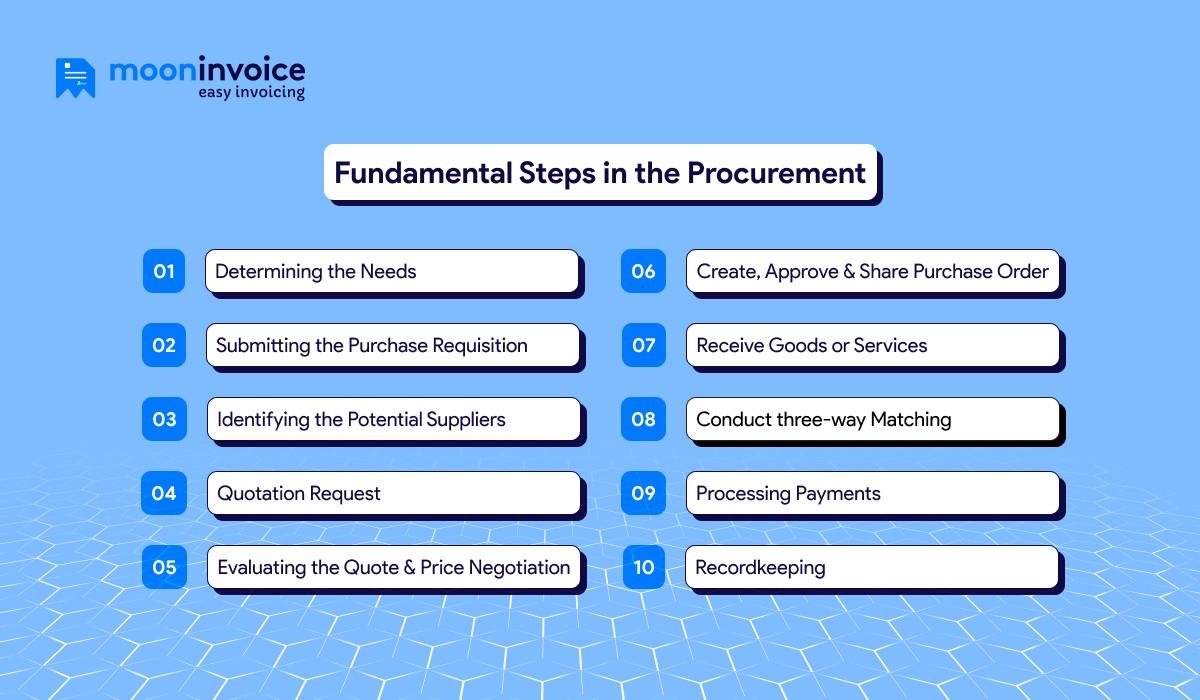
After identifying what procurement is, we now understand the basic steps that procurement involves:
1. Determining the Needs
The initial step in the broader procurement process is analysing the organization’s product and service needs. Professionals need to list out all the crucial requirements.
2. Submitting the Purchase Requisition
Once the determination of services and products is complete, the next step is submitting the purchasing requisition. The procurement team reviews the request to ensure the purchase is within the budget.
3. Identifying the Potential Suppliers
Furthermore, it’s about sourcing the right vendor to meet supply needs within the budget. Available materials, pricing, on-time delivery, and payment terms are some factors to consider when selecting potential suppliers.
4. Quotation Request
Ask the chosen supplier to share the quotation, including product/service description, quantity, and unit price.
5. Evaluating the Quote & Price Negotiation
Once you receive the quotation, it’s your responsibility to review it carefully. Inspect every detail and ensure it aligns with your needs. If required, you can negotiate the price.
6. Create, Approve & Share Purchase Order
On completion of the price agreement, the next step is to create a purchase order. Review the PO and approve it before sharing it with the vendor as a formal contract.
7. Receive Goods or Services
Get the agreed goods or services from the supplier. Make sure you receive them as per the agreement you made in the purchase order.
8. Conduct three-way Matching
Upon receiving the vendor invoice, perform a three-way match to compare the purchase order, invoice & receipt. This is to ensure no errors affect the process.
9. Processing Payments
Once you confirm that all the details are up to mark, proceed to pay the vendor as per the invoice. Things to note: you must always ensure the right payment and cross-check the amount before final payment.
10. Recordkeeping
Finally, save the purchase order, invoice, and receipt, and maintain a record for future reference. Adopting a proper centralized system makes it easier.
💡Pro Tip:
Always use a reputable purchase order software to increase purchase order processing from 50% to 80%, improving the overall procurement process.
Why Is Procurement Important in an Organization?
Along with the definition of procurement, it is necessary to understand its purpose & importance. The major goal of procurement is to keep the operation running efficiently while managing the risk. It helps companies get the best-quality products and services in the right quantities at affordable prices.
A proper procurement process enables businesses to reduce operational costs. It also affects their profit margins because businesses get the material at a budget-friendly cost, which is lower than the price at which they sell.
Following a successful procurement operation, business professionals maintain strong relationships with vendors. A long-term relationship helps the business meet its needs through a trustworthy, valuable vendor.
Key Challenges in Procurement
- Finding reliable suppliers that offer quality products or services at an optimal cost
- Difficulty in tracking accurate data due to the lack of a centralized or systematic approach
- Budgeting uncertainty caused by frequent market price fluctuations
- Poor communication between internal departments affecting workflow efficiency
- Delays in goods transportation due to geopolitical and other external issues
What Is Purchasing?
Purchasing is a transactional component of the entire procurement cycle. It involves vendor selection, acquiring products & services, requesting quotations, and sending the payments. This process focuses solely on the purchasing component of the broader strategic procurement process.
Key Steps in the Purchasing Process
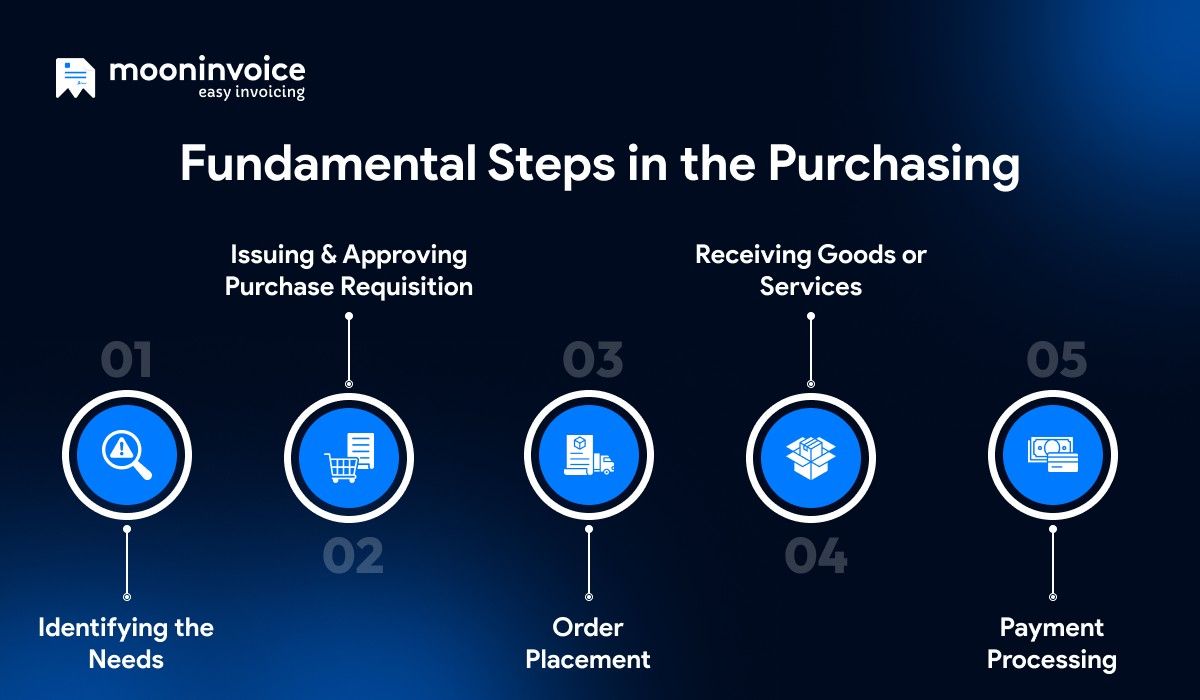
1. Identifying the Needs
The purchasing process begins with identifying the need for products and services. Companies need to analyse the products and services that are crucial to running the business operation.
2. Issuing & Approving Purchase Requisition
Next, issue the purchase requisition, a formal document requesting products and services. It includes their descriptions, quantities, and unit prices. Professionals must issue this document after proper review and approval through the finance head, procurement manager, or a C-level executive.
3. Order Placement
Once the purchase requisition is approved, the next step is to place the order. The department needs to create & issue the purchase order to the supplier. This document outlines the line items, quantities, agreed price, and other terms. PO sets the contractual agreement between the two parties.
4. Receiving Goods or Services
The supplier then sends the goods or services as per the PO. Upon receiving them, the department cross-checks to ensure the requested items comply with the agreement. If anything is missing, it is the department’s responsibility to contact the supplier immediately.
5. Payment Processing
When the supplies are upto the mark, the accounts payable department then processes the payment in accordance with the vendor’s invoice. This is the last step and completes the purchasing process.
Key Challenges in Purchasing
- A slow internal process within the company can delay purchasing and disrupt operations
- An increased risk of unauthorized purchasing and policy violations
- Lack of advanced and centralized purchasing software to track spending effectively
- Shipment delays caused by supplier-side delivery issues
- Sending incomplete or unclear purchase orders leading to poor PO management
💡Things to Know:
The “Procurement as a Service” market is projected to grow to US$22.10 billion by 2033, supported by an impressive CAGR of 14.4%.
Procurement vs. Purchasing: Key Differences Between Procurement and Purchasing
After understanding the two important terms, you must be curious to unlock the guide on the procurement and purchasing differences. After understanding the definition and its processing steps, you might have gotten a sense of how procurement differs from purchasing. Still, a clear picture, here is the complete comparison:
| Aspect | Procurement | Purchasing |
|---|---|---|
Similarities Between Procurement and Purchasing
So far, we have covered sufficient information on procurement vs. purchasing and understand the differences between the two. But what about similarities? Yes, they are quite similar in the following ways:
- Both procurement and purchasing processes are valuable in supply chain management.
- The supplier’s role is equally important in both processes.
- When it comes to cost management, both processes aim to cut costs with maximum efficiency.
- Both processes aim to align with the business’s broader goals and strategies.
- Together, both contribute to smooth business operations and efficiency.
- The two concepts are highly interconnected.
Procurement or Purchasing: What to Choose?
While understanding the difference between procurement and purchasing, you might be unsure which to choose. Choosing between the two processes depends on the business size and nature. A small-scale business with a simple supply chain can skip procurement and perform purchasing directly.
In contrast, larger enterprises with complex supply chain management need to adopt an effective procurement strategy. This approach helps the business systematically run its operations and achieve long-term benefits.
💡You Might Like:
What Is E-Procurement & Its Benefits?
E-procurement (also known as Electronic Procurement) is the process of buying goods or services through digital channels rather than the manual approach. Thus, it streamlines the overall process through automation. One can achieve it by adopting the right procurement software.
Here Are the Key Benefits of E-procurement
1. Cost Saving & Boost Process
E-procurement leads to significant cost savings by reducing operational costs. Additionally, it speeds up the process by reducing manual work. With complete digital concepts and automation, professionals successfully improve operations.
2. Increasing Transparency & Compliance
Transactions are digitally recorded, which makes data tracking easier, including for audit purposes. This also reduced fraudulent activity. Mistakes like incorrect entries and duplicate orders are not included in the process, thereby ensuring a complete, error-free process.
3. Risk & Supplier Management
E-procurement leads to a systematic process that further adds value to risk management tasks. By properly monitoring suppliers’ actions, it becomes easier to collaborate and track performance, thereby strengthening supplier relationships.
4. Real-time Visibility
One can completely get insight into spending, order status, and supplier performance through procurement software. With complete real-time analytics, professionals get accurate & current information.
How Moon Invoice Is Helpful?
Moon Invoice is one of the best platforms to choose for digitalizing purchase orders and invoicing. While reducing manual effort, one can automate the workflow, thereby improving the overall business process.
With built-in templates, professionals can easily generate digital purchase orders and invoices more quickly. It also ensures error-free documentation and keeps professionalism at a satisfactory level. It has a positive impact on the overall procure-to-pay process.
Business leaders or a financial team can easily manage their expenses using digital tools. With a few clicks, they can gain deeper insights into spending, further strengthening decision-making for expenditure and budget management.
Additionally, the platform provides an easy way to report and analyze. With clear, accurate digital reports, professionals can examine spending patterns, payment status & other performance parameters.
Moon Invoice is also helpful for international businesses managing their operations across borders. Its multi-currency and multilingual features ease operations and provide a comprehensive tax compliance solution.
The platform is AI-powered, simplifying the process by quickly scanning paper receipts and invoices and extracting data. Hence, it reduces the manual work. Additionally, the extracted data can be easily converted into invoices, POs, or other required documents.
No More Chasing Payments
Share a professional invoice that represents your brand and boost on-time payments by 3X.
Final Words
Here we are terminating our journey on procurement vs. purchasing, and we hope it enhances your knowledge. Mind it: these two terms are highly correlated but still differ in scope, goals, and focus. Therefore, one needs to know the difference between procurement and purchasing well. No matter the size of your business, the process should be streamlined with the right level of technology.
Do you want to level up your business finance management? Start your journey with a Free Sign-Up at Moon Invoice.
FAQs
What are the 7 stages of procurement and purchasing?
Is procurement another word for purchasing?
What are the 4 types of procurement?
Procurement or purchasing — who is the winner?


Jayanti Katariya is the founder & CEO of Moon Invoice, with over a decade of experience in developing SaaS products and the fintech industry. He holds a degree in engineering. Since 2011, Jayanti's expertise has helped thousands of businesses, from small startups to large enterprises, streamline invoicing, estimation, and accounting operations. His vision is to deliver top-tier financial solutions globally, ensuring efficient financial management for all business owners.