


Quick overview
Seasonal inventory refers to products that a business stocks in advance. These products are in high demand during the peak season or a particular event. E-commerce business professionals need to plan, stock, and manage inventory during specific seasons.
Customer demand is not always the same year-round. Weather conditions, festive seasons, and events always impact it. Therefore, the demands can be low or high depending on these factors.
Increasing demand leads to higher sales and revenue, but it can also make it difficult for retail businesses to manage inventory. Overstocking can lead to dead stock, while understocking leads to missed sales. Therefore, businesses need to maintain a balance and ensure optimal supply to the customer.
This is where seasonal inventory management is the right solution to consider. It is a practice of planning, stocking, and controlling inventory to meet customer demand during a specific season.
This guide will help you understand what seasonal inventory is, why it is important, and what strategies you must follow to manage it.
📌 Key highlights
- Seasonal inventory refers to the advance stocking of products to meet demand during peak seasons.
- Winter wear, festival gifts, and decoration items are common seasonal products.
- Businesses can analyze marketing trends, historical sales data, and customer buying patterns to make informed decisions.
- It is necessary to regularly review inventory performance.
- Businesses can monitor stock levels in real time and replenish inventory before stockouts occur.
Pro Tip:According to a Gitnux report, about 45% of companies encounters out of stock during the high demand periods.
What is seasonal inventory?
Seasonal inventory refers to products whose demand rises during a particular time or falls during the off-peak. Businesses need to maintain sufficient stock to meet consumer demand. Additionally, they need to avoid excess inventory once demand declines.
Examples of seasonal products
- Christmas tree sales are always at their peak during the Christmas season.
- Demand for winter jackets will be high in the market during winter.
- There will be high sales of notebooks and other stationery items at the start of the new academic session.
- Demand for raincoats, umbrellas, and other waterproof wear increases during the rainy season.
The duration of demand may be short or long depending on the product type and market. Therefore, the inventory manager should always analyze peak and off-peak periods to determine appropriate stock levels.
Why is seasonal inventory management important?
Seasonal inventory management is quite valuable for retail businesses. It helps them in the following ways:
Improves demand forecasting
Businesses can easily predict future demand through previous sales records and customer buying patterns. They can compare forecasted demand with actual sales results. This allows businesses to identify gaps and shortcomings for the upcoming season.
Reduce excess and dead stock
With a better seasonal inventory planning, businsses gets clear idea on product purchasing. This reduces the situations such as dead stock, excess inventory or markdown after season ends.
Better supplier planning
A proper seasonal inventory gives rise to improved forecasting. The early prediction allows retailers to clearly and on time share their requirements with suppliers. This ensures timely production, delivery, and sale.
Prevents missed sales
While maintaining the seasonal inventory, businesses can ensure sufficient stock. This leads to product availability for consumers during the peak. As a result, businesses never miss sales and experience continuous revenue and cash flow.
Types of seasonality in retail
There are various kinds of seasonality in retail, which are categorized as follows:
Climate and weather seasonality
Weather changes directly impact consumer demand. For example, demand for jackets will peak during the winter season. Similarly, the demand for swimwear will be high during the summer season.
Holiday seasonality
This seasonality refers to the festive season and cultural celebrations. Consumer demand typically increases for the products used during such times. For instance, Halloween costumes and decoration items are in high demand during the Halloween festival.
Calendar seasonality
Calendar seasonality refers to the holidays, events, or recurring dates that influence customer behavior. This type of seasonality relies on fixed dates and other commercial events. For example, sales increase on Black Friday and Cyber Monday.
Back-to-school seasonality
Back-to-school seasonality is closely tied to the start of a new academic session. There is a high peak in demand for notebooks, school bags, books, and other educational materials. For example, stationery shops experience high sales when schools reopen.
How do I manage seasonal inventory effectively?
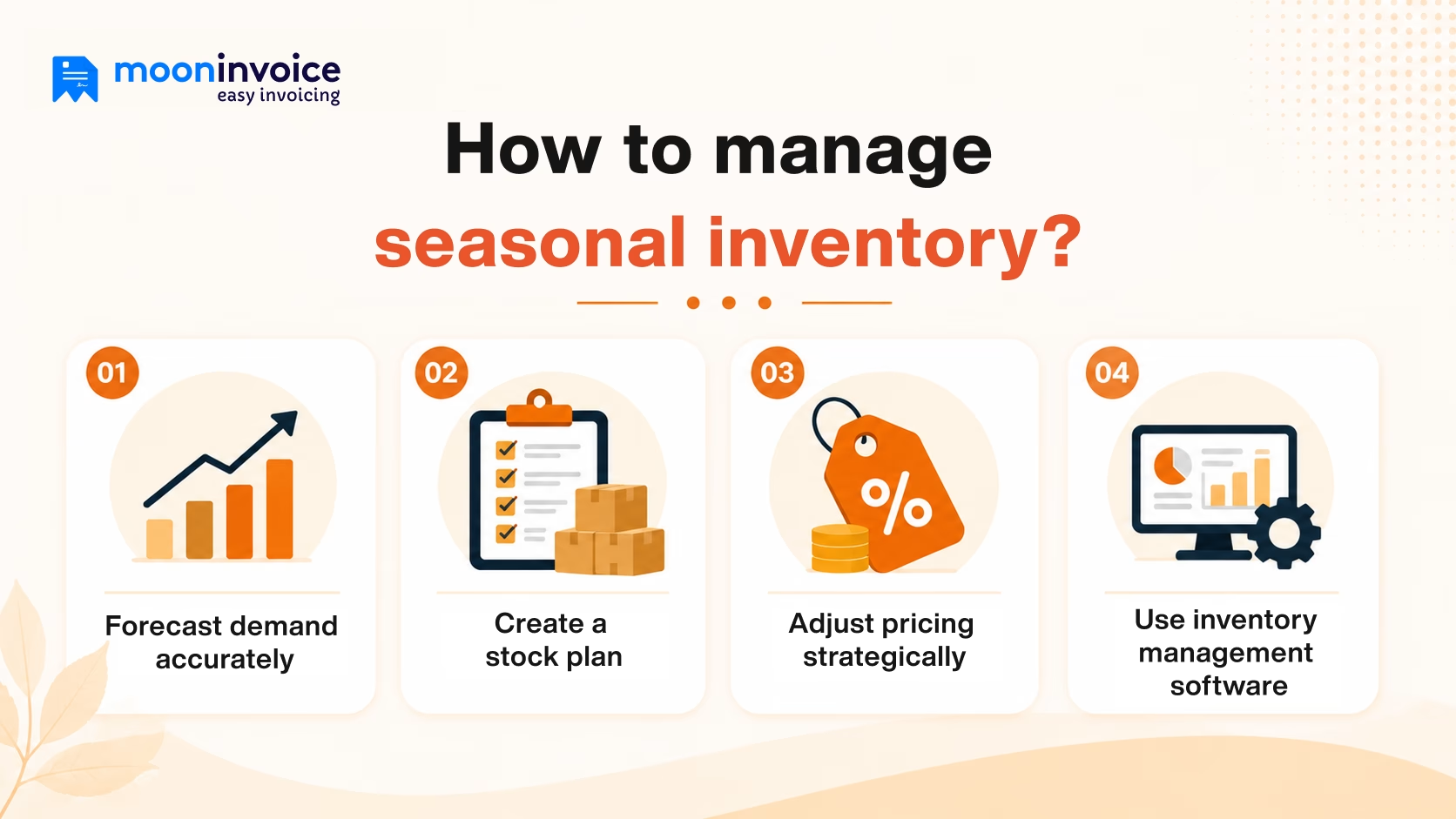
Here are some essential seasonal inventory management ways you must follow:
Forecast demand accurately
You must consider historical data and purchasing patterns to accurately forecast demand. Deploy technology and other forecast tools where possible. This reduces guesswork and gives accurate outcomes.
Create a stock plan
Outline a solid inventory plan that ensures optimal stock levels. You must consider the following questions:
- Which product to stock?
- How much inventory to purchase?
- When to replenish inventory?
Your seasonal inventory planning should cover historical sales data analysis and monitoring inventory levels. Also, it should include reorder timing and the ability to adapt to unexpected demand.
Adjust pricing strategically
Pricing can influence sales, attract customers, and drive sales. With a few pricing adjustments, retailers can increase demand during peak seasons. Also, they can offer discounts at the end of the season. This helps to clear remaining stock while selling all the products.
Use inventory management software
Inventory software reduces manual work, speeds up the process, and saves time. It also provides real-time visibility into stock, inventory movement, and sales performance. Businesses also get clear inventory insights through the reports and takes the decision wisely.
Are you managing inventory manually?
Effortlessly track your stock levels in real time with inventory management of Moon Invoice.
KPIs to monitor seasonal inventory
There are key performance indicators you can use to evaluate the effectiveness of your seasonal inventory.
Days to Sell Inventory (DSI): This KPI is also known as Days in Inventory or Days Inventory Outstanding. It indicates the average number of days it takes the business to sell its inventory.
Formula:
Rate of return: It indicates the percentage of products sold that are returned during a specific period. A high rate indicates product quality issues and customer dissatisfaction. On the other hand, a low rate indicates higher customer satisfaction and reflects better product quality.
Stockout rate: It is another KPI used to measure seasonal inventory workflow. It measures the percentage of customer demand that cannot be fulfilled due to stock unavailability.
Formula:
Inventory turnover: The inventory turnover ratio indicator measures how frequently stock is replenished over a specific period. A low rate indicates high product stock, whereas a high rate indicates smooth inflow and outflow of the product.
Formula:
Sell-through rate: It measures the percentage of seasonal inventory sold compared to total inventory available for the specific period. This helps businesses identify how quickly they are selling the seasonal products.
Formula:
Backorder rate: It measures the percentage of customers who didn’t receive their order due to a stock shortage but later received the item. A lower backorder rate indicates better inventory levels, whereas a higher rate indicates insufficient inventory.
Formula:
Common inventory strategies to manage seasonal inventory
Here are the common inventory strategies that you must use to manage seasonal inventory:
First-In, First-Out (FIFO)
In this model, the oldest product is used or sold first while the newest product remains in stock. Therefore, it is particularly useful for perishable products with a limited lifespan. This helps to reduce inventory obsolescence and spoilage.
First Expired, First Out (FEFO)
This strategy is commonly used for expiry sensitive items such as food, beverages, pharmaceutical. Under this, the product with the earliest expiration date is used or sold first. This leads to prevention of inventory loss and expired stock.
Just-in-time (JIT)
Rather than storing, this inventory model focuses on minimizing inventory levels. It means products are produced or ordered only when they are in high demand. However, this reduces the preparation for an unexpected increase in demand.
Seasonal stockpiling
This is another inventory management strategy. Under this strategy, businesses purchase and stock products in advance to meet expected demand during peak season. This helps to prevent stockouts and also ensures product availability.
Safety stock
To meet the unexpected rise in demand, businesses can maintain extra inventory known as safety stock. This helps to prevent stockouts. To determine safety stock, businesses must consider historical peak-season demand, supplier lead-time variability and demand fluctuations.
Economic Order Quantity (EOQ)
With the EOQ inventory model, businesses can determine the optimal quantity of product to order at a time. This helps maintain the balance between the total cost of ordering and the cost of inventory. Businesses can avoid excess stock and maintain optimal inventory levels.
ABC Analysis
In this inventory model, inventory is broken down into three groups – A, B, and C. The division is based on their values and importance.
- Category A: High value items
- Category B: Medium value items
- Category C: Low value items
This helps businesses can focus more on high-value items while reducing effort on low-value products.
What are the common seasonal inventory challenges?
The common challenges in seasonal inventory management are as follows:
Supply chain disruptions
Inventory management remains smooth with continuous material flow. In contrast, any disruption delays the supply of materials or products across the network. This prevents businesses from fulfilling consumer demand during the season.
Inaccurate demand forecasting
One of the most common challenges in seasonal inventory is predicting the seasonal demand. Unexpected customer demand and changing marketing conditions are the major factors that lead to inaccurate forecasting.
Limited warehouse space
Often businesses struggle with limited space. This makes it difficult for them to manage seasonal and regular inventory together. Businesses experiencing excess seasonal stock commonly face this kind of issue.
Stockouts
Many times, businesses assume that products are in less demand. This kind of approach leads to product stockouts. As a result, it leads to missed sales, customer loss, and damage to brand reputation.
Overstocking
Businesses sometimes order more inventory than is actually required. After the season passes, there is a huge amount of unsold inventory. It creates unnecessary storage costs or compels businesses to offer steep discounts to clear stock.
Simplify seasonal inventory with Moon Invoice
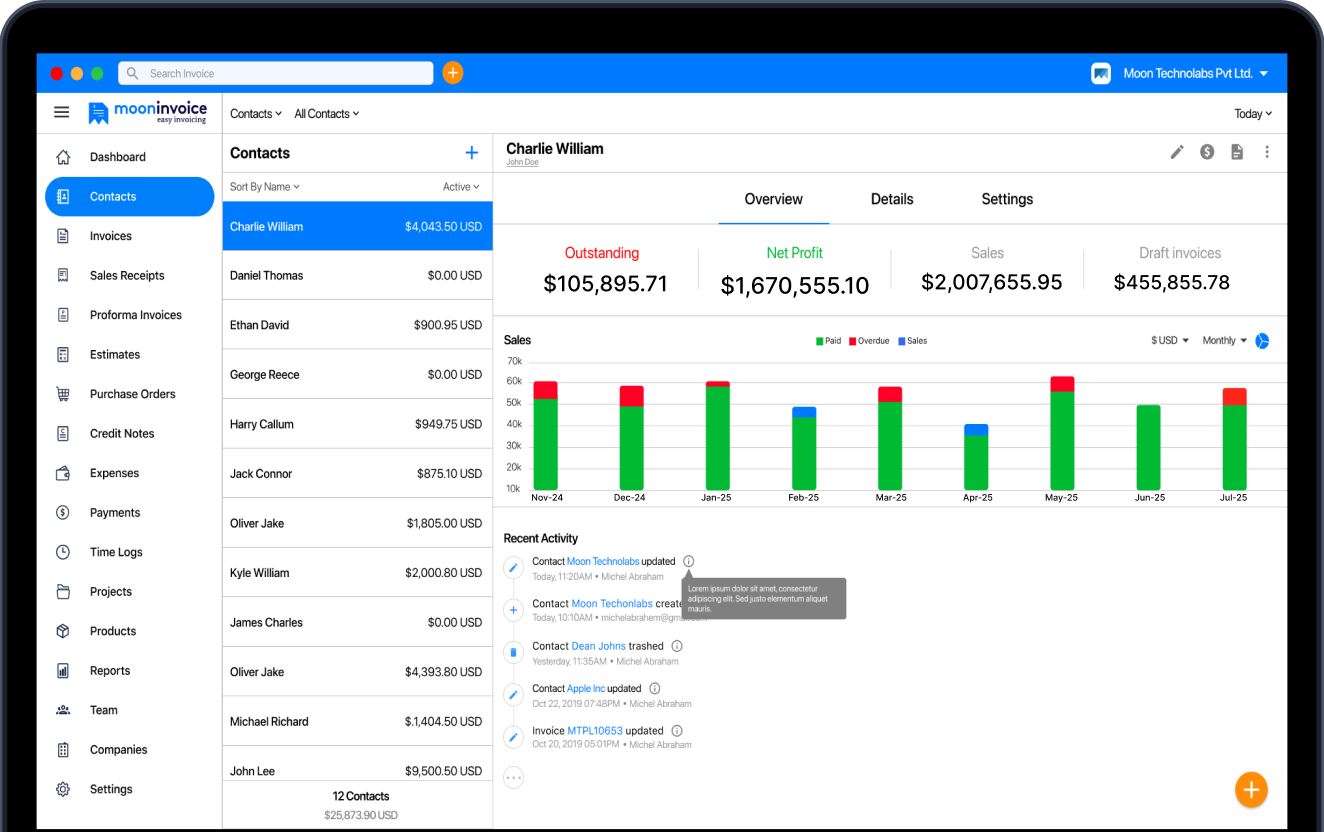
With Moon Invoice, you can streamline your seasonal inventory. This AI-powered invoicing software helps small to mid-sized businesses simplify their billing and inventory tracking from one platform.
The platform automatically updates the inventory level as the invoice is generated. This simplifies the workflow, reduces manual work, and eliminates the risk of errors during peak seasonal demand.
It also supports low-stock alerts that notify you when stock levels drop below the threshold. The software allows you to categorize the product by item name, unit price, stock value, and SKU. It’s handy to download stock reports and also invite team members to collaboratively manage inventory.
The tool offers a dedicated POS feature that supports barcode scanning. It helps retailers and restaurants quickly add products to the POS. This reduces data entry errors and checkout time while promoting faster billing during busy sales seasons.
Overall, Moon Invoice helps businesses prepare for seasonal sales demand and inventory challenges. You can maintain optimal inventory levels, lower storage costs, and improve efficiency.
Manage inventory like a pro with Moon Invoice
From stock to sales, effortlessly manage everything in one place.
Stock alert
Barcode scanning
Easy billing
Seasonal inventory questions
What are FEFO and FIFO?
What are the common examples of seasonal inventory?
What benefit do I get with successful inventory management?
How can I forecast seasonal inventory demand?
Which businesses benefit the most from seasonal inventory management?



Jayanti Katariya is the founder & CEO of Moon Invoice, with over a decade of experience in developing SaaS products and the fintech industry. He holds a degree in engineering. Since 2011, Jayanti's expertise has helped thousands of businesses, from small startups to large enterprises, streamline invoicing, estimation, and accounting operations. His vision is to deliver top-tier financial solutions globally, ensuring efficient financial management for all business owners.