




Definition
Principles of financial accounting are the guidelines and rules that govern how companies record, report, and present their financial information.
Understanding the principles of financial accounting is essential for anyone starting an accounting firm or already managing it. Whether it is a small business or a large corporation, it is equally important. But what are they? This question remains a mystery for many business professionals and even some accountants.
Financial accounting principles are guidelines that business professionals must follow when recording and reporting financial information. Thus, you have a standardized framework for filling out statements such as the cash flow statement, income statement, and balance sheet.
📌 Key Takeaways
- A general accounting principle offers a structured framework for reporting financial transactions.
- Generally Accepted Accounting Principles (GAAP) and International Financial Reporting Standards (IFRS) are standardized frameworks with structured accounting guidelines.
- Understanding the principles of accounting improves financial decision-making and business management.
- Businesses comply with legal and regulatory financial reporting requirements while following these principles.
- US public companies generally follow GAAP, whereas IFRS applies to international businesses.
What Is Financial Accounting?
Financial Accounting is a branch of accounting that focuses on recording, summarizing, and reporting the transactions to present a clear picture of the company’s financial performance and position.
Transactions are summarized in financial statements, such as the balance sheet, cash flow statement, and income statement. The recording process is based on frameworks such as GAAP and IFRS to ensure consistency.
It differs from managerial accounting, which is mainly used by internal teams. Financial accounting is primarily useful for external parties such as investors, creditors, and managers.
Key Financial Accounting Statements
Balance Sheet – The balance sheet describes what the company owns (assets), owes (liabilities), and the shareholders’ equity.
Income Statement – The income statement reflects the net income of the business.
Cash Flow Statement – The cash flow statement presents the company’s income and debt, with a primary focus on cash transactions.
Shareholders’ Equity Statement – The shareholders’ equity statement shows the change in the company’s owners’ equity for the specified period.
What Are Accounting Principles & Their Importance?
Accounting principles refer to the guidelines/rules that companies must follow when recording and reporting financial transactions. Thus, companies are bound to strict regulations, making it hard to hide anything when reporting the transactions.
Thus, the general accounting principle sets transparency in accounting through standardization. With high clarity, investors, creditors, and managers make better investment decisions. Moreover, companies earn the trust of investors and creditors by providing reliable financial reporting.
A Single Mistake Can Ruin Your Accounting Game
Digitalize your business financial story and ensure 100% accuracy.
8 Fundamental Principles of Financial Accounting
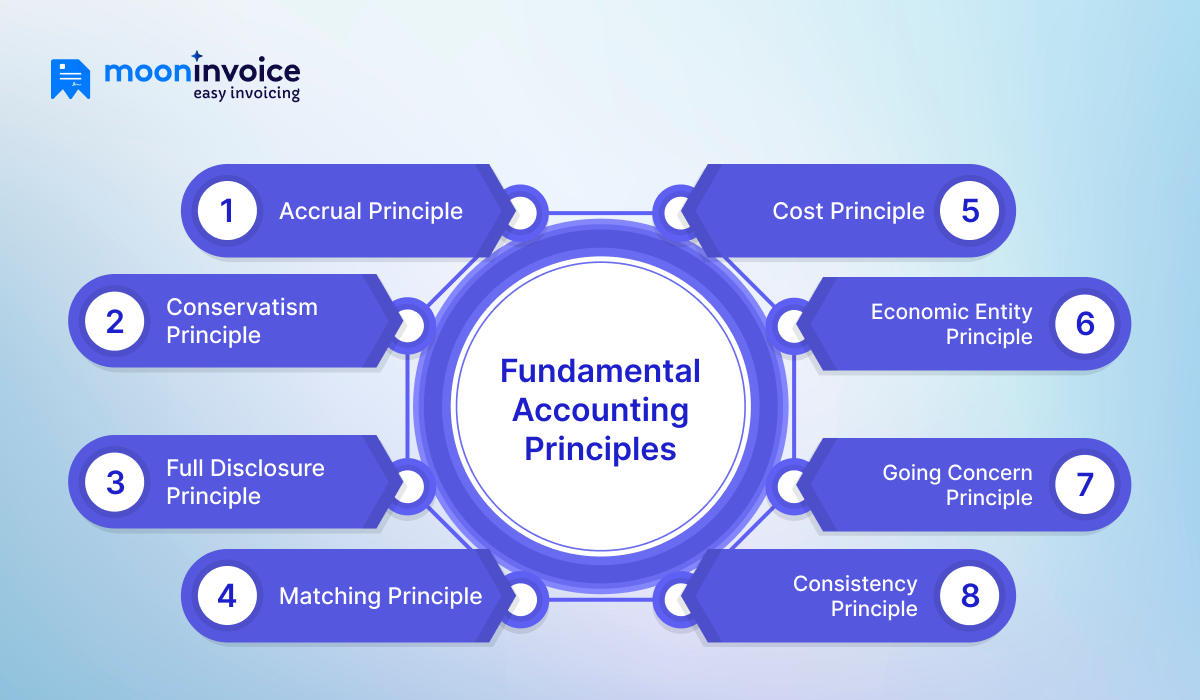
1. Accrual Principle
This principle states that financial transactions should be recorded as soon as they occur, regardless of when the cash is received or sent. It means the company will recognize revenue as soon as the product or service is delivered, even if payment has not yet been received from the customer.
Similarly, the company will recognize and record the expense as soon as any expenditure is incurred, regardless of when the payment is made. This principle helps the company better match revenues to the expenses used to generate them.
Thus, the financial statements prepared under the accrual principle present the true financial performance of the business.
Example of the Accrual Principle
Suppose an IT company provides an app development service in January and sends an invoice. But if the client pays the invoice in February, the company still records the revenue in January, even though the payment was received in February. It means the company is treating it as revenue before receiving payment.
2. Conservatism Principle
According to this principle, expenditures, losses, and current liabilities are recorded as soon as possible. But income and revenue are recognized only when there is a high level of confidence that payment will be received.
This is one of the principles of accounting that prevents businesses from overstating their company’s assets, profit, or financial strength. Thus, this principle leaves no room for misleading stockholders, including investors, creditors, and management. It maintains credibility in the financial reporting.
Example of the Convervastism Principle
Suppose a company sells a product to a customer on credit for $5,000. Somehow, the customer didn’t pay the full amount, and the company realized he wouldn’t pay the remaining balance. So the company will record it as a bad-debt expense in its accounts.
3. Full Disclosure Principle
According to this principle, companies should report the correct information in their financial reports. The information should be detailed, covering the financial condition, accounting methods, and risk.
Thus, companies ensure transparency by providing detailed information that helps investors make informed decisions. Incomplete and inconsistent information should never be a part of when using this principle.
Example of the Full Disclosure Principle
When a company takes a business loan from the bank, it must disclose all relevant details in its reporting. According to the full disclosure principle, the bank must disclose all material information, including the loan amount, loan term, repayment schedule, and any other relevant details.
4. Matching Principle
This is one of the important principles of financial accounting. According to it, revenue and expenses should be recorded in the same period. It also states that the cost and the receipt must be correctly identified in the financial statement. In other words, the cost to operate the business must be matched to the income earned in that business for the specified period.
Companies can easily predict profitability by linking expenditures to revenue. This principle helps maintain accuracy and transparency and supports investors in their investment decision-making.
Example of Matching Principle
A company purchased the gift item for $500 in March and resold it for $700 in April. Initially, $500 is recorded as inventory (an asset) in March, while $700 is recorded as revenue. The $500 will be treated as an expenditure, and the company will record it with matching revenue for the same period, i.e., April.
5. Cost Principle
This principle is also known as the historical cost principle. It states that a company should record its assets, equity, and contributions at the price at which they were purchased.
It means the current price value is not considered, and prices never change accordingly when recording in the statement. The company records the original value in the accounting statement as it existed at the time of purchase.
Thus, it helps maintain accuracy and objectivity because the values are based on real transactions rather than estimates.
Example of Cost Principle
Let’s take an example of an IT company that purchased the printer for $4,000. Later on, the cost of the same printer increased to $4,500. According to the cost principle, the company will still record it as an asset on its balance sheet for $4,000.
6. Economic Entity Principle
This is one of the accounting principles the business must follow. This principle states that business professionals should distinguish between business and personal accounting. It means the records reflect only business-related transactions, even though all transactions are handled under a single identity.
It makes the accounting record clear, organized, and reliable. By presenting the business’s finances separately, investors and creditors are never confused. Also, they evaluate the business’s true financial condition.
Example of Economic Entity Principle
Suppose the business owner purchased two laptops but used one of them for personal use. In this case, the record will be made only for the laptop used for business purposes, not for personal use. The business used laptop will be treated as a business asset, while the personal laptop will be treated as the owner’s withdrawal.
7. Going Concern Principle
The principle of concern states that the company’s sustainability is assured and that it will continue operations, or will not be required to liquidate its assets. It means the core focus is on long-term operations rather than immediate liquidation.
Thus, it helps the business prepare long-term plans, investments, and other financial reporting. This principle is crucial because it demonstrates a company’s stability, which induces investor trust.
Example of Going Concern Principle
Taking the example of an IT company, suppose the company purchases the printer at $5,000 and expects to use it for the next 4 years. Initially, the company will record it as an asset in its financial statement; instead, the cost will be spread over 4 years through depreciation. It is because the company assumes it will continue operating while using its assets.
Depreciation Explained
8. Consistency Principle
The consistency principle states that accounting practices should remain consistent throughout the different accounting periods.
In simple terms, once a company has adopted a specific accounting method, it must use it consistently. Such accounting methods include depreciation and inventory valuation methods.
If the company changes the method for any reason, it must disclose the change in the financial statements. The disclosure statement includes the type of method used and the reason for changing it.
The main purpose of this principle is to present an accurate picture of financial performance when the investor analyzes at different time periods.
Example of Consistency Principle
Suppose a company uses an inventory valuation method; it will continue to use the same method in the future. The company will not change its method, and if it does, it must provide a proper reason in the financial statements.
How are GAAP and IFRS Related to Accounting Principles?
Generally Accepted Accounting Principles (GAAP) and International Financial Reporting Standards (IFRS) are the two accounting frameworks. Their framework guides the application of accounting principles in financial reporting.
USA-based public companies must follow GAAP to provide consistent information to creditors, regulators, and investors. On the other hand, IFRS is used by other global companies in their international financial reporting.
The major aim of both frameworks is to ensure that companies prepare financial statements in a standardized manner. GAAP is applicable to certain transactions, whereas IFRS accountants provide a broader frame of principles.
GAAP is a rule-based framework and includes strict rules, whereas IFRS is a principle-based global accounting standard.
Accounting Methods Based on Fundamental Accounting Principles
On the basis of the fundamental accounting principles, there are two accounting methods, which are as follows:
Accrual Method
Under the accrual method, revenue is recorded when it is earned, not when it is received. It means professionals instantly record the bill as soon as it is generated, whether payment is made or not. This method also follows key principles, such as revenue recognition and matching. Generally, larger companies or public corporations use the accrual method for external reporting.
Cash Method
The cash method is purely cash-oriented. Transactions are recorded only when cash is received. Revenue is recorded when received in cash, and expenses when paid in cash. This method is generally simple and easy to maintain, and is commonly used by small business partners and private companies.
Well-managed Accounting Makes Business Strong
Simply your accounting with Moon Invoice, trusted by 1.7M global customers.
Bottom Lines
Principles of financial accounting are crucial for businesses because they form reliable financial reporting. By following these principles, you can present a trustworthy picture of your accounting records. This practice contributes to long-term growth with investors and creditors. When you present a clear picture of your finances, it becomes easy for your company to attract investors and support business growth.
Frequently Asked Questions
What are the fundamental principles of accounting?
What are the 4 pillars of finance?
What are the 7 principles of finance?
What are the 5 C’s of Finance?



We at Moon Invoice, are the best minds behind smarter invoicing and seamless business growth. We love to solve financial problems and keep providing effective tips through our blogs, newsletters, and social media channels. As a team, we continue exchanging ideas about growing financial challenges and smart use of automation tools.