

In brief
When a customer of the company fails to pay an outstanding balance and the business bears it, it is referred to as an uncollectible debt expense. Businesses can account for bad debt using either the allowance method or the direct write-off method.
For any business, smooth cash flow is a lifeline that keeps operations running, and on-time payment plays an important role. Unfortunately, not every business receives the payment as expected.
Sometimes, customers fail to pay outstanding amounts, and the company recognizes them as uncollectible, a charge commonly known as bad debt expense. This negatively impacts cash flow, accounts receivable, and the overall company’s financial health.
Let’s understand it deeply with an example, along with how to calculate it and different prevention approaches.
📌 Key takeaways
- Bad debt expense is recognized when the company determines that an outstanding balance is uncollectible.
- The direct write-off method and allowance method are two methods for recording these expenses.
- Calculating bad debt expense depends on the accounting method that the business uses. Also, it relies on the amount of accounts receivable expected to be uncollectible.
- Unpaid invoices can put pressure on a company’s cash flow, especially for businesses relying on credit sales.
- Businesses can identify collection problems early through accounts receivable KPIs. This can reduce the likelihood of receivables becoming bad debt.
- Regular receivable monitoring, clear credit policies, timely payment reminders, and proactive collections are key ways to reduce the bad debt ratio.
What is bad debt expense?
Bad Debt Expense (BDE) is the amount a company recognizes as an expense when it does not expect to collect from the customer. Thus, the company recognizes it as a collection loss. There are multiple reasons why this uncollectible accounts expense occurs; some of them are as follows:
- The client might go bankrupt.
- Stops responding to collection efforts.
- The client is unreachable or goes out of business.
- Miscommunication that leads to confusion over the payment terms.
- The customer is unwilling to settle the outstanding balance.
Generally, these expenses lead to financial pressure on the business. It may lead to a reduction in revenue and profitability with changes in accounts receivable value.
It is important to note that bad debt and bad debt expense are related but not identical. Bad debt is the amount owed (whether from an unpaid invoice or a loan) that the company cannot collect. On the other hand, bad debt loss or expense is an accounting expense recognized for the amount expected or determined to be uncollectible. It is an official expense entry used to record that financial loss on the company’s financial statements.
Example of bad debt expense
Suppose a company issues an invoice worth $20,000 to a customer. The company records that amount as accounts receivable because the customer is expected to pay. The client pays $15,000 of the total amount.
Later on, after a long time, the client is unable to pay the remaining $5,000 due to financial issues. The company recognizes the amount as a bad debt expense, assuming that the outstanding amount is unlikely to be collected. Thus, $5,000 will be considered an uncollectible accounts expense.
How to record bad debt expense?
There are generally two methods of recording/reporting bad debt expense on the financial statements.
1. Direct write-off method
In this method, you immediately write off the portion of the specific receivable that has been determined to be uncollectible. Generally, it works well when the bad debt expense is small. In the journal entry, debit the uncollectible accounts expense and credit the accounts receivable.
For instance, if a customer owes $500 and the business determines it is an uncollectible amount, then the amount recorded will be as follows:
| Account | Debit | Credit |
|---|---|---|
| Bad debt expense | $500 | |
| Accounts receivable | $500 |
2. Allowance method
In the allowance method, the business or lender assumes that a portion of its receivables may go unpaid. In other words, the company records an estimated bad debt expense in advance, rather than waiting for a payment failure from the client.
It uses a contra-asset account called Allowance for Doubtful Accounts. This reduces the AR value to reflect the amount the business expects to collect.
For instance, if a company has $20,000 in accounts receivable and expects $500 to be uncollectible, then it will record the amount as below:
| Account | Debit | Credit |
|---|---|---|
| Bad debt expense | $500 | |
| Allowance for doubtful accounts | $500 |
Once the assumed amount of $500 is confirmed as uncollectible, the business will do a journal entry as per the write-off method as follows:
| Account | Debit | Credit |
|---|---|---|
| Allowance for doubtful accounts | $500 | |
| Accounts receivable | $500 |
Are your invoices not resulting in on-time payments?
Explore 66+ customizable invoice templates and create professional and clear invoices in a minute.
How do you calculate bad debt expense?
Businesses can perform the bad debt expense calculation by estimating the portion of credit sales or accounts receivable that are expected to be uncollectible. There are three major accounting methods to find this uncollectible expense. The formula for bad debt expense depends on the method used.
1. Percentage of credit sales method
According to this method, businesses multiply the net credit sales for the period by the uncollectible estimate percentage. The formula for this method is as follows:
For example, suppose a company makes total credit sales of $40,000 and estimates that 3% will be uncollectible; the bad debt loss will be as follows:
BDE = $40,000 x 0.03 = $1,200
2. Percentage of accounts receivable method
This method is similar to the credit sales method. However, it uses accounts receivable instead of sales. It means it estimates the amount of ending accounts receivable that may be uncollectible. The formula is as follows:
For example, suppose a company has ending accounts receivable of $40,000 and an estimated uncollectible percentage of 2%. The bad debt expense is as follows:
BDE = $40,000 x 0.02 = $800
3. Accounts receivable aging method
In this approach, the business estimates bad debt based on how long outstanding invoices will remain overdue. The older the invoice, the greater the chances of uncollectible amounts.
The receivable accounts are grouped by age, and an estimated loss rate is assigned as a percentage. This rate is based on the historical data. The formula is as follows:
For example, suppose a company possesses an aging schedule that looks like this:
| Aging category | Receivables | Estimated loss rate | Estimated bad debt |
|---|---|---|---|
| Current | $20,000 | 2% | 20,000 x 0.02 = 400 |
| 31 to 61 days | $15,000 | 3% | 15,000 x 0.03 = 450 |
| 61 to 90 days | $10,000 | 4% | 10,000 x 0.04 = 400 |
| Over 90 days | $5,000 | 5% | 5,000 x 0.05 = 250 |
| Total | $50,000 | $1,500 |
So, the estimated uncollectible amount is $1,500. However, it is not the final bad debt expense; to find it, you need to subtract the existing allowance from the required allowance.
Suppose $500 is the existing allowance; the uncollectible accounts expense is as follows:
$1,500 – $500 = $1,000
How to prevent and reduce bad debt?
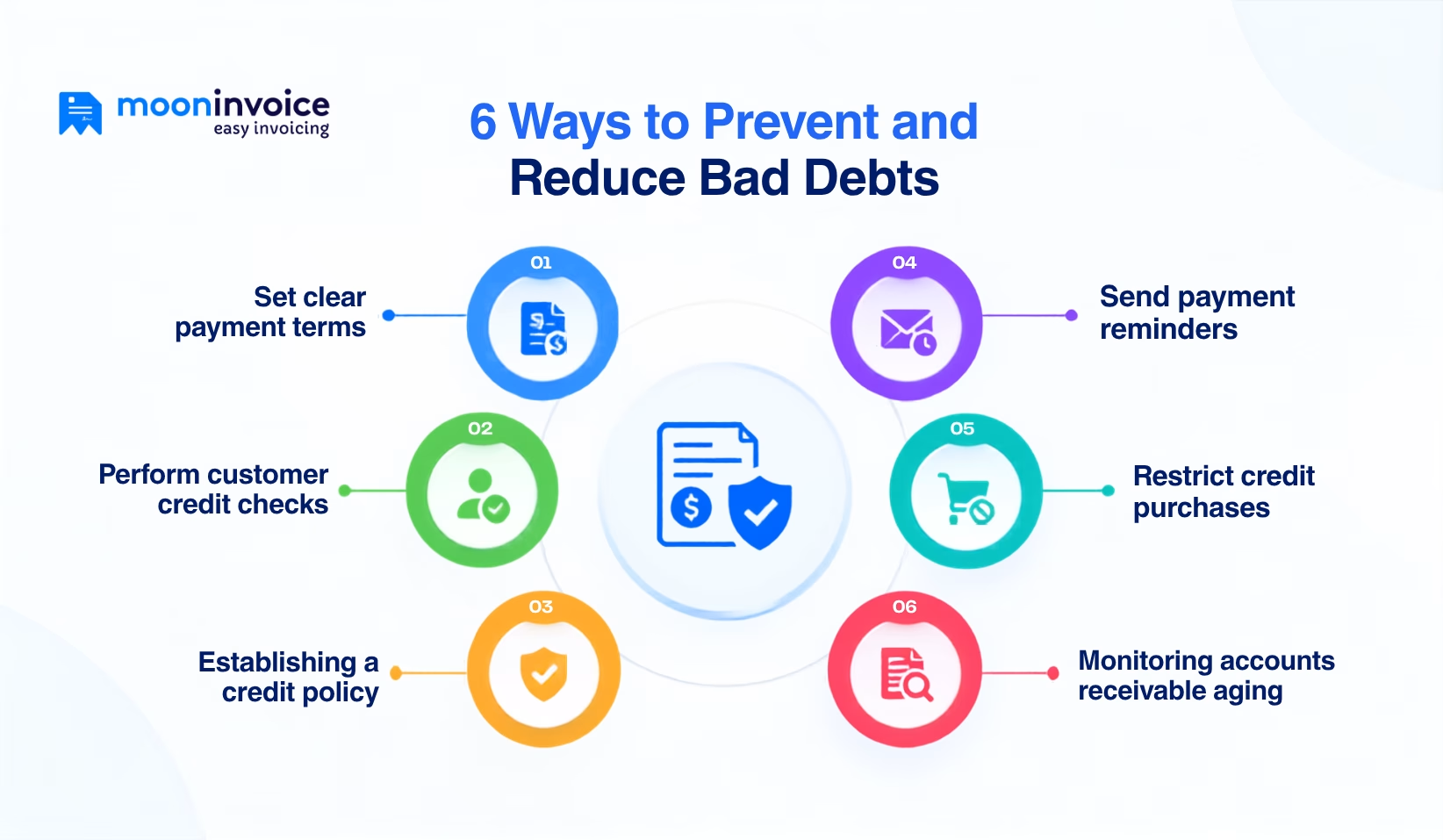
Preventing bad debt helps businesses maintain smooth cash flow, reduce financial losses, and strengthen growth. There are several ways to prevent bad debt, explained below:
Set clear payment terms
Either you generate an estimate or an invoice; always clearly state the payment terms in an understandable format. You must include the due date, available payment methods, and the applicable late fee. This helps achieve on-time payments and reduce the risk of bad debt.
Perform customer credit checks
Before extending credit, it is crucial to check a customer’s credit history and financial background. Certain factors such as previous payment behavior, outstanding debt, financial stability, and credit history must be considered and reviewed. This helps set credit limits and payment terms accordingly, reducing the risk of bad debt.
Establishing a credit policy
A well-defined credit policy is always helpful in reducing bad debt. It must cover how much credit is allowed, which customers are allowed to use it for, and when and how they need to pay. You must also mention credit limits, payment terms, and late-payment rules.
Send payment reminders
Just issuing an invoice and waiting for the payment does not work. You must keep on reminding your client about the payment and take the follow-up wisely. It encourages your client to make on-time payments, which helps to reduce bad debt.
Restrict credit purchases
If the customer doesn’t pay the outstanding amount, you can pause credit purchases. Later on, you can allow purchases only after the pending amount is cleared. This is another way to prevent bad debt expense.
Monitoring accounts receivable aging
You must track unpaid invoices based on how long they remain unpaid. It helps to prevent future debt by highlighting high-risk accounts. With the clear identification of unpaid invoices, you can take action such as sending payment reminders to encourage payment.
Using expense tracking software ,you can streamline your business expense management. It helps you track end-to-end transactions and get a clear picture to make informed decisions.
Get your accounting workflow smarter with Moon Invoice
With manual handling of your accounting and finances, you may encounter errors along with a sluggish process. Moon Invoice helps overcome this issue with digital concepts and advanced features.
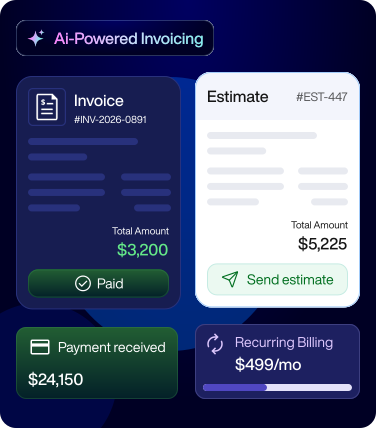
Trusted by over 1.7M global users, this AI-powered invoicing software helps businesses streamline their billing process. It reduces errors, saves professionals time, and speeds up the workflow.
AI automation: Its AI-rich features help speed up workflows and boost overall productivity. You can create invoices, estimates, and receipts with its quick scan feature. Additionally, you can quickly record payments and contacts through AI by uploading the required details.
Customizable templates: It offers 66+ customizable invoice templates that let you create personalized, professional, and clear invoices in minutes.
Centralized platform: The centralized system helps manage all the documents in one place. This prevents any document or information from being lost or missing, enhancing systematic document management.
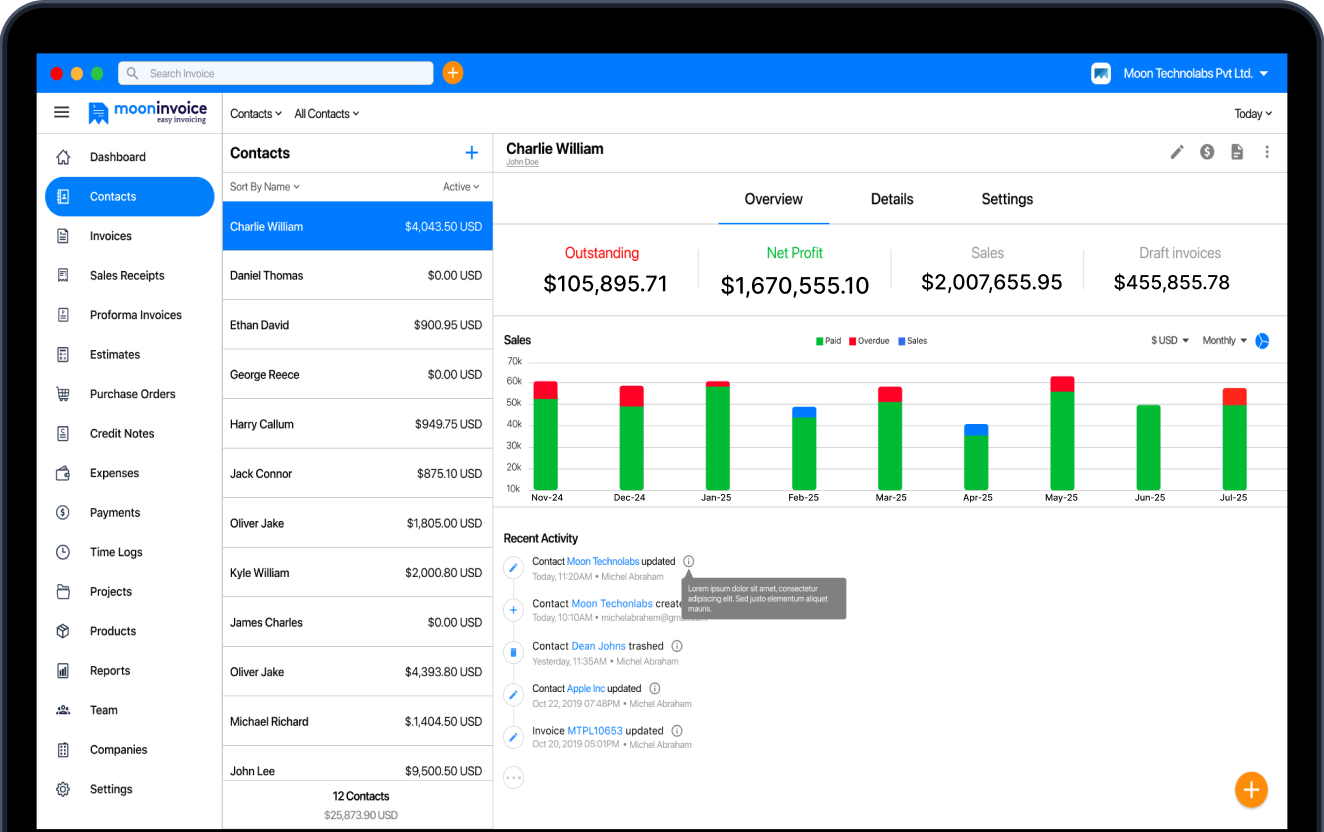
Real-time tracking: Supports 15+ reports that showcase the outstanding balance and other financial metrics to make informed decisions.
Recurring invoicing: Additionally, this invoicing software allows you to set recurring invoices for ongoing purchases. It ensures you never miss issuing any invoice for a single sale.
Payment reminder: Easily set payment reminders for your customers. This ultimately contributes to on-time payment, which helps prevent unpaid invoices.
Multiple payment methods: Moon Invoice supports various payment gateways, including Stripe, PayPal, UPI, Apple Pay, and Google Pay. This allows businesses to offer convenience to the customer.
Tracking of unpaid invoices: Simply track the due amount by applying a filter in the invoice.
Using Moon Invoice, businesses can reduce late payments and improve collection efficiency. This lowers the likelihood of uncollectible amounts that could become bad debt expense.

Quick answers on bad debt expense
What causes bad debts?
What is the difference between bad debt expense and allowance for doubtful accounts?
Is bad debt expense an operating expense?
What is the difference between bad debt and doubtful debt?
Is bad debt expense tax-deductible?



We at Moon Invoice, are the best minds behind smarter invoicing and seamless business growth. We love to solve financial problems and keep providing effective tips through our blogs, newsletters, and social media channels. As a team, we continue exchanging ideas about growing financial challenges and smart use of automation tools.