


TL;DR
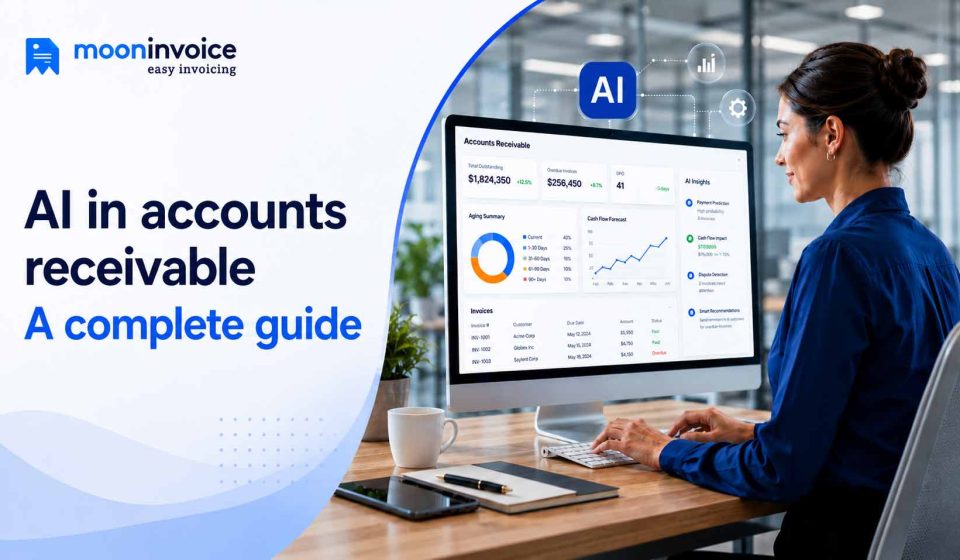
Artificial intelligence in accounts receivable enhances the overall accounting process of the business. It automates the process, payment tracking, and collection follow-ups. Machine learning, OCR, and natural language processing (NLP) are the key technologies that power AI in accounts receivable.
A traditional manual approach in the AR process can lead to errors and consume your time. At this point, the best step is to implement AI-powered accounts receivable.
This Artificial Intelligence enables you to automate repetitive tasks, save time, and improve your overall efficiency. It also accelerates cash flow while reducing human error that could negatively impact your business.
According to the Forbes Technology Council report, 99% of organizations report reduced Days Sales Outstanding (DSO) by using AR automation.
But how could you implement AI in accounts receivable, and what technologies work behind it, you must know it. So, let’s unlock the answer here.
📌 Key takeaways
- Adopting AI in accounts receivable reduces human error and improves accuracy.
- AI automates repetitive AR tasks, including invoice processing, data entry, and other accounts receivable workflows.
- By adopting AI in accounts receivable, business professionals can reduce processing costs.
- Artificial Intelligence in accounts receivable is an effective approach for detecting fraud and anomalies.
- It helps businesses to speed up invoice approvals and payment cycles.
What is AI in accounts receivable?
AI in accounts receivable refers to the use of NLP, machine learning, and other technologies in the accounts receivable process. It automates various tasks, such as data entry, invoice generation, sending payment reminders, follow-up & tracking.
In this way, business professionals can handle their tasks more efficiently, save time, and ensure high accuracy. AI implementation transforms the traditional concept into a modern system, contributing to business productivity.
Core elements of AI-powered AR solutions
Multiple intelligent components work together to automate invoicing, improving cash flow, and reducing manual work. Here are the main components of AI-powered AR automation:
Intelligent invoice processing
Technologies such as Optical Character Recognition (OCR) help to extract data. It means that instead of typing each piece of data, the AI automatically retrieves information such as invoice number, customer information, due date, amount, etc. This enhances accuracy, boosts the process speed, and helps to save time.
Automated workflow
AI is the right solution for automating recurring tasks, such as invoice delivery and collection reminders. This eliminates manual effort, enabling faster processing and saving time. Thus, by using accounts receivable automation, one can achieve the right positive impact on overall operations.
Conversational AI
Using AI to automate customer interactions is a great approach. Technologies such as natural language processing (NLP) and machine learning enable the system to respond to customers while understanding their queries. This enables the team to focus on other tasks while taking charge of customer handling.
Agentic AI
Agentic AI is a real game-changer in the accounting world. It is capable of solving complex issues and proactively executing the tasks that humans do. Monitoring outstanding invoices, prioritizing overdue accounts, sending payment reminders, and following up are major tasks that AI can handle.
Fraud detection and anomaly identification
The real challenge in accounting is identifying unusual activities and fraud. AI technologies, such as machine learning, identify unusual patterns, including payment irregularities, fraud, and billing errors. It is mainly useful where a large volume of financial data is processed.
What are the AI technologies applied in AR?
There are certain technologies behind the successful work of AI in accounts receivable. Some of these technologies are as follows:
Machine Learning
In accounts receivable strategy, Machine Learning analyzes the customers’ behavior and historical payment data. With continuous learning from this data, it becomes easy to identify trends and predict results.
Natural Language Processing (NLP)
Natural Language Processing technology is primarily useful for automating customer interactions via chatbots. This technique enables the system to understand human language and respond to queries more effectively. Even if it is not capable of answering the queries, it is responsible for gathering important information from the customer. Thus, it simplifies the team’s task.
Predictive Analytics
Predictive analytics is more about predicting the future based on historical data. Thus, it plays a crucial role in cash flow forecasting. The major focus is on the future payment outcome and identification of collection risk. The early detection of risk helps organizations to reduce their Days Sales Outstanding (DSO) and strengthen their overall financial performance.
Optical Character Recognition (OCR)
OCR technology in accounts receivable helps extract data from scanned documents. You can easily get the key details such as invoice number, invoice date, due date, business details, and client information. It reduces manual processing and enhances the workflow. Extracting the data helps you to get accurate information and saves time.
Robotic Process Automation
RPA is not a subset of Artificial Intelligence but rather a complementary technology. It refers to automating the repetitive tasks of the invoicing process. It includes data entry, payment reconciliation, and invoice matching. In this way, it reduces manual effort and streamlines the process.
Simplify your invoice tracking with Moon Invoice
Monitor your outstandings and automate your payment reminders within a single platform
How to implement AI in accounts receivable?
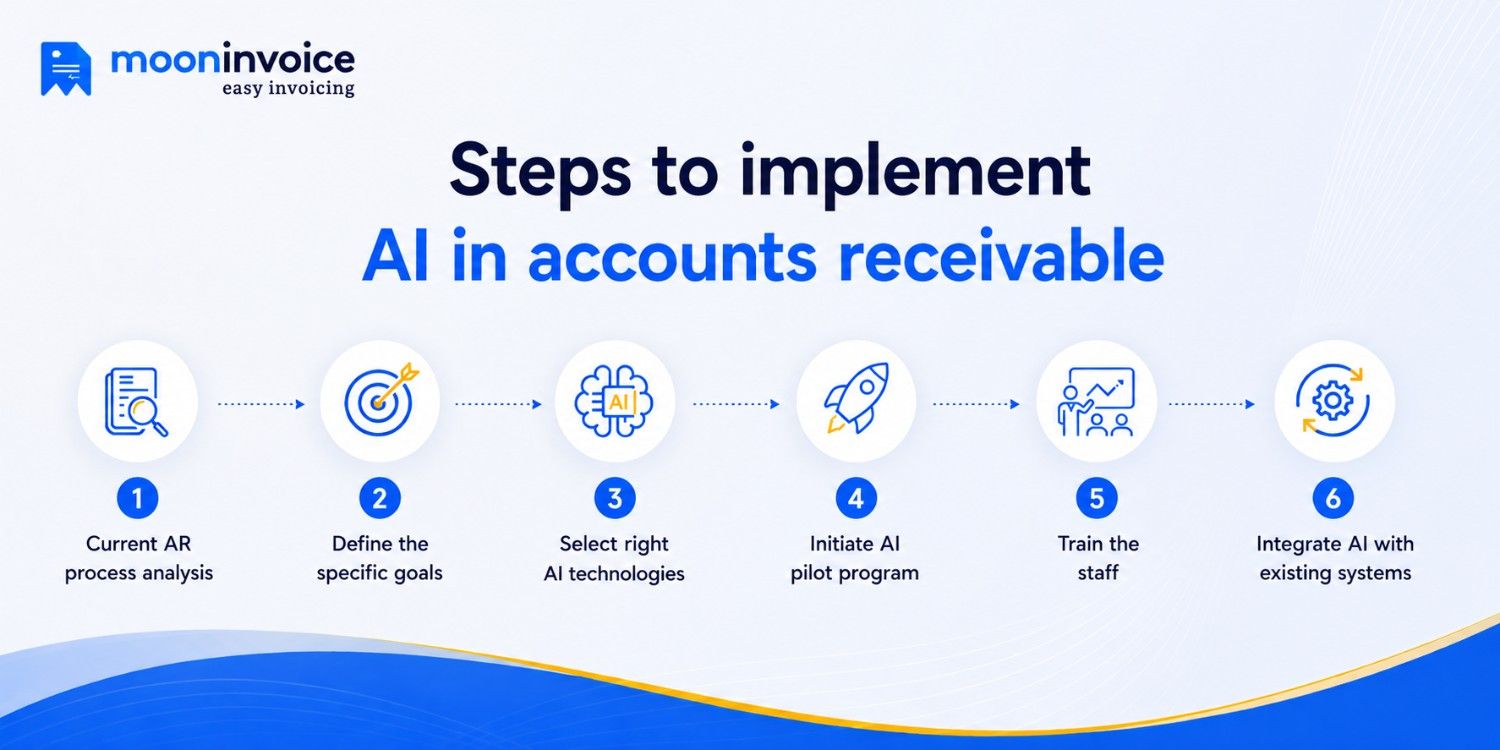
Implementing AI in accounts receivable (AR) requires a strategic approach to define business objectives and select the right technology.
Here are the steps to add AI in accounts receivable:
1. Current AR process analysis
Initially, you need to examine your existing AR process to identify the shortcomings and issues. It is an important step because analysis gives you a clear idea of where AI will work better.
2. Define the specific goals
Before implementing AI in AR, you must define your goals. Typical objectives can include boosting invoicing processing and reducing processing time, detecting fraud, or enhancing customer interaction. Here, you need to understand when and how to incorporate AI technologies.
3. Selecting the appropriate AI technologies
One common mistake business professionals make is choosing the most popular and trending technology. Here to ensure that AI technologies are aligned with your specific needs and budget. You must also analyze the technology’s capability and scalability.
4. Initiate AI pilot program
Before implementing AI in accounts receivable, it is necessary to run a small pilot test. This helps you assess whether the chosen AI technology integrates well with your system or if you need to switch to another technology. It is an important step that you must not skip.
5. Train the staff
Introducing the AI process would be something new for your team. So, it is always a good idea to provide appropriate training on AI tools. You must be clear about how AI works and how it benefits your operation. Also, allow your team to speak about their concern over AI before the final implementation.
6. Integrate AI with existing systems
Once you are confident that the chosen AI technology is aligning well with your process and there are no issues, it’s time to implement it. You can connect it to ERP, accounting, and other procurement systems.
Benefits of AI integration in AR processes
AI integration into AR processes affects the overall accounting process of the business. Here are the key advantages of its integration:
Automate the process
Artificial intelligence makes a high contribution to automating the various accounting processes. This further saves time, commits high accuracy, and frees up the resources involved in operation.
Boost the cash flow
AI-powered AR automation helps enhance processes such as analyzing outstanding invoices, sending payment reminders, and following up. This directly impacts the cash flow, ensuring you get on-time payment for every deal.
Improves customer experience
The automated payment process offers customers a faster payment experience and reduces their wait time. Additionally, they get personalized communication that feels valuable to them. Faster problem resolution strengthens the business-client relationship.
Challenges associated with AI in accounts receivable
Deploying AI in accounts receivable is not as simple as it may seem. There are various challenges that you can face when dealing with AI in your accounting:
Data privacy and security
AI systems process a large amount of sensitive data, such as invoices, bank details, and credit information. Unfortunately, these systems are more prone to data breaches and hacking. Therefore, it becomes a major challenge when the appropriate security measures fail to protect information.
Operational complexity
Intelligent accounts receivable is not a cost-effective solution. You can experience significant complexity while implementing AI in accounts receivable. It is because not every technology can be fitted well with the specific system. Also, it is necessary to continuously monitor your system to ensure the business achieves optimal outcomes.
High implementation cost
Deploying AI in the accounts receivable system is quite expensive. There is a significant investment in the system integration, infrastructure, employee training, and software license. However, this can be a good return on investment for large volumes of data. It is because organizations achieve faster cash collection and greater efficiency.
Unlock smarter AR management with Moon Invoice
Utilizing AI in accounts receivable speeds up the accounting process, improves accuracy, and shortens the payment cycle. Organizations that rely on AI experience greater operational efficiency. In the future, it will continue to evolve and help businesses transform their operations to a higher level. However, leveraging these benefits depends on selecting the right solution.
Moon Invoice, a reputable AI-powered invoicing software, helps millions of businesses worldwide with their daily invoicing process. This billing software simplifies your AR workflow by managing invoices, customer data, payments, and more in a single centralized system. Therefore, it gives a systematic approach to handling your information and other details.
Using Moon Invoice, you can automate your payment reminders and enhance your payment flow. Further, the system provides valuable insights into outstanding payments and other historical data to support informed decision-making.
With its AI-enabled quick-scanning feature, you can create a receipt, invoice, or estimate by scanning the document. Similarly, it allows you to create your contacts and payment records using AI by simply uploading the details.
Overall, Moon Invoice reduces administrative workload and helps businesses manage their AR more effectively.
Ready to take control of your accounts receivable with Moon Invoice?
Automate your billing, ensure on-time payment, and improve cash flow for every deal.
AI in accounts receivable FAQs
How is AI used in accounts receivable?
How does AI improve accounts receivable management?
Can I automate payment reminders?
Is AI in accounts receivable secure?
Is accounts receivable AI good for small businesses?



We at Moon Invoice, are the best minds behind smarter invoicing and seamless business growth. We love to solve financial problems and keep providing effective tips through our blogs, newsletters, and social media channels. As a team, we continue exchanging ideas about growing financial challenges and smart use of automation tools.