
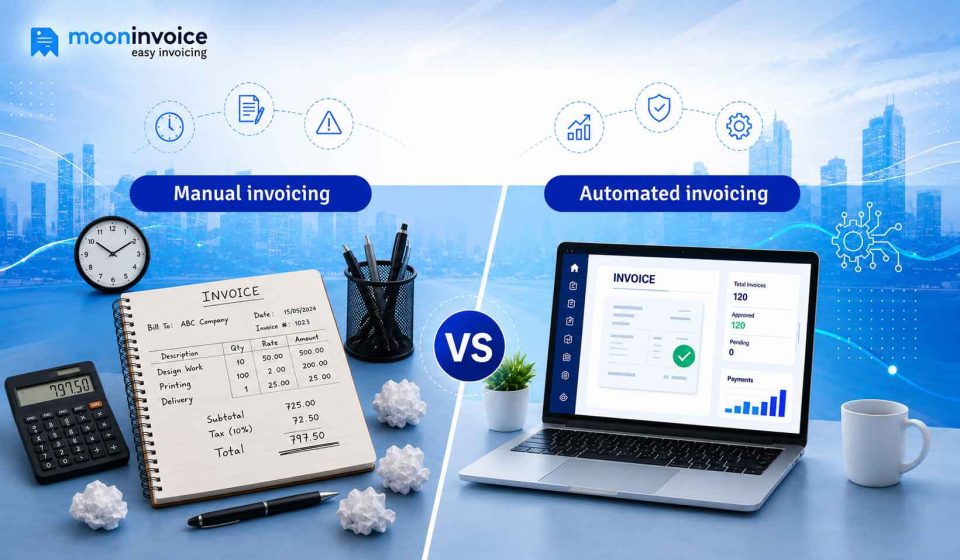


That Monday morning, when you open a spreadsheet and sigh. What you get is 50+ invoices waiting, along with some duplicates. Plus, emails from vendors and suppliers. And plenty of other things on the plate. But who will sort all this out? Certainly not someone who wants to spend hours staring at rows of numbers until their eyes blur.
If you are following the same approach, you are not alone because there are millions of businesses that are doing it this way. That’s Manual invoicing.
Now, here’s the catch – the way you process invoices is quietly costing you thousands of bucks. This itself stresses the need for automated invoicing and not a paper-based manual approach. But does an automated billing system make a difference? Let’s find out.
What is manual invoice processing?
Manual invoice processing refers to the traditional approach, where hand-written invoices are picked up and handed over to the recipient, prompting them to pay outstanding dues. For every invoice, the same process is followed by the issuer. They do it again and again. Even 50 times or more.
That is manual invoice processing, where every step relies on human intervention. A process where human time is absorbed into a task that feels administrative but carries financial consequences, too.
Either the data is in spreadsheets or buried in long email threads, which means a lot of dependencies on who handles the invoicing process. When he or she goes on leave, you know nobody else knows how things work.
Spending hours processing invoices?
Adopt Moon Invoice’s AI automation now and reduce your time spent on invoice processing.
How does it work?
- An invoice is generated using a piece of paper and sent via email
- The concerned person reviews the invoicing details
- The approver reviews, signs off, and returns it
- Payment is manually scheduled and processed
- The manual data entry is made in the spreadsheet for record-keeping
Now, invoice processing automation – let us paint the picture.
What is automated invoice processing?
Automated invoice processing is the process of generating, sending, and managing invoices using an automated billing system. The software lets you prepare an invoice as fast as twice, and with minimal human intervention through AI automation.
You neither need to go through every invoice nor waste time correcting small errors. Automating your invoice processing is like having someone who does all the hard work, so your team doesn’t have to.
How does it work?
- The invoice lands in your inbox
- OCR (Optical Character Recognition) scans and reads it
- The invoice is automatically routed to the approver
- The approver reviews at their own pace
- Once approved, payment is scheduled automatically
Comparing manual vs automated invoice processing
Below, we compare how manual and automated invoice processing differ in certain ways.
| Aspects | Manual invoice processing | Automated invoice processing |
|---|---|---|
| Accuracy | Incorrect amounts, duplicate invoices, missing information, or tax miscalculations can easily slip through the cracks when teams process large invoice volumes manually. | An automated way guarantees higher accuracy in invoice processing by automatically extracting invoice data. |
| Invoice tracking | Manual invoice processing makes tracking very difficult because records are scattered across spreadsheets, emails, and whatnot. | On the contrary, automation, when coupled with AI, provides seamless tracking of invoices and other important documents. |
| Human intervention | Human involvement is required at every stage when processing invoices manually. A person needs to add invoice details, verify the amount, and update the records. | There is little to no requirement for human intervention when it comes to the automated invoice processing, meaning no need for extra resources. |
| Payments | Dispatching payments significantly slows down due to the involvement of multiple people in the process. This will lead to late payments and sometimes, even additional penalties. | Automated invoice processing, on the other hand, speeds up the payment cycle. Because invoices move through the workflow automatically. |
| Invoice management | Organizing invoices is a tad difficult because invoices remain scattered. Some sit in the inbox while others rest in archive boxes. This makes it difficult to prepare financial records. | Automated invoice processing centralizes all of them in cloud storage, meaning you can generate reports like the P&L report, the invoice aging report, and other reports in seconds. |
Some myths about invoice automation
Now, as you know, there are several misconceptions about invoice automation. So, let’s separate fact from fiction.
Myth #1 – “Automation is for large businesses.”
In accounting firms, you mostly see individuals making assumptions that invoice automation is a luxury reserved for corporations with million-dollar budgets. Small and mid-sized businesses might reckon, “That’s not built for us.” But that is not true. Automation aids every business, regardless of its size.
Myth #2 – “It’s not fully secure.”
Security concerns are the main reasons why businesses hesitate to adopt invoice automation.What they believe is that their data may be leaked and fall into the hands of unauthorized parties. That’s completely untrue because automation, in fact, is more secure than processing invoices manually.
Myth #3 – “If we automate invoice processing, we will lose control.”
Now, this myth is something deeply psychological. Your control over financial processes is tied to accountability, trust, and confidence. The automation, however, does not take control away, but strengthens it. By bringing in automation, you can still see exactly where things stand at any moment.
Myth #4 – “It doesn’t help when our invoice volume is too low.”
Businesses handling 50, 60, or even 80 invoices think that automation simply is not worth it. Some of them may reckon they are too small to adopt invoice automation, which might not make any difference. The automation not only accelerates invoice processing but also makes sure it is done correctly, regardless of your invoice volume.
When should businesses switch to automated invoicing?
In case your finance team, or worse, your founders and managers, are spending more time managing invoices, then it’s time to bring in automation, maybe AI-driven invoice automation. If you are dealing with errors even after spending enough time generating them, then it’s a clear signal that manual processing is no longer sufficient.
Apart from that, if invoices are waiting for approval, getting lost in email threads, or being approved too late, then your invoicing process needs structure. Switching to automated invoicing assures invoices reach the concerned person without reminders. It is a complete paperless approach, which means you neither face delays nor the chance of inaccuracy in invoicing.
Top receipt scanning apps
Speed up invoice processing with automation software
Every hour you spend on invoice processing is an hour not spent on your business.
An advanced invoicing software, Moon Invoice, gives back those hours.
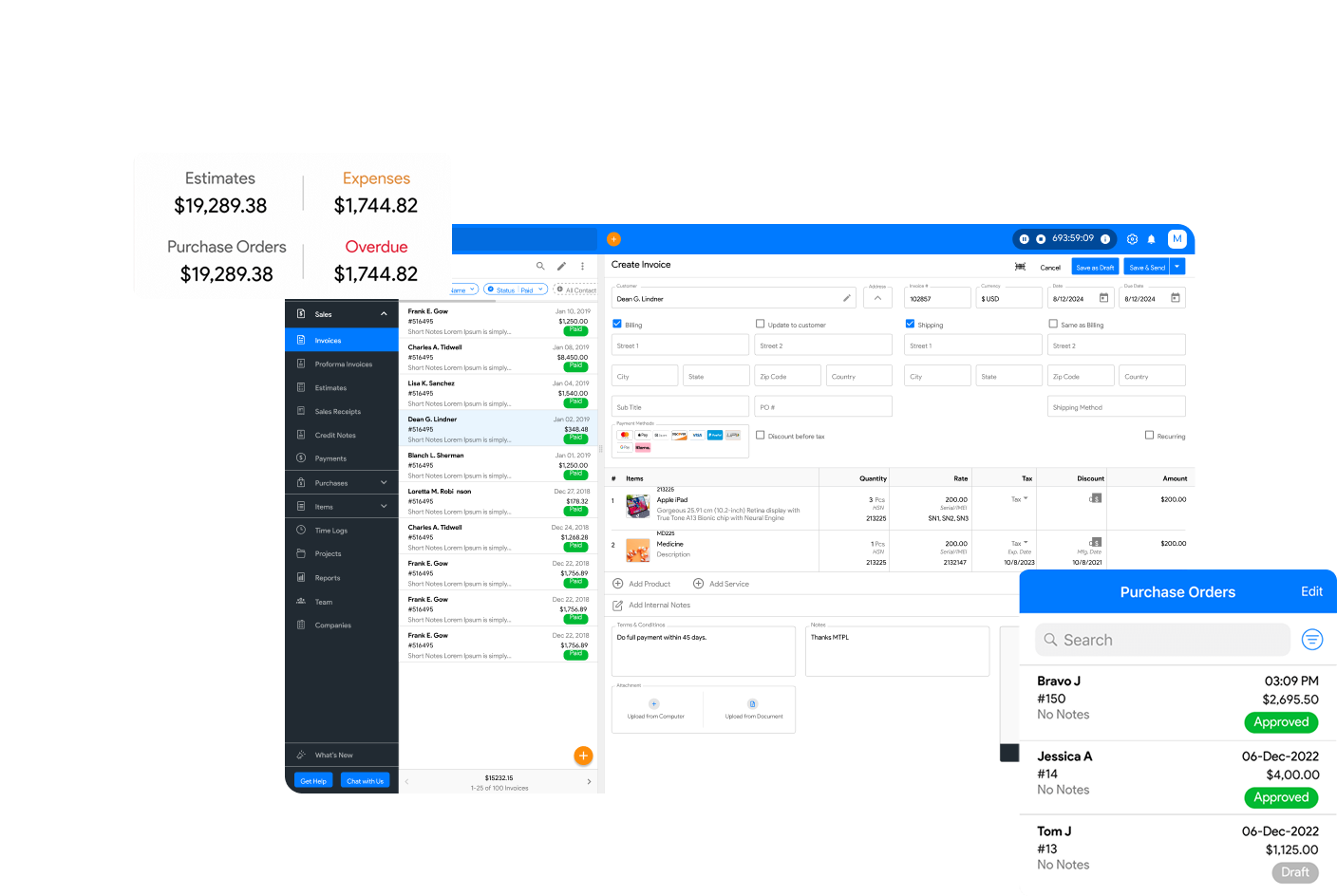
Moon Invoice takes that burden off your team’s plate completely by automating the entire invoicing process. Your team is notified as soon as there is an incoming invoice. This means your accounts payable department can verify the details against the purchase order and quickly proceed with payment.
With smooth workflows and timely payments, there is no chance of incurring hefty penalties. Neither fear of straining vendor relationships. The best part is that you can manage multiple vendors using the same platform and even allow or restrict them to check the current invoice status.
Here are more reasons to automate your invoicing process with Moon Invoice:
- Customizable invoice templates
- AI predictor
- Financial statements
- AI-enabled receipt scanner
- Vendor management
- Bank reconciliation
- Online payments
- Offline access
- Cloud storage
Eliminate delays with AI automation
Process invoices 2x faster

PDF templates
WhatsApp share
On-time payment
Manual vs automated invoice processing: Which one has an edge?
There was a time when manual invoice processing was the only choice, and somehow, businesses made it work. That time is largely behind us. Nowadays, businesses move faster. Vendor networks are larger. Compliance requirements are stricter. And the cost of even small errors is also higher than it used to be. Manually processing invoices works, but the environment around it has simply become more demanding.
To meet the growing demands, the automated systems, particularly in invoicing, have become the need of the hour. It automates most of the tedious and repetitive tasks, so finance teams and businesses can focus on other core activities. Therefore, the edge goes to automation.
General questions answered
What is the difference between manual and automated invoice processing?
Is automated invoice processing compliant with tax and audit regulations?
How much does invoice automation software cost?
How secure is invoice automation software?
Can small businesses use invoice automation software?



We at Moon Invoice, are the best minds behind smarter invoicing and seamless business growth. We love to solve financial problems and keep providing effective tips through our blogs, newsletters, and social media channels. As a team, we continue exchanging ideas about growing financial challenges and smart use of automation tools.