


Profit margin definition:
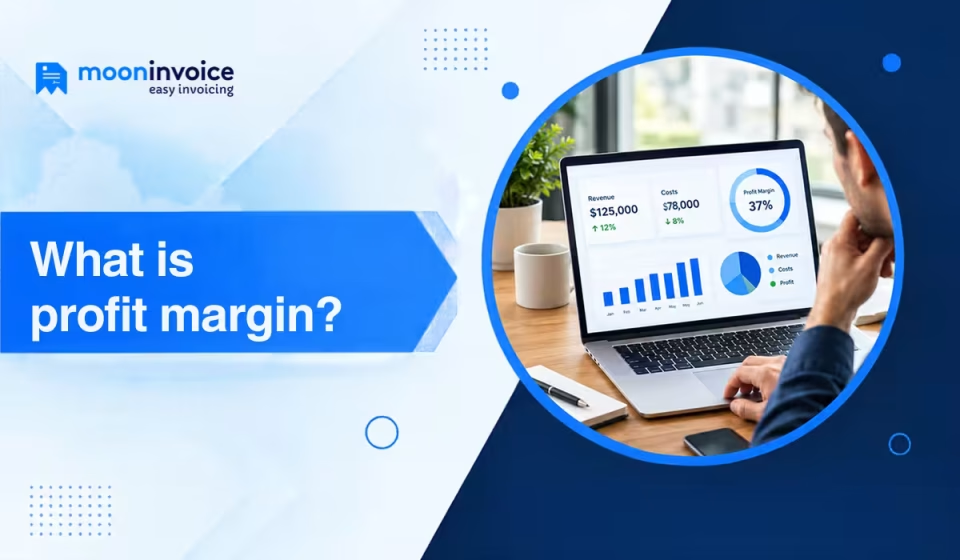
Profit margin is the percentage of revenue a business retains as profit after deducting relevant costs in a bid to measure profitability.
Revenue is usually the first thing every business owner notices in the balance sheet. When revenue numbers are good, it shows you are on the right path towards achieving your business goals. However, revenue only tells you how much money came in. It doesn’t tell you how much of that money you actually keep.
That is the gap profit margin fills. Whether you run a manufacturing unit, a consulting practice, or an early-stage startup, profit margins show how efficiently you turn sales into profit. It helps you set the correct price for your products or services and address pricing-related issues. By looking at profit margin, you can quickly tell whether your growth is healthy or simply expensive.
In this guide, we will discuss what is profit margin, walk through its types, and how to calculate it step by step.
So, let’s get started without wasting any time…
📌 Key takeaways
- Profit margin shows the percentage of revenue a business keeps as profit after expenses.
- There are four types of profit margin, namely: gross profit, operating profit, pretax profit, and net profit margin.
- To calculate profit margin, first find total revenue, then identify the relevant profit figure, and apply the formula.
- Profit margin uses selling price as its base, while markup uses the product’s cost.
- Key factors that affect profit margin are selling price, direct costs, operating expenses, and sales mix.
What is profit margin? (Profit margin meaning)
The term “profit margin” is a percentage that shows how much profit a business earns from every unit of revenue it generates. Profit margin helps businesses understand what they are actually earning from sales and how to manage spending efficiently.
Some businesses also call profit margin a “profit margin ratio” because it expresses profit as a proportional relationship (usually a percentage) of total revenue.
The general profit margin formula is:
Where,
- Profit: The amount remaining after deducting relevant expenses from the revenue.
- Revenue: The total income generated from selling goods or services before expenses are deducted.
Do more than just calculate profit margin.
Create invoices, manage expenses, generate reports, and maintain records with Moon Invoice.
Profit margin example
Let’s assume a small design studio has earned $50,000 in revenue in a quarter. After subtracting expenses, it is left with $10,000 in profit.
Here, the profit margin will be:
- Profit margin = ($10,000 / $50,000) x 100 = 20%
So, the studio generates $0.20 of profit for every $1.00 it bills.
Now imagine another studio with $200,000 in revenue and $20,000 in profit. In this case, the profit margin is only 10%. Notice the difference: even though the second studio has higher revenue and profit, it is still less efficient than the first studio.
This is the kind of insight a profit margin reveals, while a raw profit figure hides it.
Types of profit margin
So far, we discussed what is profit margin, and now we will look at its types. Businesses use different types of profit margins to get clarity on how much revenue remains as profit at various stages.
Here are the four most common profit margins to consider.
1. Gross profit margin
Gross profit margin shows how much profit remains after you deduct only the direct costs of producing goods or delivering services.
These are usually called cost of goods sold (COGS) or cost of revenue. They include raw materials, direct labor, and direct expenses of delivering a service.
Gross profit margin formula:
2. Operating profit margin
Operating profit margin measures profit from core business operations, before interest and taxes.
Operating profit is revenue minus COGS minus operating expenses such as salaries, rent, utilities, software, and marketing. Since taxes and other non-operating expenses are excluded, it portrays a clean picture of how well your business performs in its day-to-day operations.
Operating profit margin formula:
Where,
3. Pretax profit margin
Pretax profit margin shows profit after operating costs and after interest and other non-operating items, but before deducting taxes. It is helpful when comparing businesses or periods with different tax situations.
Sometimes pretax profit margin is also referred to as EBT (earnings before tax).
Pretax profit margin formula:
Where,
4. Net profit margin
Net profit margin is the bottom line. It shows what is left after every expense has been deducted: cost of goods sold, operating expenses, interest, taxes, and any other costs.
Businesses use this margin to understand their overall profitability after accounting for expenses beyond core operations.
Net profit margin formula:
Where,
Other types of profit margin
In addition to these 4 primary types, some businesses also use the following two. Here they are:
- EBITDA margin: Measures earnings before interest, taxes, depreciation, and amortization as a percentage of revenue. It helps businesses evaluate operating performance before these items are considered.
- Contribution margin: Shows how much revenue remains after variable costs are deducted. Businesses use it to assess how much is available to cover fixed costs and contribute toward profit.
How to calculate profit margins?
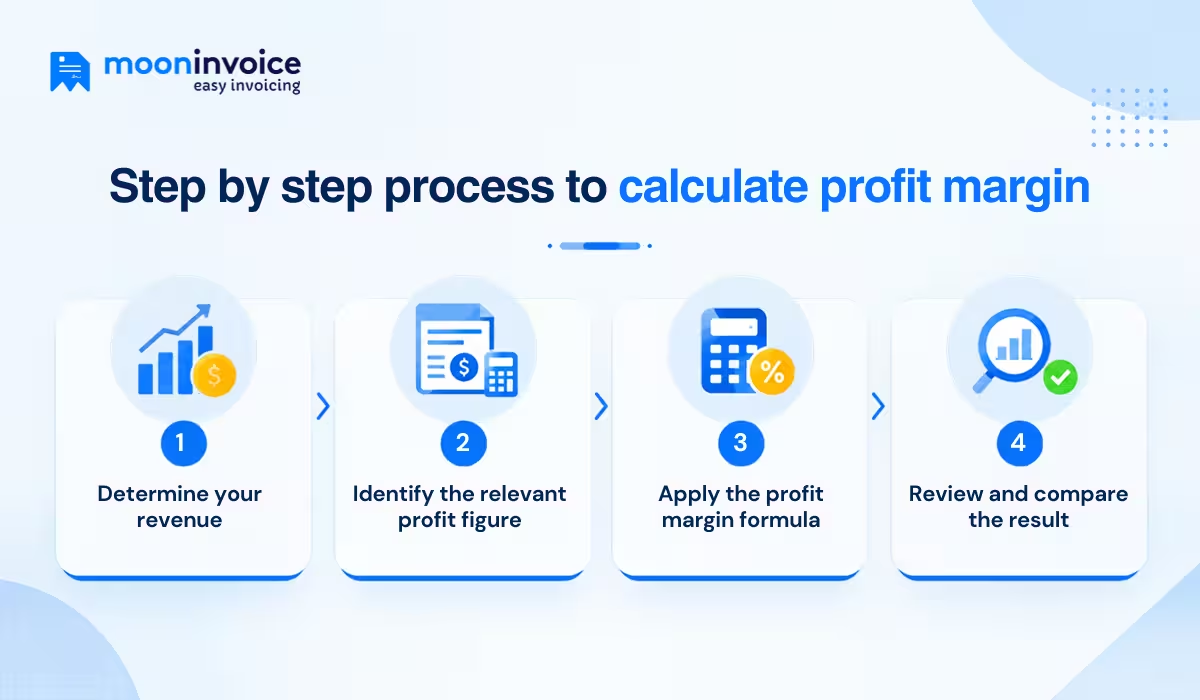
Calculating profit margin is easier when you have the correct financial numbers. Follow the four steps below to measure your business’s profit margin effectively.
Step 1: Determine your revenue
To calculate your business’s profit margin, find the total revenue for the period you are reviewing. You can find total revenue in your business’s P&L statement.
Total revenue is the income you earn from selling goods or services in a specific period, before any deductions. For example, if your P&L statement shows revenue of $63,500 for the last month, you can use that figure as the starting point for your calculation.
Step 2: Identify the relevant profit figure
Next, decide which margin you want to calculate, whether gross, operating, pretax, or net profit margin. For example, if you want to calculate a business’s operating profit margin, you need to identify the operating profit.
To make this clearer, let’s look at an example.
Suppose a business generates $50,000 in revenue, incurs $20,000 in direct costs, and spends $10,000 on operating expenses. Its operating profit will be:
- Operating profit = $50,000 – $20,000 – $10,000 = $20,000.
This operating profit ($20,000) will later be used to calculate operating profit margin.
Step 3: Apply the profit margin formula
Using the same example from Step 2, the business’s operating profit is $20,000. So, now to calculate the operating profit margin, we need to apply the formula, which is
- Operating profit margin = (Operating profit / Revenue) x 100
Here, the operating profit margin will be,
- Operating profit margin = ($20,000 / $50,000) x 100 = 40%
It means the business generates $0.40 in operating profit for every dollar of revenue, before interest and income taxes.
Step 4: Review and compare the result
After calculating the margin, compare it with previous months or quarters to identify changes in profitability. You can also compare margins across products or services to understand which offerings contribute more to your earnings.
If the financial figures have changed, ask why: did revenue move, or did costs? When you compare gross, operating, and net margins against one another, you will get a better idea of what worked and what went wrong.
A healthy gross margin with a weak net margin indicates higher overhead costs.
Pro Tip:If you don’t want to work through manual calculations, use an online profit margin calculator to get results faster. Enter your revenue and profit figures to calculate the margin without working through the formula yourself.
Profit margin vs markup: key differences
Profit margin and markup both explain the profit a business earns from selling a product or service, but they work differently. The table below compares profit margin and markup by purpose, calculation process, and examples.
| Key differences | Profit margin | Markup |
|---|---|---|
| Purpose | Helps measure profit relative to sales and assess profitability. | Helps determine how much to add to cost when setting a selling price. |
| Calculation | Measured against selling price. | Measured against cost. |
| When to use it | When reviewing financial performance or evaluating whether a business maintains a healthy profit margin. | When setting prices based on product or service costs. |
| Example | A product costing $60 and selling for $100 generates a 40% profit margin. | The same product generates a 66.67% markup. |
Practical use cases of profit margin in businesses
Businesses use profit margin to understand how overall revenue translates into profit and identify unnecessary costs to maximize profits. Below are some of the practical use cases that showcase how profit margin helps in making strategic financial decisions.
1. A business has good revenue but lower margin
Let’s assume a marketing agency bills $300,000 a year with a net profit of $15,000, leaving a 5% net margin.
Revenue looks healthy, but costs consume almost all of it.
To improve net profit, the agency should review both its gross and operating margins. Gross margin shows whether delivery costs are the issue, while operating margin shows whether overhead is the problem.
If the agency adjusts its pricing, reduces unnecessary discounts, or defines project scopes more carefully, it can improve profitability.
2. A business cuts costs and improves margin
Imagine a retail shop earns $200,000 in revenue with total costs and deductions of $180,000. So, the profit is $20,000, for a 10% net margin.
To increase profit, the shop owner renegotiates supplier terms, removes unused subscriptions, and cuts costs by $10,000.
Here, the total revenue is unchanged, but the profit rises to $30,000 and the margin to 15%. The gain came without selling a single extra unit.
3. A business compares margin across products or services
Suppose a company sells two products.
Product A brings in $60,000 in revenue with $24,000 in direct costs. Here, the gross profit margin is 60%.
Product B brings in $90,000 in revenue with $63,000 in direct costs. Here, the gross profit margin is 30%.
In this case, there is a vast difference in gross profit margin between Product A and Product B. Although Product B generates more revenue, Product A has twice Product B’s gross profit margin.
This comparison helps the business decide which products to promote, reprice, or reassess.
What factors can affect profit margin?
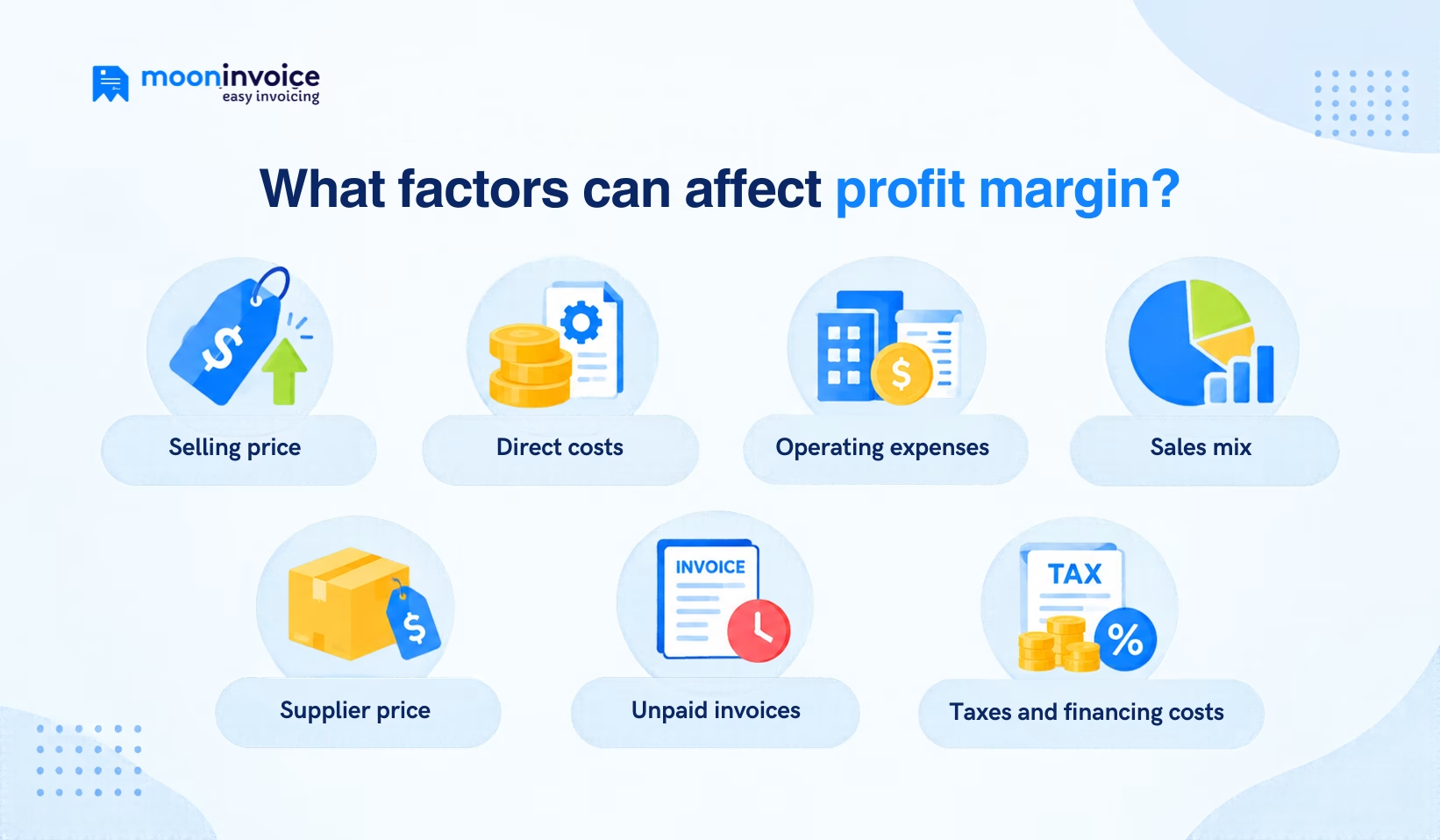
Profit margin can shrink or rise depending on multiple factors. Here are the factors that most affect profit margin.
- Selling price: Underpricing your product or service shrinks the margin on every sale, and heavy discounts reduce it further.
- Direct costs: Higher costs for materials, labor, or service delivery reduce gross profit, leaving less of the revenue as profit.
- Operating expenses: Rising rent, salaries, utilities, and marketing expenses can lower operating profit margins, even when revenue remains steady.
- Sales mix: Selling more low-margin products or services can reduce overall profit margin, even when total sales revenue increases.
- Supplier price: Higher supplier prices increase purchasing costs and can reduce profit margins unless the business adjusts its selling prices.
- Unpaid invoices: Overdue invoices can create cash flow problems. If amounts become uncollectible and are recognized as bad debt expenses, they can also reduce net profit margins.
- Taxes and financing costs: Interest expenses and applicable taxes reduce the profit remaining after operating activities, directly affecting the net profit margin.
Manage your business finances smartly
Revenue alone doesn’t show a clear picture of how well your business is performing. It is the profit margin that gives context by showing what you have truly earned.
When you understand where your money is going, you can better manage your business expenses, which can indirectly improve your profit margin. But would you spend hours calculating your numbers manually, one by one? That could take away many productive hours and may not be ideal, especially for startups and new businesses.
So, what’s the solution? The best way to manage your business finances is to use software such as Moon Invoice. It offers a centralized space to manage all of your financial documents, i.e., invoices, expenses, estimates, and receipts, digitally. No more complex calculations or repetitive manual errors.
Is product management becoming overwhelming?
Organize products and their variants efficiently.
Assemble Products
Generate Barcodes
Batch Tracking
Frequently asked questions
How to determine profit margin?
What is a profit margin ratio?
Is a higher profit margin always better?
How often should a business calculate profit margin?



Jayanti Katariya is the founder & CEO of Moon Invoice, with over a decade of experience in developing SaaS products and the fintech industry. He holds a degree in engineering. Since 2011, Jayanti's expertise has helped thousands of businesses, from small startups to large enterprises, streamline invoicing, estimation, and accounting operations. His vision is to deliver top-tier financial solutions globally, ensuring efficient financial management for all business owners.