


Quick summary
Vendor fraud is a significant form of business fraud in which a vendor engages in fraudulent activity. Sometimes, in collusion with a company employee. It can result in financial loss and adversely affect business-supplier relationships. However, with a strong verification process and a reliable vendor management tool, businesses can prevent it.
Businesses often encounter various kinds of financial deceptions. These malpractices undermine their financial health and disrupt day-to-day operations.
Vendor deception is one such threat that can have serious consequences for businesses. It can drain business finances and disrupt overall operations. Altering invoices , manipulating payments, overbilling, and vendor impersonation are common practices in supplier fraud.
So, exactly what is vendor fraud, and how can you prevent it? You’ll find the answer in this blog, along with its examples and best prevention tips to follow.
📌 Key takeaways
- Vendor fraud may occur when a vendor, contractor, or employee intentionally deceives a business for financial gain.
- Inadequate monitoring of vendor onboarding, invoice approval, and payment processing can increase the risk.
- Matching invoices to purchase orders, checking for duplicate invoices, and reviewing vendor pricing are common practices for identifying potential supplier-related fraud.
- Businesses can use vendor management software and automation to strengthen the payment procedure.
What is vendor fraud?
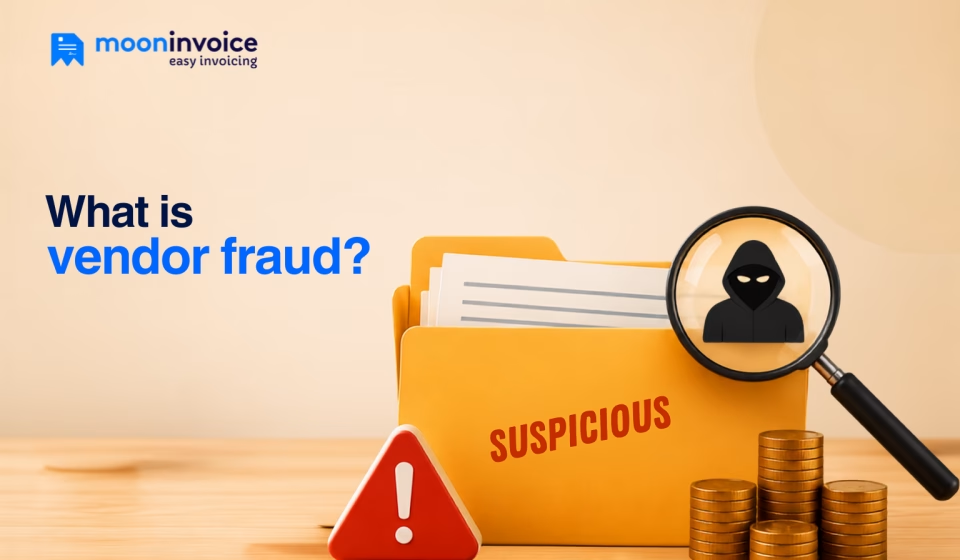
Vendor fraud is a type of business fraud in which a vendor or supplier engages in fraudulent activities to obtain unauthorized financial gain. A company’s employee working with the vendor may also engage in such malpractices.
These unethical activities can occur at different stages of the procurement process. Duplicating invoices, overcharging, altering invoices, or charging for products or services that were not delivered are common practices.
Vendor fraud may result in financial and operational losses, as well as inaccurate accounting records. It can also lead to strained relationships with legitimate vendors.
How does vendor fraud happen?
Poor monitoring and weak vendor control often lead to this kind of fraudulent activity. Some common causes of it are as follows:
Submitting a fake invoice
The vendor or supplier may submit an invoice for products that were not ordered and received. The main intention behind this is to gain payments for a purchase that did not take place. This kind of practice generally happens due to weak invoice verification.
Duplicate invoicing
Duplicate invoicing refers to issuing the same invoice more than once, either intentionally or by manipulating invoice details. This misleads the company and leads to multiple payments on the same invoice. In this way, it can negatively affect the company’s cash flow and financial health.
Relying on manual processing
Following a paper-based manual workflow can increase the risk of errors. The payment can be made to the wrong vendor or lead to an incorrect amount during the vendor payment process. These kinds of mistakes and unusual transactions are difficult to detect due to a lack of automation.
Lack of a robust approval process
Companies with a weak approach to invoice approval are more likely to fall victim to vendor fraud. The internal team may approve an inappropriate invoice without properly reviewing it. This leads to incorrect payments or paying duplicate invoices. In general, a company faces such an issue when employees are inadequately trained or lack a standardized approval workflow.
Examples of vendor fraud
Here are vendor fraud examples demonstrating the explanation:
Changing invoice
In this case, the vendor may intentionally alter the invoice by itself. The major changes are made to quantity, prices, or other billing details.
Suppose a company ordered 100 units at $5 each, making a total of $500. The supplier changed the quantity on the invoice, listing 150 instead of 100. This would make the total payable amount $750.
If the company pays this amount without verifying the quantity, it will result in a financial loss.
Overcharging for products or services
This kind of vendor fraud occurs when a supplier charges more than the agreed-upon rates.
Using the same example above, suppose the company ordered 100 units at $5 each, for a total payable of $500. The supplier changed the price on the invoice from $5 to $10. This would make the total amount payable $1,000 instead of $500.
Therefore, it may result in a payment amount greater than the actual amount if the team doesn’t verify the invoice against the purchase order.
Duplicate invoicing
In this vendor fraud, the supplier sends the same invoice multiple times for the same purchase. For instance, in the example above, suppose the supplier sends an invoice for 100 units at $5 each, and the company pays $500 in total. After a few days, the supplier resends the invoice for the same order with a different invoice date, indicating suspicious activity.
In this case, the company may experience financial loss if it pays the invoice without reviewing the date and other details.
Manual billing can put your business at risk.
Secure and simplify your business billing with AI-powered automation of Moon Invoice.
What are the types of vendor fraud?
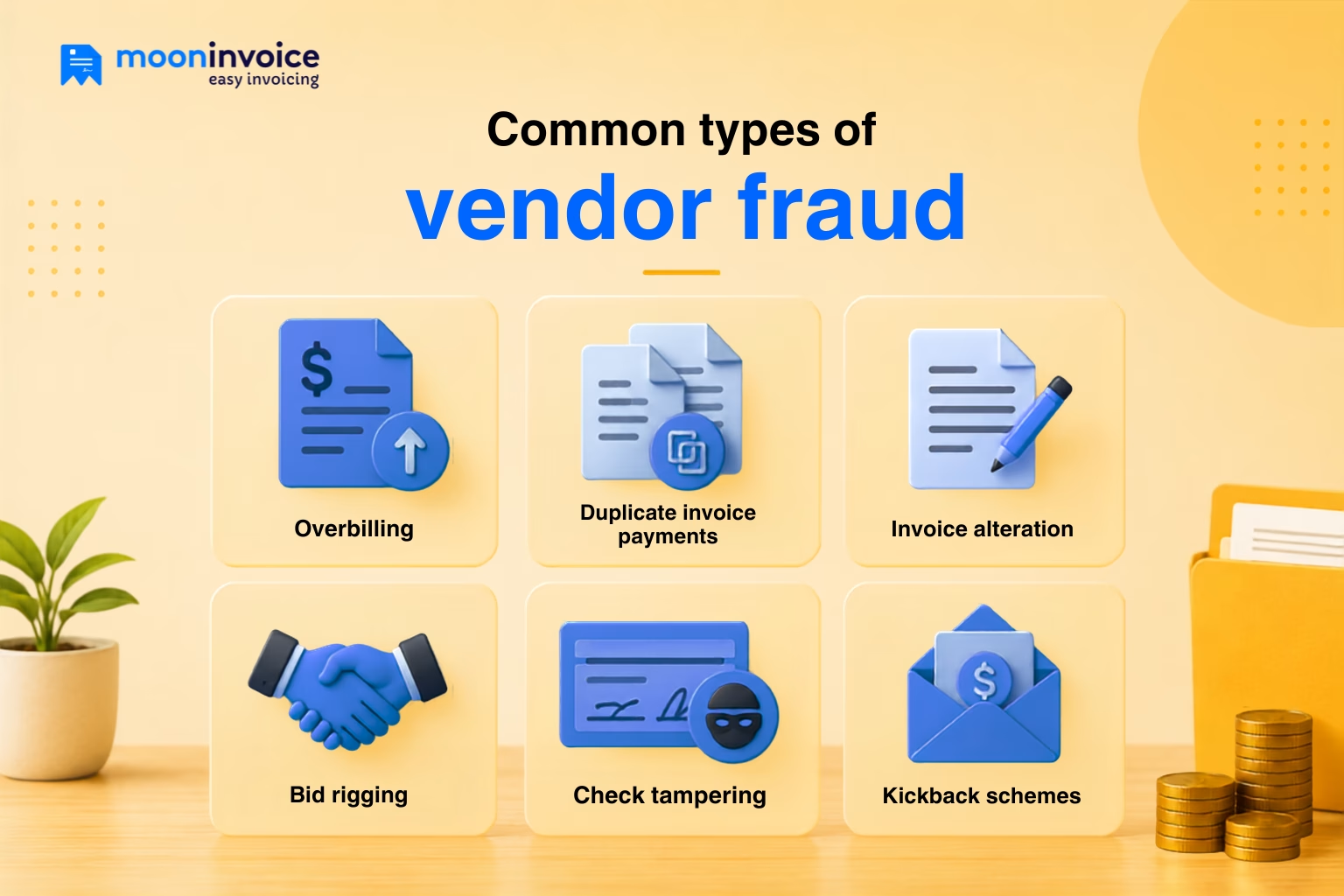
There are various forms of supplier fraud that occur in the business world. Some of them are as follows:
Overbilling
This is a common vendor fraud that may occur when a vendor charges more than the agreed-upon amount. It is quite common among the vendors supplying products in bulk. The vendor may increase quantities to increase the amount or mention a higher rate.
Duplicate invoice payments
The vendor intentionally submits the invoice more than one time with minor changes. This is done to obtain a larger payment amount for the same order. In such cases, businesses must check and identify duplicate invoices.
Invoice alteration
This type of vendor fraud involves intentional changes to an invoice by the vendor itself. Common modifications may involve quantities, price, and tax amount. The changes can also be made to the PO number, invoice number, or date.
Bid rigging
Bid rigging refers to the secret manipulation of the bidding process by the involved vendors. They secretly decide who wins the bid and what approach to follow in the bidding process without informing the company. This leads businesses to make procurement-based purchases rather than genuine ones.
Check tampering
In general, the company’s employees perform this kind of action. Employees alter and misuse business checks to gain personal financial benefits. It becomes a form of vendor fraud when an employee and a vendor work together to engage in such practices and divert payment.
Kickback schemes
This type of fraud activity involves employee-vendor collusion. The vendor secretly offers gifts, commissions, money, or other benefits to an employee to secure inflated payments. This increases business costs and leads to unfair purchasing decisions.
How to detect vendor fraud: Key red flags
Identifying vendor fraud is crucial for maintaining smooth business operations. You can detect this by checking the red flags:
Fictitious vendors: Vendors with incomplete, unverifiable, or suspicious information may engage in fraudulent activity.
Sudden changes to bank accounts: An unexpected change in the vendor’s bank details can be suspicious. If this happens, you must check for any fraudulent transactions that may have occurred.
Round-dollar or unusual amounts: Repeated invoices with unusual rounded amounts are a warning sign of suspicious activity.
Repeated invoice numbers: If multiple invoices share the same or similar invoice numbers, there could be fraudulent activity.
Unusual pricing: There could be a higher price than agreed upon on an invoice, indicating overbilling or an unauthorized price change.
Frequent changes to invoice details: This can be a red flag for fraud if the vendor continuously changes the invoice even after submission.
Invoices just below approval limits: Multiple invoices approved that fall just under the authorization threshold also may be a red flag for potential fraud.
Missing or mismatched PO: If a particular invoice doesn’t include a purchase order or it is mismatched, it is another red flag for vendor fraud.
Vendor information matching an employee: Various details, including the address, phone number, and other information, appear to be shared by the vendor with an internal employee. This is an undisclosed relationship that may lead to a scam.
Urgent payment requests: Vendors putting pressure for immediate payment without allowing the team to complete verification can be suspicious.
Tips for vendor fraud prevention
Prevention is always better than dealing with the consequences of fraud. Therefore, instead of identifying fraudulent actions, you must prevent them in the following ways:
- Strengthen the vendor onboarding process and review information carefully.
- Verify the vendor’s tax identification number and ensure it matches the registered business name.
- Maintain vendor information properly and prevent unauthorized access to it.
- Regularly audit vendor details to identify unusual activity and strengthen vendor management.
- Always perform a three-way match between the invoice, purchase order, and goods receipt notes.
- Monitor unusual vendor transactions, including high prices, urgent payment requests, or other suspicious activity.
- Provide anti-fraud training to employees on handling the approval and payment process.
- Segregate key financial duties so that one employee cannot control the entire accounts payable process.
- Use reliable vendor management software to centralize vendor details and improve payment oversight.
- Adopt automation where possible to detect duplicate payments and flag unusual transactions early.
What should I do if I detect vendor fraud?
If you detect or suspect vendor fraud, you can adopt the following approaches:
- Hold the vendor payment and do not process it until the matter is resolved.
- Review all the related documents such as invoices, purchase orders, contracts, and other payment records.
- Report the matter to finance management, the accounts manager, or an appropriate person within the organization.
- Take advice from the financial advisors and legal experts.
- If there is sufficient evidence of fraudulent activity, you can report it to local law enforcement or regulatory authorities.
- Identify the gaps in the overall operation and take necessary steps to strengthen it.
- Adopt automation, improve invoice verification, and segregate roles among the team to reduce such incidents.
How can Moon Invoice be helpful?
A manual billing and payment process is more vulnerable to vendor fraud. However, by using reputable vendor management software and an invoicing tool such as Moon Invoice, you can easily overcome this challenge. Trusted by more than 1.7M global customers, this AI-powered tool simplifies billing and helps manage data securely on a single platform.
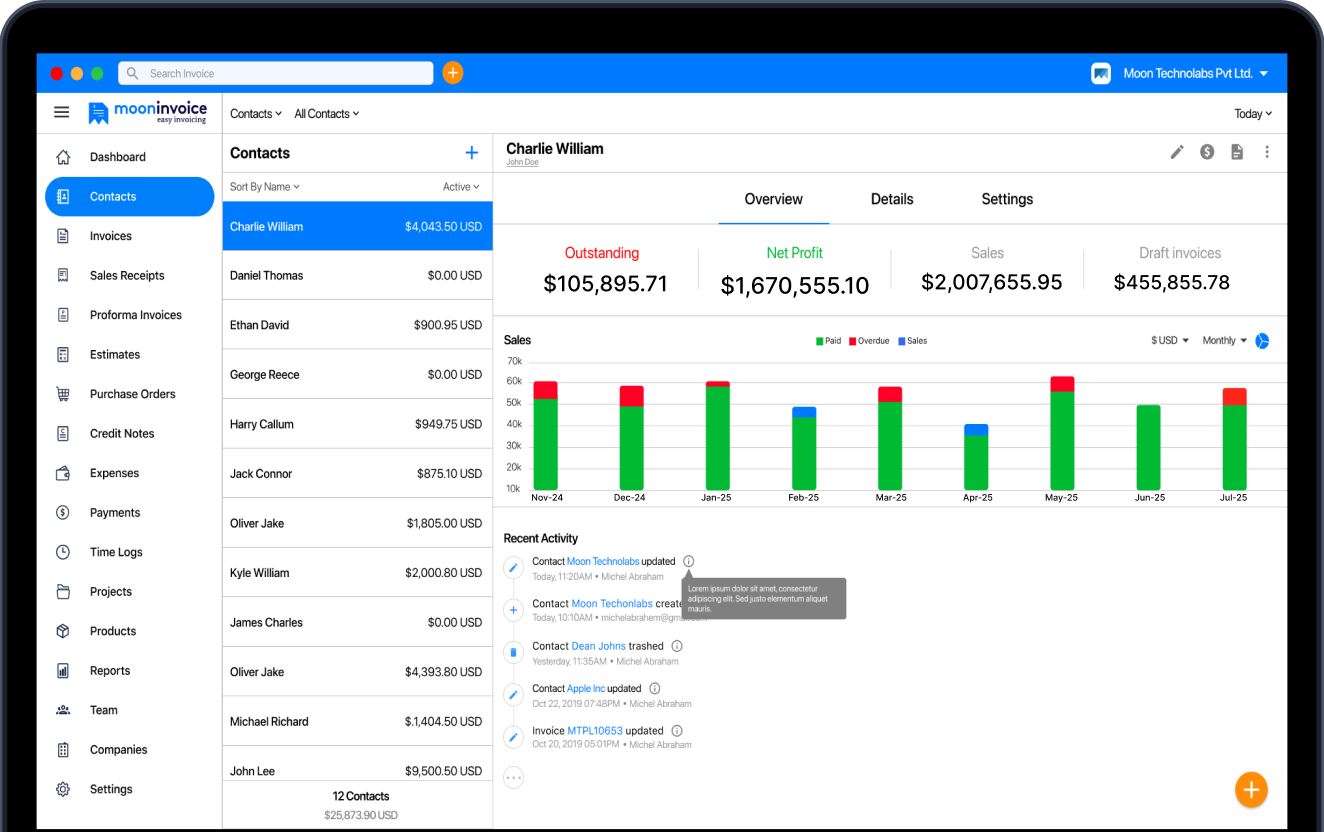
Centralized vendor management: A dedicated module to save and manage vendor details in a single place. Get your vendor management organized. You can view a vendor’s recent activity on a single dashboard.
Generate vendor statement: Easily generate a statement for a particular vendor in a few clicks. This provides real-time, clear visibility that helps verify things and avoid confusion.
AI features: The invoicing software offers a range of AI capabilities. Its quick scan feature helps extract information from uploaded documents using OCR technology. Additionally, you can add vendors and record payments with the help of AI. This boosts the workflow and enhances accuracy.
Role-based permissions: Business owners can assign team access to specific modules. They can add team members and allow them to perform edit and delete actions with the modules. This restricts unauthorized access to invoices, documents, purchase orders, and other sensitive information.
Financial reports: Supports 15+ financial reports to review outstanding balance, revenue, and other important metrics. This helps to track the overall performance and detect unusual financial transactions.
Payment tracking: The platform allows you to easily track payment status. Business professionals can have clear records of paid amounts and outstanding invoices.

FAQs on vendor fraud
What are the signs of vendor fraud?
Who is involved in vendor fraud schemes?
How does vendor fraud affect the business?
Who is responsible for detecting vendor fraud?
What is the difference between vendor fraud and invoice fraud?



Jayanti Katariya is the founder & CEO of Moon Invoice, with over a decade of experience in developing SaaS products and the fintech industry. He holds a degree in engineering. Since 2011, Jayanti's expertise has helped thousands of businesses, from small startups to large enterprises, streamline invoicing, estimation, and accounting operations. His vision is to deliver top-tier financial solutions globally, ensuring efficient financial management for all business owners.