
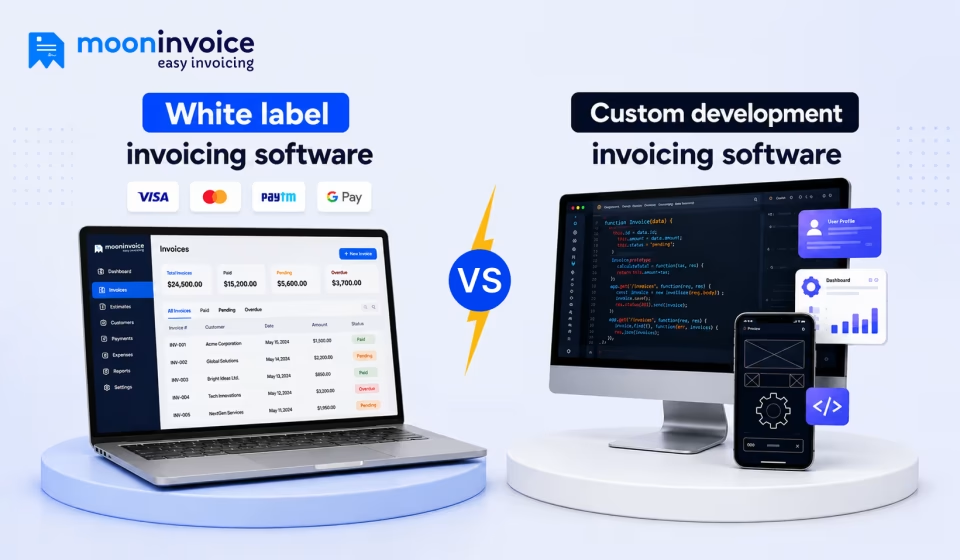


If you are choosing between white label and custom development solutions for your invoicing software, pay serious attention because it can make or break your financial operations. White label invoicing allows you to launch a ready-made invoicing software solution under your brand; no coding or months of development required.
On the other hand, custom development is all about building an invoicing software right from scratch, which can be complex to maintain and eat up a lot of your productive hours. Both white-label and custom development have their own advantages and limitations.
Let’s find out how white label vs custom development invoicing software differ in this detailed guide.
📌 Key takeaways
- A white label invoicing software is a ready-to-use invoicing software that can be rebranded and sold to customers.
- Custom invoice software is full-fledged software built from scratch, backed by research, planning, and vision.
- White label invoicing software is significantly cheaper than custom software and provides quick access to the market.
- Custom software involves development, design, testing, and maintenance costs, which increase its total budget cap.
- White-label software helps you increase your ROI by allowing you to sell it to your clients under your brand name.
What is white label invoicing?
White-label invoicing is a business practice in which a company offers invoicing services under its own brand as if they developed the software themselves, even though it is actually provided by a third party. Instead of building an invoicing platform from scratch, businesses can rebrand an existing solution with their logo, brand name, colors, and domain.
White label invoicing is commonly adopted by startups, SaaS providers, agencies, and other businesses looking to expand their service offerings without the time and cost of developing invoicing software from the ground up.
Launch your branded invoicing platform today
Skip the months of exhausting software coding. Deploy an AI-powered invoicing platform with Moon Invoice.
What is custom invoicing software?
It is an invoicing solution built from scratch and can be personalized to the business’s needs. Unlike ready-made invoicing software, here, the company has complete control of the software’s functionality, design, and scalability.
Custom invoicing software is generally preferred by enterprises and large MNCs with complex billing processes that require a highly reliable solution in the long term.
Key differences: white label vs custom software development
If you are unsure of whether to choose white label invoicing or custom invoicing software, this section could answer all your doubts. Here is a detailed breakdown of white-label invoicing software and custom invoicing software.
| Differences | White-label invoicing software | Custom invoicing software |
|---|---|---|
| Setup time | Since the platform is already built and tested, implementation is usually quick. Businesses can customize branding, configure settings, and start using the software instantly. | Building custom invoicing software takes considerably longer. Development, testing, revisions, and deployment can take several weeks or even months before the system is ready for use. |
| Branding control | White-label invoicing software allows businesses to apply their logo, brand colors, company name, and other visual elements to create a branded customer experience. | Custom invoicing software offers complete control over branding, design, user experience, and functionality, allowing organizations to create a fully unique solution tailored to their requirements. |
| Maintenance required | The software provider handles maintenance, updates, security patches, performance improvements, and bug fixes. Businesses can use the platform without worrying about technical upkeep. | The company is fully responsible for maintaining the software. Technical issues, security updates, server management, and feature enhancements must be managed either by an in-house team or through outsourced development services. |
| Compliance | Many white-label solutions are designed to meet common invoicing, tax, and financial compliance requirements. Providers also regularly update the software to align with changing regulations. | Companies must ensure the software complies with applicable financial, tax, and industry regulations. This often requires continuous monitoring and updates to remain compliant with evolving legal requirements. |
Custom invoicing software vs. white-label invoicing software: pros and cons
Both custom and white-label invoicing have varied advantages and limitations; let’s explore them below.
Pros of custom invoicing software
The points below explain the pros of custom invoicing software.
- Developed as per specific business needs: Every feature, workflow, and functionality can be developed to meet your invoicing requirements.
- Complete ownership of the software: You will have full control over the software, from source code to future development decisions.
- Customizations are not limited: Whenever you want to add new features or integrations or make a change to the decision, you can ask the team, and changes could be in effect instantly.
- Scalable from the beginning: As your company grows, you can expand the software without depending on the vendor’s roadmap.
- Competitive differentiation: With custom invoicing software, you can add specialized services that create a unique customer experience and make your software stand out.
Cons of custom invoicing software
Custom invoicing also comes with limitations you should be aware of. Here they are:
- The development cost is too high: In order to focus on each part of the SDLC (software development life cycle), such as UI/UX, development, testing, deployment, and maintenance, a high budget is required.
- Takes time to go live: Building an invoicing software from scratch may take months of hard work to make it operational.
- Higher ongoing maintenance costs: Custom solutions require continuous investment in bug fixes, software updates, security patches, and performance enhancements throughout their lifecycle.
- Requires ongoing technical expertise: Businesses need skilled developers or outsourced teams to keep the software up and running.
Pros of white label invoicing software
White-label invoicing comes with many advantages for companies, as it is a ready-to-use solution. Let’s explore all of them below:
- Access to a custom domain: The white-label provider offers access to a custom domain, which means the website URL will consist of your desired company or owner’s name.
- Quick deployment: A company can launch and brand its own invoicing software within one or two days rather than months.
- Lower initial investment: A white-label solution is more affordable than building software from scratch.
- Managed by the software provider: All kinds of maintenance-related work, updates, security improvements, and bug fixes are managed by the software provider.
- Multiple revenue streams: Selling white-label invoicing software provides an additional source of income beyond the primary business operations.
Cons of white label invoicing software
Although white label invoicing software comes with bigger advantages than building software from scratch, they do have some limitations too. Here they are:
- Customization options are limited: You will only be able to customize branding elements such as the logo and name.
- You may deal with integration-related issues: As white-label solutions are pre-made, they may not support certain third-party integrations.
- Less control over the software: All new updates, feature releases, and product improvements are more often controlled by the software provider.
Cost comparison: white label vs custom software development
In the U.S., generally, the white label invoicing software cost starts from $50 to $300 per month for businesses that need a basic invoicing solution. For organizations that want either a medium setup or an invoicing software with advanced features, the price ranges between $300 and $1,500+.
Custom invoicing software development, on the other hand, will require a heavy investment right from the start of development. Depending on the features, customizations, integrations, and other specific needs, the total development cost may range from $15,000 to $20,000.
Cost generally plays a big part when deciding between white-label and custom invoicing software. 9 out of 10 times, white label software is more affordable than custom development due to one simple reason: they have already been developed and tested. In white-label invoicing software, an organization pays a one-time setup cost, a monthly fee (recurring), and can start using the software right from the word go.
Pricing factors (white-label):
- Subscription charges: Companies usually pay a monthly or annual subscription fee depending on active users, storage, features, and customer support level.
- Branding fees: Generally, white-label providers include branding options (logo, color, name, and domain) within the subscription plan. However, advanced branding or logo removal may include additional charges.
Pricing factors (custom development):
- Development team expenses: You need a dedicated team including project managers, developers, designers, and QA testers. These costs often take the largest portion of the overall development budget.
- Infrastructure cost: You need to invest in hosting, server management, databases, backups, and cloud services. Also, these costs are not one-time; if the user base grows, these expenses will increase.
- Maintenance and upgrades: After deploying and launching the software, the company needs to allocate resources for bug fixes and software updates. These costs are necessary to stay competitive in the market.
- Licensing and third-party integration costs: Custom invoicing software often requires paid APIs, payment gateway integrations, email services, or other third-party tools. These recurring licensing fees can increase the overall cost of development and operation.
Why choose white label over custom invoicing software?
Custom invoicing software undoubtedly brings more customization and control into your software, but is that all you want? Instead of spending those hefty amounts, consider a white-label invoicing software that could be a game-changer for your organization.
Here’s why you should choose white label over custom invoicing software:
1. Access to ready-made software
White label invoicing software gives you faster access to the software, as it is ready-made and tested by the software provider. Unlike with custom development, here you don’t need to spend months on extensive testing to reach the final version of the software.
2. Focus on core business goals
Not every company specializes in building software. Imagine a retail or import-export business whose primary goal is to grow revenue and acquire customers. With white-label invoicing software, small businesses can shift their focus to business goals and growth initiatives without stressing over technical skills.
3. Easier expansion into new markets
Businesses expanding into new countries often need invoicing software that supports multiple currencies and tax systems. Some countries have strict e-invoicing regulations, which make compliance essential before entering the market. That’s why white-label invoicing platforms, including specialized e-invoicing software, become a necessity for such businesses.
4. Fuel business growth
Building custom invoicing software requires significant investments in research, planning, development, testing, and ongoing maintenance. As a result, businesses often dedicate substantial time, budget, and internal resources to software development. By choosing white-label invoicing software instead, they can redirect those resources toward business growth by investing in revenue-generating activities such as marketing, customer acquisition, and product innovation.
Elevate your professional brand today
Let Moon Invoice customize invoices in a way that enhances your brand recognition.
Try an invoicing software that yields high ROI
To conclude the choice between white label invoicing and custom invoicing software development, there are many things to consider. If budget is not a concern and you want top-tier customization, you should definitely choose to develop an invoicing app from scratch.
However, if you want a branded invoicing platform without the high development costs and complexity, white-label invoicing software offers a faster, more practical path.
Having said that, embracing the right white-label invoicing platform, like Moon Invoice, makes sense. You sell it under your own brand and amplify your income. A revenue-generating opportunity that is poised to double your ROI. Want to grab it? Ask us for a quick demo.
Additional Questions on White Label vs Custom Invoicing Software
Custom vs white-label invoicing: which is better?
Can white label invoicing software be customized?
How to resell invoicing software?
Is white label software cheaper than custom development?
Is white label invoicing software secure?



Jayanti Katariya is the founder & CEO of Moon Invoice, with over a decade of experience in developing SaaS products and the fintech industry. He holds a degree in engineering. Since 2011, Jayanti's expertise has helped thousands of businesses, from small startups to large enterprises, streamline invoicing, estimation, and accounting operations. His vision is to deliver top-tier financial solutions globally, ensuring efficient financial management for all business owners.