



The usual timeframe for an international wire transfer is 1 to 5 business days, but some transfers may arrive sooner. Wire transfer processing time depends on several factors, such as the banks involved, destination countries, cut-off times, holidays, and compliance checks.
Some international wire transfers are processed very quickly, i.e., within minutes or hours, but the recipient still can’t access the funds immediately. This happens because the receiving bank may require additional time to process and credit the payment to the recipient’s account.
Once you understand how wire transfers work across borders, you can set realistic expectations for international wire transfers. Moving forward, we will explore how long does a wire transfer take, how it works, what causes delays, and the cost of an international wire transfer.
Let’s get started…
📌 Key takeaways
- The standard timeframe for an international wire transfer is 1 to 5 business days.
- The recipient’s full name, bank information, and SWIFT/BIC codes are key details required to send a wire transfer.
- Incorrect payment details, compliance checks, and bank cut-off times are among the top causes of wire transfer delays.
- International wire transfer costs range from $35 to $50 for outgoing transfers and $10 to $25 for incoming transfers.
- Avoid wire transfers if you may need to reverse the transaction later.
International wire transfer processing time
International wire transfer processing time varies between 1 and 5 business days. The timeframe isn’t fixed and depends on many factors such as banks, countries, and the payment route.
According to SWIFT (Society for Worldwide Interbank Financial Telecommunication), 75% of payments reach the beneficiary bank within 10 minutes and more than 90% within one hour. The remaining time is spent on final processing steps at the receiving bank before the funds are credited to the recipient’s account.
| Transfer situation | Average processing time |
|---|---|
| International wire transfer | 1 to 5 business days |
| Payment reaching beneficiary bank through SWIFT | Often within minutes to hours |
| Final credit to recipient | May take additional time |
What information is required to send a wire transfer?
Before initiating an international wire transfer, gather the recipient’s personal and bank details, along with payment information. Requirements can vary by destination country and financial institution.
- Recipient’s full name and address: Provide the beneficiary’s name and address as required by the receiving bank.
- Recipient’s bank name and address: Include the full name and location of the financial institution receiving the payment.
- Bank account number or IBAN: Provide the recipient’s account number. For countries that use IBANs, the IBAN (International Bank Account Number) may be required instead of, or as, the relevant international account identifier.
- SWIFT/BIC code: Provide the recipient bank’s 8- or 11-character SWIFT/BIC code, which identifies the financial institution for an international payment.
- Amount and currency: Specify how much you’re sending and the transfer currency. Some banks may also require the recipient account’s currency.
- Purpose of the payment: Some banks or countries require you to provide the reason for the transfer, such as an invoice payment or business expense.
- Additional country-specific details: Depending on the destination, the bank may request another local bank identifier or other information needed to route the payment.
More payment options, fewer barriers
Accept payments through 20+ payment methods, not just wire transfers, with Moon Invoice.
How does an international wire transfer work?
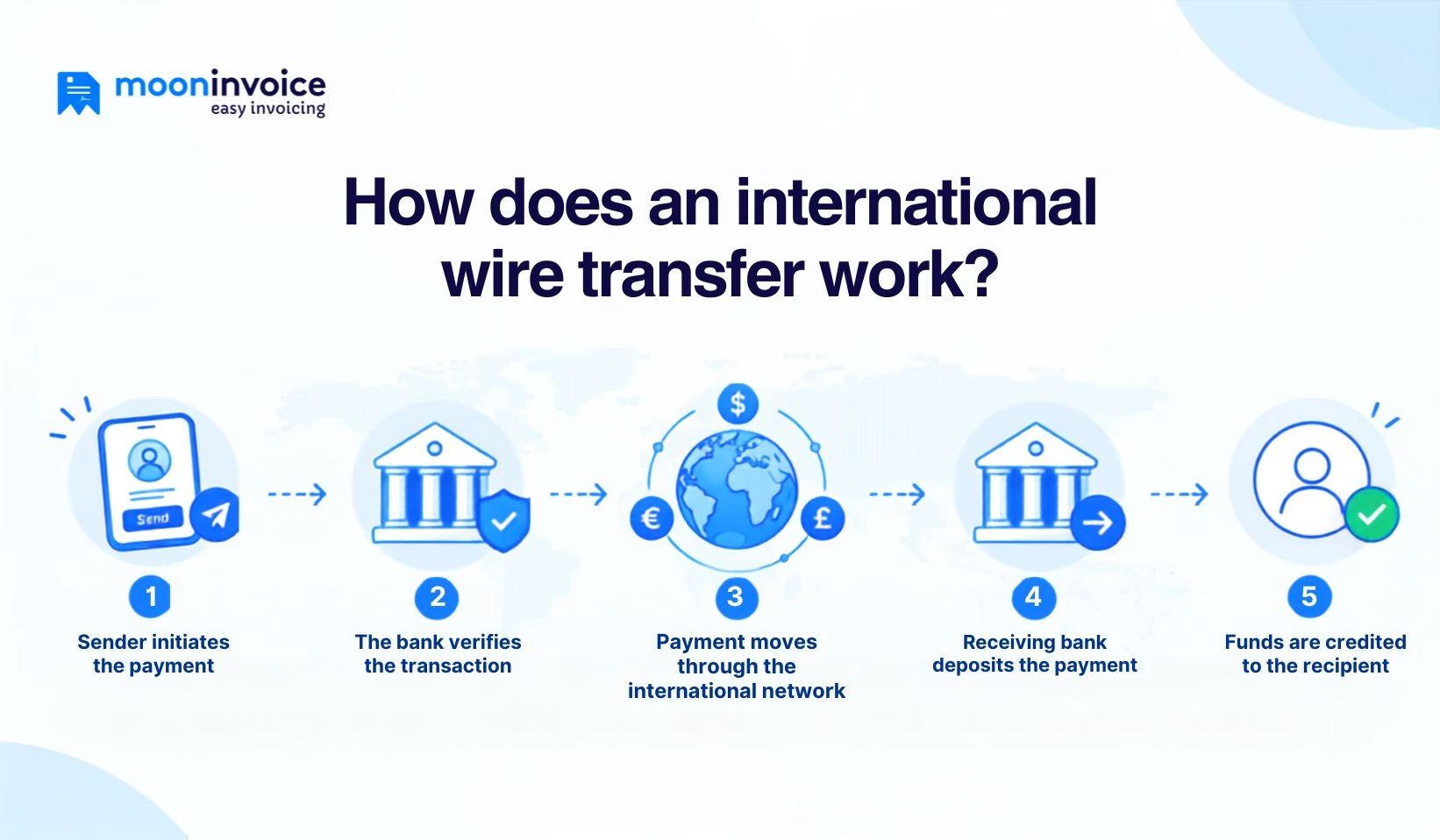
An international wire transfer passes through several stages, from payment initiation and bank verification to international processing, receipt, and final crediting.
1. Sender initiates the payment
The process begins when you enter the recipient’s required information, including their name, bank details, account number or IBAN, and SWIFT/BIC code. You also need to specify the payment amount and currency.
Banks support both domestic and international transfers, but international transfers generally require additional information because the payment crosses national banking systems. For large transfers, you may also need to provide additional details or complete verification before the bank accepts the payment.
2. The bank verifies the transaction
After you submit the payment, the sending bank reviews it before processing. The bank may verify the sender’s account, payment details, available funds, and other required information.
For international transfers, the bank may also perform security and compliance checks before releasing the payment. These checks are especially important for large transfers, where banks require additional verification or supporting information.
3. Payment moves through the international network
Once the sending bank completes its checks, it releases the payment for processing. The payment then moves through the international payment network. In some cases, it may pass through one or more intermediary banks before reaching the recipient’s bank.
These institutions help process wire transfers when the sending and receiving banks do not have a direct relationship.
4. Receiving bank deposits the payment
The receiving bank deposits the incoming payment after it passes through the required payment channels. It reviews the transaction and may perform its own checks before making the funds available to the recipient. Processing times vary depending on the receiving bank, destination country, currency, and payment details.
5. Funds are credited to the recipient
After the receiving bank completes processing, it credits the funds to the recipient’s account. At this point, the international money transfer is complete. However, the time between the payment reaching the receiving bank and the funds appearing in the recipient’s account can vary based on the bank’s internal processing.
What causes delays in international wire transfers?
Several factors can affect international wire transfer speed, even when the sender has provided the correct payment details. Common causes include:
- Bank cut-off times: A transfer submitted after the bank’s daily processing cut-off may not be processed until the next business day. This can delay international wire transfers.
- Weekends and bank holidays: If you send money on a Friday afternoon, and there’s a bank holiday in either your country or the recipient’s, you’re looking at a multi-day standstill.
- Incorrect payment details: Errors in the recipient’s account number, IBAN, or SWIFT/BIC code can cause delays or rejection.
- Compliance checks: Banks may review international payments for fraud, sanctions, or regulatory requirements. Due to this review, some wire transfers may take days to complete.
- Currency conversion: Converting funds between currencies can add to the processing time. This extra step of calculating exchange rates and shifting funds between currency accounts can add a few hours (or a day) to the wire transfer.
Wire transfer vs ACH: What’s the difference?
Both wire transfers and ACH transfers are electronic methods to transfer money from one bank account to another. However, they operate completely differently. The table below compares how they differ in transfer speed, cost, processing, and more.
| Basis of comparison | Wire transfer | ACH |
|---|---|---|
| Transfer speed | Often processed quickly; same day to 5 days | 1 to 3 business days |
| International payments | Widely used for cross-border transactions | Primarily used for local payments |
| Cost | Usually has a higher wire transfer cost | Generally low-cost or no fees in some cases |
| Transfer limit | Often supports large-amount transfers | Comes with low transfer limits |
| Payment reversal | Very difficult to reverse once initiated | Can be reversed |
| Best for | Large international payments | Recurring payments, scheduled payments |
How to track an international wire transfer?
To track an international wire transfer status, use the correct reference numbers and ask the bank to trace it. Different identifiers vary by payment network and bank.
Let’s find out how you can track the status of your international wire transfers.
1. Find the wire reference number
Find the international transaction details the bank provided for your wire transfer. If it is a SWIFT payment, you should ask for the UETR (Unique End-to-End Transaction Reference) number. It is a 36-character identifier designed to follow the payment throughout its journey. Some banks or payment providers may provide their own UTRN (Unique Transaction Reference Number) or transaction reference.
2. Contact the sending bank
If the recipient (to whom you are sending money) has not received the money within the expected timeframe, contact the sending bank and request a payment trace. Provide the UETR or other transaction reference, along with the transfer date, amount, currency, and recipient details.
3. Check whether the payment reached the receiving bank
Ask the bank for the latest payment status. Depending on the payment network and the bank’s tracking capabilities, it may be able to confirm whether the payment is still being processed or has been credited to the recipient. SWIFT’s tracking systems use the UETR to provide visibility into a payment’s journey.
How much does an international wire transfer cost?
International wire transfer fees range from $35 to $50 for outgoing transfers. Incoming wire transfer fees range from $10 to $25 in flat upfront bank fees. However, the actual cost is often higher because of hidden fees.
Breakdown of wire transfer costs:
- Upfront sending fees: Banks generally charge this to initiate the transfer, usually between $35 and $50. Some banks waive this cost if you send funds directly in a foreign currency rather than USD.
- Foreign exchange markup: This is the most expensive part of wire transfers. Banks add a 1% to 4% markup to the exchange rate. For instance, sending $1,000 with a 3% markup means you lose $30 on the currency conversion alone.
- Intermediary bank fees: Most regional banks do not connect directly to every foreign bank. They route money through “middleman” banks using the SWIFT network. These intermediary banks also charge $15 to $30 per bank.
- Incoming fee: Lastly, the recipient’s bank also charges a flat fee of $10 to $25 to deposit the international wire transfer into their account.
Manage your payments in minutes, not hours!
Save time organizing invoices, payment activity, and financial records.
20+ payment gateways
Audit-ready reports
Payment tracking
When should you use a wire transfer?
Wire transfers are generally faster than other payment methods, but you should know when to use them if you frequently deal with international payments.
Use a wire transfer when:
- You are sending money internationally: Cross-border payments are generally faster when the recipient’s country or bank supports this payment method.
- The payment is time-sensitive: Wire transfers are fast and processed quickly, depending on the banks and payment route.
- You are sending large payments: Wire transfers are commonly used to make large payments and are subject to the sending bank’s limits and requirements.
- In case of domestic payments: Domestic wire transfers work just as well as international wire transfers. It is useful for direct bank-to-bank payments.
- The recipient specifically requests a wire transfer: Some businesses, vendors, or financial institutions require payments via wire transfers.
Simplify your international payments with Moon Invoice
Sending international payments can involve multiple details, from recipient information and payment references to tracking the transfer after it is initiated. Having the right tools can make this process easier to manage and keep your payment records organized.
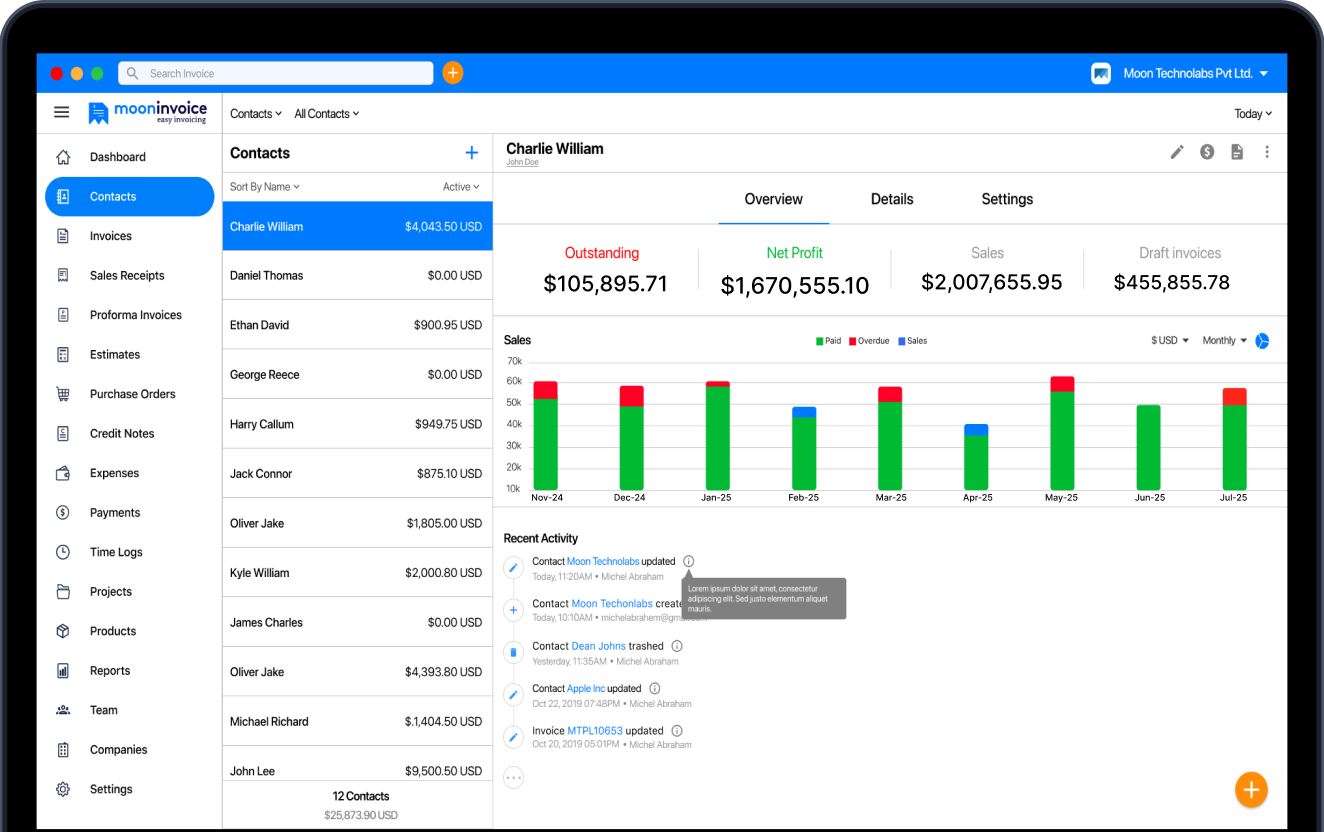
With Moon Invoice, you can manage invoices, payment records, and business transactions in one place, with support for 20+ payment gateways to meet different payment needs. You can also track payment activity and maintain audit-ready reports without managing everything separately.
Simplify your payment workflow and keep every transaction organized with Moon Invoice.
Additional questions on wire transfer
How long does it take for a wire transfer to go through?
Are wire transfers instant?
Is wire transfer processing time faster than ACH?
Are wire transfers safe?



We at Moon Invoice, are the best minds behind smarter invoicing and seamless business growth. We love to solve financial problems and keep providing effective tips through our blogs, newsletters, and social media channels. As a team, we continue exchanging ideas about growing financial challenges and smart use of automation tools.