


Brief overview
Tracking business expenses matters a lot, regardless of the company’s size or nature. To track expenditures, business owners can use expense-tracking software, categorize expenses, maintain separate business expense records, and reconcile bank statements.
Usually, small-scale companies often struggle with poor tracking of their spending. This leads to cash flow problems, reduced profit margins, and tax filing errors.
This is where it becomes necessary for owners and financial leaders to understand how to track business expenses properly. It enables professionals to streamline the tax process, reduce fraud, and accurately manage and track business expenses. Most importantly, they can make wise investment decisions with an eagle eye on business spending.
This guide will walk you through the right approach to tracking business expenses.
📌 Key takeaways
- Tracking business expenses is a core part of any business’s financial management.
- Professionals can maintain accurate financial records through regular expense records and receipt analysis.
- Business categorization is crucial for simplifying reports and for better insights into business spending.
- Using an expense tracking system, one can automate and reduce manual errors and maintain accuracy.
- To track business expenses efficiently, it is crucial to maintain personal and business finances separately.
What are business expenses and why do they matter?
Business expenses are expenditures the company incurs to run the operation smoothly. These costs are essential for keeping the business alive through day-to-day operations and for efficient functioning.
Payroll, rent, utilities, office supplies, marketing, and travel are common expenses needed to run the business efficiently. The types of expenses vary from business to business depending on the industry.
Why is tracking expenses important?
Tracking expenses is necessary because it allows professionals to –
- Manage the cash flow in a better way
- Get eligible for a tax deduction by claiming
- Identify unnecessary expenses
- Make the right decisions on the budget
- Maintain accurate financial records
- Forecast the company’s future financial performance
- Simplify the audit procedure
Examples of common business expenses
There are various expenditures that businesses bear. Many of them are tax-deductible under IRS rules. Therefore, companies should maintain a proper record of these expenses. Some of the common business expense examples are as follows:
- Office supplies – It covers pens, paper, printers, and other items essential for official work.
- Space lease – Rent paid for the space used under a lease is also a business expense.
- Utility bill – Bill amount paid for water and electricity consumption falls under business expenditure.
- Internet – The bill for internet usage is another business cost that the company pays.
- Software subscription – The amount paid to the business for the subscription is also a business expenditure.
- Marketing and advertising – The company’s spending on marketing and advertising also comes under business expenditure.
- Travel and transportation – All costs incurred for travel and transportation fall under business expenses.
- Education and training – All costs incurred for employee education and training are also business expenses.
- Insurance – Paying insurance premiums for general liability, health insurance, or workers’ compensation coverage is deductible.
- Communication – The amount you pay for phone calls is dedicated to business purposes.
Track your business expenditures accurately with Moon Invoice.
Generate customized expense reports and gain the insights you need to make the right decision.
How to track business expenses?
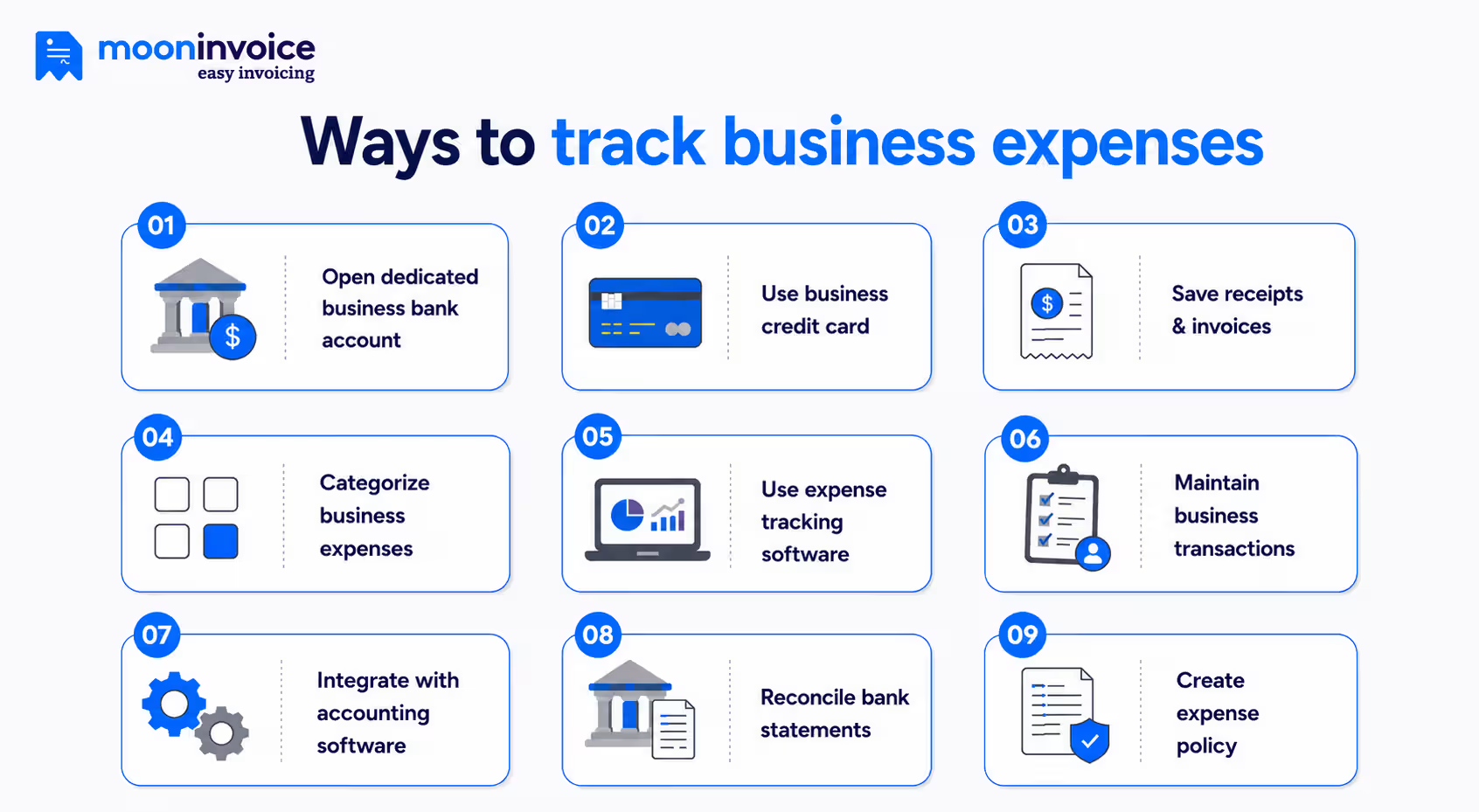
So, exactly how to keep track of business expenses? It is necessary for business professionals to have a clear understanding of this question. Here is the correct strategy for it.
1. Open a dedicated business bank account
Keeping your business’s finances separate from your personal finances is important. For this purpose, you must have a separate bank account dedicated to business purposes. This makes it easy for you to manage your business finances, including storing funds and processing required transactions.
Separating your business finances also simplifies your taxation process. You can easily track the cash flows, and it also improves business credibility.
You must be aware of the following things while choosing a business bank account:
- Choose low-fee or monthly-fee bank accounts if you have a startup business.
- Ensure that the bank offers strong security features.
- Choose the bank account that offers multi-currency transactions if you serve international clients.
- Choose a bank account with transaction limits that match your business needs.
- Ensure the bank offers good net banking services
- Check the customer support.
Documents required to open your business bank account:
- Address proof of your business
- Business registration certificate
- Tax identification number
- Partnership agreement (if any)
- Business license
- Ownership information for all authorized signatories
2. Use a business credit card
Similar to a separate business account, it is a good idea to choose a separate business credit card. It reduces the company’s expense reimbursement process when employees use a corporate card instead of a personal one. This makes it easier to track business spending and provides clear insights.
While choosing the corporate cards, you must check the following things:
- Check for the spending controls
- Review security features properly
- The card should be aligned with your business expenses
- Ensure the card offers payment flexibility
- The card should be acceptable worldwide (for international transactions)
3. Save receipts and invoices
Invoices and receipts are two important documents to track business expenses. Using these documents, it is easy to track the transaction because they contain all the details. Additionally, it helps streamline the taxation process.
Companies maintaining a clean record of receipts and invoices can claim eligible tax deductions and reduce the risk of penalties. It is also helpful to calculate the tax liabilities accurately.
4. Categorize business expenses
Every business spend is for a specific purpose. Therefore, you can easily categorize your business expenditures accordingly. This clarifies the spending pattern and helps make informed decisions based on the data. For instance, if your office supplies are incurring higher costs, you can cut a few unnecessary purchases.
Common business expense categories are as follows:
- Marketing
- Office supplies
- Interest
- Utilities
- Depreciation
- Wages
- Rent
- Travel
5. Use expense tracking software
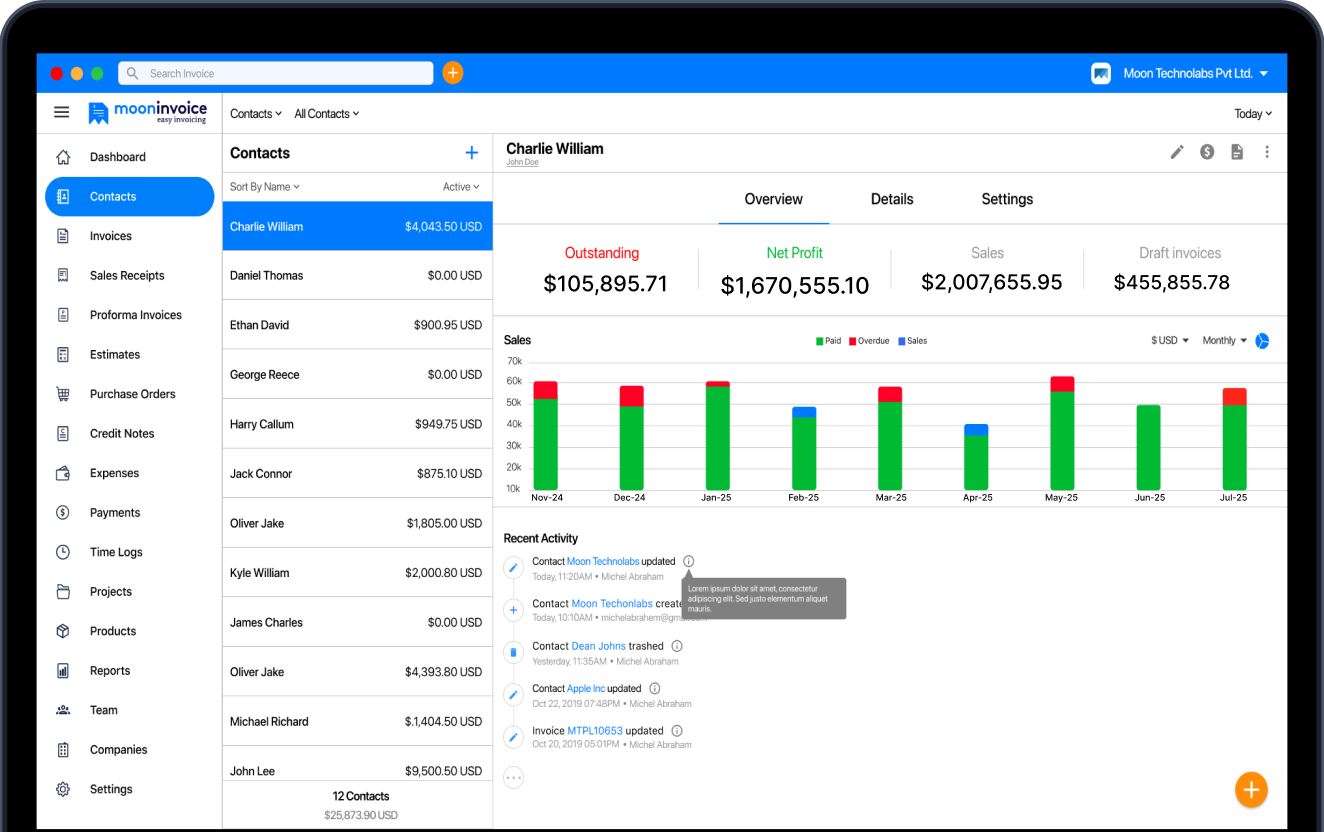
Using expense-tracking software such as Moon Invoice is the best way to track business expenses. The simple, feature-rich application allows business professionals to manage their expenses more effectively. It saves time and reduces errors by eliminating the need to enter details manually.
One should choose software or an app that offers advanced features. Focusing on the AI-powered application is a good idea as it is the latest trend. Additionally, look for several features such as –
- Easy expense categorization
- AI receipt scanning
- Supporting multi-currency
- Generating real-time reports
- Multi-user access for team collaboration
- Bank synchronization support
6. Maintain business transactions
Recording expenses as soon as the transaction occurs is good practice. It keeps your expense log up to date, making it easy to track business expenses. Also, professionals should thoroughly review the record file.
Instead of handling spreadsheets, use an expense-tracking tool to record expenses systematically. This also helps track expenditures quickly, saving time.
7. Integrate with accounting software
One of the easiest ways to simplify small business expense tracking is to integrate your expense-tracking software with your accounting software, bank account, and credit card. This approach leads to high accuracy and reduces errors that are most likely to happen in manual entries. Also, automatic sync keeps the record up to date with the latest transaction. With integration, it is easy to track every transaction.
8. Reconcile bank statements every month
This is another important point when you think about how to track expenses for a small business. Perform reconciliation at the end of every month to ensure bank and credit card statements are aligned well. This approach allows you to catch mistakes early, ensure accuracy, and keep discrepancies at bay.
It also simplifies tax preparation and helps to prevent unauthorized transactions. Regular reconciliation also helps to identify uncleared checks or any other unpaid transactions.
9. Create an expense policy
A company must define an expense policy to prevent unnecessary spending. It also helps to maintain consistency in managing expenditures. A proper expense policy outlines and covers the following points:
- Approval workflow – Defines the proper flow of the reimbursement approval process.
- Spending limit – Set maximum spending limits to control overspending.
- Receipt requirement – Defines which expenses need a proper receipt for reimbursement.
- Eligible expense – Clearly states which expenses are reimbursable and which are not.
- Reimbursement timeline – The timeframe under which employees must submit expense claims.
Common expense tracking mistakes and challenges
Most businesses face certain challenges in tracking business expenses.
Lack of resources
Businesses, especially small ones, often lack the resources to manage their accounting. As a result, it leads to inaccuracies in small business expense tracking and improper reporting. Also, it creates an extra burden, as a business owner must handle everything. Spending on accounting software is the right solution to overcome this problem, as it allows for smart expense management.
Inefficient recording
Expense tracking becomes difficult when professionals fail to record the payment efficiently. For small businesses, professionals often overlook small expenses. Relying on manual receipts is another mistake because they are prone to loss. These practices cause issues in tracking business expenditure. It is better to record all expenditures and receipts in one centralized expense management system.
Not differentiating personal and business finances
It is a common mistake that small businesses make. Mixing personal and business finances directly affects the business’s financial processing. It creates confusion, leads to inaccurate financial management, and complicates the process. This further wastes unnecessary time in correcting those mistakes.
Lack of scalability
Manual handling of business expenditure works well at the initial stage of business. However, a problem arises when the business grows and processes more transactions. With manual processing, handling large volumes becomes difficult, and the risk of errors increases.
Instead of manual processing, it is better to use scalable expense-tracking software. It allows businesses to handle the expenses efficiently even as transactions increase with growth.
Unclear expense policy
Often, companies set improper expense policies, which lead to inaccurate financial records. It is because employees lack knowledge of how to classify expenditures as claimable or non-claimable. Also, they submit incomplete claims.
Companies should set clear, well-defined expenditure policies. They must define all terms, including spending limits, reimbursement procedures, and approval workflows. It provides employees with greater transparency and streamlines the reimbursement process.
Manage and track expenses with Moon Invoice
Trusted by 1.7M+ global business professionals, this invoicing software advances expense management for every kind of business. This easy-to-use system offers every required solution to manage expenses in a better way through the following features:
- Expense categorization – Easily categorize business expenditures as office supplies, interest, utilities, etc.
- Recurring expenses – Effortlessly set recurring expenses for ongoing spending that occur weekly, biweekly, or monthly.
- AI-powered feature – Effortlessly generate invoices, receipts, expenses, and purchase orders by scanning uploaded documents. Also, easily record payment and contact details using AI by uploading the required details.
- Generate expense reports – Create custom expense reports in seconds. Preview, download, take a printout, or share it easily over WhatsApp or Email. Get insights on the profit and loss statement, revenue, and other expenses.
- Upload supporting documents – Easily upload the supporting documents for better expense management.
- Multi-currency – The system supports 100+ currencies to facilitate international transactions.
- Import expenses – Simply import expense details by uploading the documents.
- Duplicate expense – Create another copy of the expense with one click.
- Create invoice – Directly generate an invoice through expense with one click.
- Sync bank transactions – Effortlessly connect your bank accounts and automatically import transactions.

FAQs on How to Track Business Expenses
How can small businesses track expenses automatically?
What is the $75 rule?
How many expenses can I claim without receipts?
What is the best expense tracking app?



Jayanti Katariya is the founder & CEO of Moon Invoice, with over a decade of experience in developing SaaS products and the fintech industry. He holds a degree in engineering. Since 2011, Jayanti's expertise has helped thousands of businesses, from small startups to large enterprises, streamline invoicing, estimation, and accounting operations. His vision is to deliver top-tier financial solutions globally, ensuring efficient financial management for all business owners.