



Quick summary
Accounting trends refer to emerging technologies and evolving business requirements. Artificial intelligence, automation, cloud accounting, cybersecurity, and ESG reporting are major emerging practices in the accounting industry. These evolutions simplify the workflow, boost productivity, and save time.
The accounting profession is not a static field. It continues to evolve with changes in regulations, technology, and business needs. Over time, innovations keep occurring to reshape how accounting work is performed. Accountants and other related professionals must stay up to date with these accounting industry trends to keep their workflows running smoothly.
The adoption of artificial intelligence, blockchain technology, and other forms of automation has modernized traditional accounting. Similarly, implementing security measures or staying compliant with tax policies is a necessity for professionals.
Unfortunately, sometimes professionals remain unfamiliar with these trends in the accounting industry. Professionals who rely on outdated concepts often struggle with the changing business needs. Also, they miss the opportunity to refine their operations.
If you are keen to explore these latest trends and understand how they transform your workflow and business, then this blog is for you.
📌 Key takeaways
- The accounting workflow is continually evolving due to technological advancements and changing business demands.
- Adoption of these accounting trends makes the workflow transparent, efficient, and data-driven.
- Real-time data analytics help accounting professionals to make the right, informed decisions.
- Developing new digital skills is always beneficial for accounting professionals. It helps them handle their work more efficiently.
- Reliable accounting software helps simplify accounting practices.
What are accounting trends?
Accounting trends refer to developments, technologies, and practices that reshape the accounting cycle and overall workflow. These trends arise from the evolution of new technologies and changing market needs. Thus, accounting practices become automated, connected, efficient, and data-driven.
Understanding the latest accounting industry trends helps businesses prepare for a changing landscape and manage finances wisely. Adopting and implementing these trends is not a rapid process.
Deploying new technologies, providing training for professionals, and adjusting existing workflows take time. However, the impact of these concepts is long-lasting and affects accounting operations.
Don’t let outdated manual processes slow down your finances.
Adopt automation and speed up your financial handling by 2X with Moon Invoice.
12 accounting trends important to know
1. Adopting AI and automation
AI adoption has grown in several industries. In the accounting world, companies are adopting it to reduce workload and save time. According to an Agile Market Intelligence report, about 37% of accountants say their software saves them at least 30 minutes daily.
Many organizations use AI to detect red flags for fraud. This enhances accuracy and speeds up the workflow. AI is a companion that automates the everyday work.
However, adopting AI alone is not enough to improve accounting. Accountants and professionals must understand AI, its deployment, and its output. With the right knowledge of how to use AI effectively, it can only yield fruitful results.
2. Adopting cloud accounting
Cloud accounting involves managing accounts using internet-based software. Professionals can access the data from anywhere, at any time, while collaborating with their teams. They can access up-to-date financial information to stay informed.
Using reliable cloud-based accounting platforms, professionals can access features such as backups, data synchronization, invoicing, and financial reporting. These tools enhance accessibility and collaboration and eliminate the dependency on locally stored accounting data.
3. Remote and outsourced accounting
Since the COVID-19 pandemic, many industries have continued to adopt a remote work culture. This applies to the accounting industry. Remote and hybrid work have become more established in the accounting profession. Businesses outsource their accounting tasks, including payroll, bookkeeping, accounts payable, and accounts receivable.
The major benefits of outsourcing are cost reduction, access to specialized talent, and improved flexibility. Companies do not have to maintain a large in-house accounting team. Firms can hire specialized experts as needed, leading to cost savings.
4. Cybersecurity and data protection
As technologies and digitalization rise, companies need to be more careful about accounting data protection. As accounting is getting digitalized, implementing strong cybersecurity measures is a priority. It becomes essential for companies to protect sensitive financial data from phishing attacks, data breaches, and unauthorized access. Also, preventing vendor fraud and other scams related to invoices and payments is important.
Companies also need to train their employees on data security. The team must be experts in preventing and handling various accounting security threats. Additionally, regular audits help identify vulnerabilities and strengthen data protection.
5. Sustainability and ESG reporting
Environmental, Social, and Governance (ESG) reporting represents a company’s performance and impact across these factors. Many organizations must comply with this reporting. Accounting professionals have to collect, measure, and verify non-financial data and submit the report along with the financial data.
Energy usage, carbon emissions, and workforce diversity are such non-financial information. This helps investors, regulators, and customers better understand how the company manages its social impact and ethical leadership risks.
6. Blockchain and distributed ledger technology
Blockchain and distributed ledger technology (DLT) are emerging accounting trends. These technologies improve the way businesses record, verify, and share financial transactions.
Instead of a traditional centralized system, these technologies allow professionals to record transactions across multiple nodes. These captured transactions are traceable and visible to authorized participants. Also, these are not easy to alter, depending on the blockchain design.
Blockchain also supports faster transaction verification between the involved parties. The adoption of blockchain and DLT will strengthen transaction recording, support verification, and lead to more efficient audits.
7. Digital payments reshape accounting
The continuous adoption of digitalization and a paperless approach pushes companies to shift towards digital payments. Receiving and sending digital payments through QR codes, bank transfers, and mobile wallets streamlines the transaction process.
Businesses can automate their transactions and reduce manual data entry by integrating payment platforms with ERP software. This improves the overall process, making it more robust and secure.
8. Changing tax policies and regulations
Tax policies around the world keep changing, compelling finance professionals to stay compliant. Changes in tax rates, tax reporting, and related laws are the major factors affecting how businesses handle their finances and tax-related work. Keeping up with these updates helps to avoid penalties and maintain accuracy and compliance.
For instance, in the United States, the recent tax legislation has introduced changes for the 2026 tax year. Businesses and accounting professionals need to continuously monitor these changes and adjust their processes accordingly. The IRS is a useful resource for the latest tax updates.
9. Real-time financial visibility
In the accounting world, real-time financial visibility is an essential component today. It helps professionals view the latest financial insights to make informed decisions.
Professionals can easily gain visibility over expenses, income, revenue, and outstanding balances using a reliable accounting tool. This also reduces dependency on traditional spreadsheets that may include errors.
Real-time tracking allows financial experts to analyze performance and identify cash flow issues. This approach contributes to improved forecasting and overall financial control.
10. New skills for accountants
The role of an accountant is no longer limited to financial record-keeping. Future trends in the accounting profession indicate that accountants’ contributions are expanding beyond traditional bookkeeping. Along with financial data handling, they must also be well-versed in handling software and AI use. Companies will prioritize accountants with strong communication and technical skills when hiring.
In the coming time, firms will also invest in the training and development of accounting professionals. The demand for such accountants will be high among those with interpersonal skills and the adaptability to changing requirements.
11. Shift towards value-based pricing
Hourly billing is gradually giving way to alternative pricing models in the accounting industry. More firms are adopting value-based pricing, charging fixed fees based on the value delivered to clients rather than on time spent. This major shift is due to the adoption of automation, which reduces the time spent on routine tasks. With a value-based pricing model, clients also get clarity over what they are getting. Additionally, it allows accountants to focus more on strategic services.
12. Moving from reactive to proactive accounting
Businesses are moving toward a proactive approach that goes beyond traditional accounting. This broad concept includes agile accounting, data analysis, and automation. Instead of reviewing data at month-end, accountants are expected to analyze data periodically to identify issues early.
Accountants and finance teams can continuously monitor certain accounts receivable KPIs such as days sales outstanding (DSO), CEI, and average days delinquent. In simple terms, proactive accounting means using financial information to take action early, rather than simply reporting what has happened.
Role of Moon Invoice in modern accounting
Over 1.7 million global users trust the AI-powered invoicing software, Moon Invoice. The platform simplifies billing and bookkeeping work with advanced features and simple navigation.
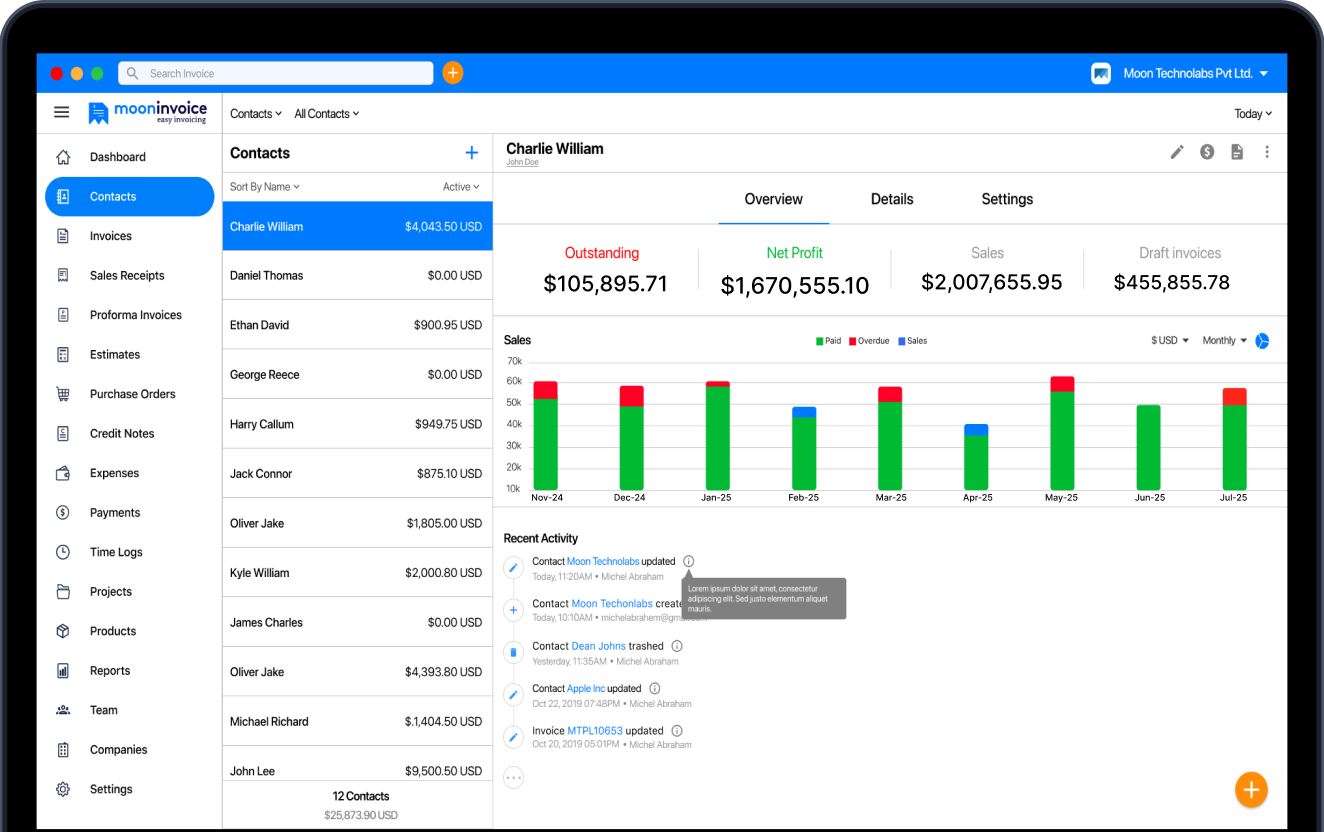
Real-time reporting: Access 15+ business reports to track financial performance and key financial updates. Get insights into income, expenditures, outstanding balances, and profit and loss statements to make informed decisions. Download the report in PDF or share it through WhatsApp or email.
AI-powered features: Speed up your routine tasks with AI. Create invoices, receipts, or purchase orders through the quick scan feature by uploading a document. Additionally, create contacts or record payments through AI, saving time and enhancing accuracy.
Manage expenses smartly: Record and handle business expenses digitally in a centralized way. Easily categorize the expenditures for better expense analysis. Duplicate it as an expense or create an invoice in a single click.
Simplify reconciliation: Easily connect bank accounts and credit cards with the platform. Set the matching rules, import transactions, and reconcile accounting records with bank statements.
Moon Invoice enhances proactive accounting by providing easy access to financial data, bank reconciliations, and expense tracking. The financial team can systematically manage key information and identify potential discrepancies, enabling earlier action.

FAQs on accounting trends
Will AI replace accountants?
What are the biggest technological trends in accounting?
How are accounting trends affecting small businesses?
What accounting skills will be important in the future?



Jayanti Katariya is the founder & CEO of Moon Invoice, with over a decade of experience in developing SaaS products and the fintech industry. He holds a degree in engineering. Since 2011, Jayanti's expertise has helped thousands of businesses, from small startups to large enterprises, streamline invoicing, estimation, and accounting operations. His vision is to deliver top-tier financial solutions globally, ensuring efficient financial management for all business owners.